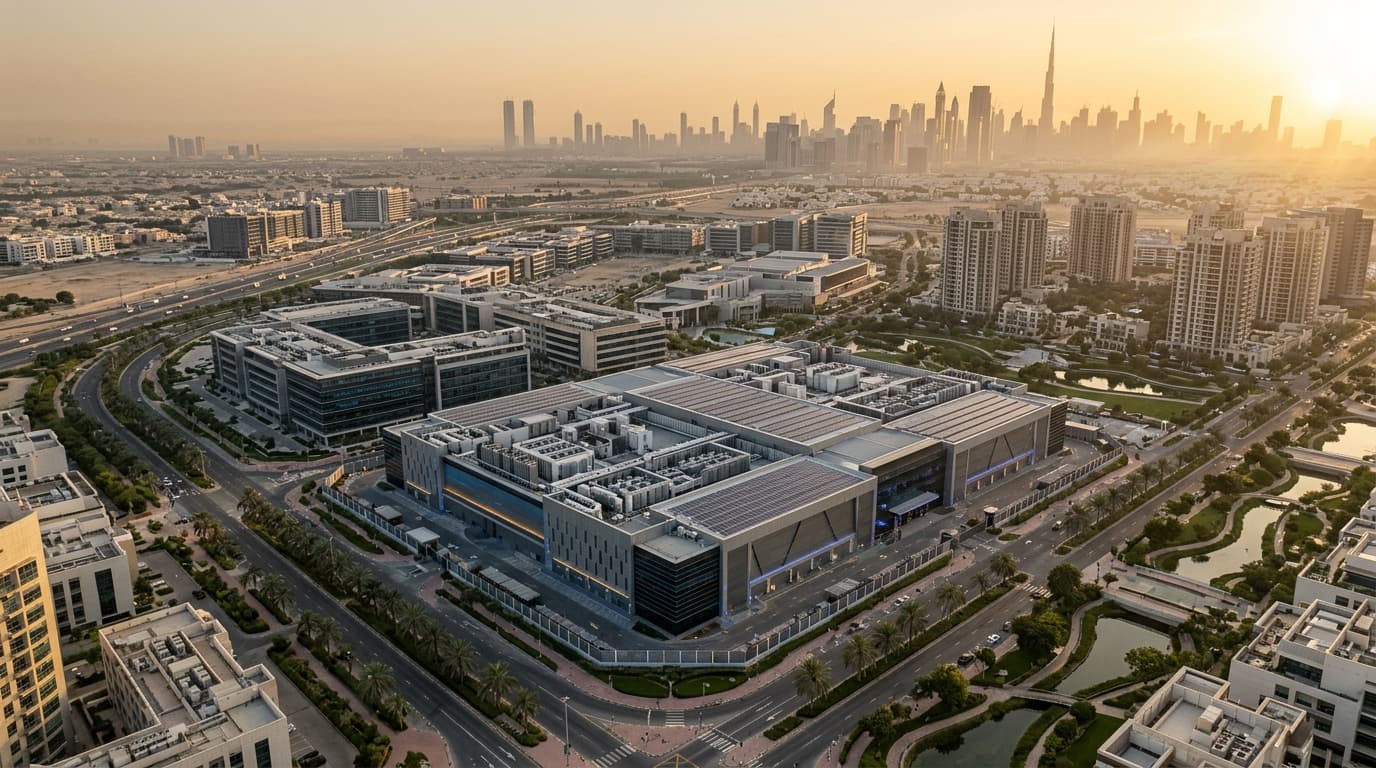
Artificial intelligence has moved from labs to large-scale infrastructure, and Dubai is rapidly positioning for the compute and storage that power it. Behind every model run and inference request is a physical footprint: high‑power data centres, networked edge sites, and resilient real estate with specialised cooling.
For investors and occupiers, AI infrastructure is no longer a niche technology topic—it is a real estate story. It affects land values near substations, drives demand for industrial plots and high‑spec commercial buildings, and creates new leasing and financing structures. This guide unpacks what matters, where it’s happening, and how to position capital.
Why AI is reshaping demand for space
AI training and inference require dense compute, stable power and low latency. That translates into specific real estate characteristics that are in short supply and rising in value.
- High power density: Facilities commonly target tens of megawatts (MW) per campus, with per‑rack loads far above traditional enterprise rooms.
- Cooling and heat management: Liquid and advanced air systems, generous ceiling heights, and layouts that permit hot/cold aisle containment.
- Connectivity: Diverse fibre routes and proximity to internet exchanges reduce latency for AI workloads and content delivery.
- Zoning and resilience: Plots that allow generators, substations, and 24/7 operations with strict uptime SLAs.
The result is a bifurcation: hyperscale campuses on utility‑adjacent land, and smaller edge nodes embedded in business districts to serve latency‑sensitive applications.
Where do AI data centres fit in Dubai’s map?
Dubai’s digital economy zones and logistics corridors are natural candidates because they combine connectivity, utilities and pro‑innovation regulation.
- Dubai Silicon Oasis (DSO): Purpose‑built tech ecosystem with data‑friendly planning, established fibre, and access to district cooling in parts.
- Dubai Internet City/TECOM cluster: Strong network backbone for enterprise and content workloads; suitable for edge and retrofit opportunities.
- Dubai South: Large-scale land bank, proximity to aviation logistics, and growing utility capacity—attractive for campus‑style developments.
- Jebel Ali and adjacent industrial areas: Access to port, power infrastructure and land parcels, suitable for build‑to‑suit or co‑location shells.
Hyperscalers and regional cloud providers are expanding UAE capacity, with new regional zones and availability domains coming online. While operators seldom disclose exact addresses for security reasons, the pattern is clear: near substations, dark fibre, and cooling sources.
Power, cooling, and land: the constraints that set value
Utilities are the primary underwriting variable for AI‑capable space. Developers and investors focus on:
- Electrical capacity and timelines: Allocations from DEWA, substation lead times, and the ability to phase power delivery (e.g., 10–20 MW tranches).
- Redundancy: N+1/N+N design, dual feeds, and on‑site generation for emergencies within regulatory allowances.
- Cooling strategy: District cooling (where feasible), high‑efficiency chillers, and preparedness for liquid‑cooled racks as densities rise.
- Floor loading and clear heights: Heavy MEP, battery rooms and generators require structural allowances beyond typical warehouses or offices.
- Land tenure and zoning: Freehold or long‑leasehold plots in designated zones that permit data centre use, noise envelopes and 24/7 logistics.
These constraints compress viable supply and can lift land values and rents for qualifying plots and shells relative to general industrial stock.
Leasing models and transaction structures
AI data centres are capital intensive and typically transact on longer terms than standard commercial leases. Common structures include:
- Build‑to‑Suit (BTS): Landowner/developer delivers a powered shell or turnkey facility to an operator on a long lease with step‑up rents.
- Sale‑Leaseback: Operator sells the real estate to release capital but retains a long operational lease, often with CPI‑linked escalations.
- Co‑location: Landlord provides space, power and cooling; enterprises and AI tenants lease capacity (by MW or by rack) under service agreements.
- Powered Shell: Landlord delivers envelope, floors and utility interfaces; tenant funds fit‑out of white space and MEP.
Typical commercial terms reflect higher credit diligence, phased handovers and performance milestones tied to power delivery. Transfer of freehold property involves the standard 4% Dubai Land Department transfer fee (paid on the property value), plus admin and trustee fees. In many free zones, long‑term land leases are more common than freehold for utility‑intensive sites.
What it means for rents, yields and adjacent asset classes
The AI build‑out affects more than data halls. It ripples across industrial, office and residential markets.
- Industrial/logistics: Well‑spec plots near power and fibre can command a premium over traditional warehouses. Stabilised, long‑lease digital infrastructure can trade at yields typically seen in the mid‑single to high‑single digits, depending on covenant and term (indicative ranges, not guarantees).
- Office: Demand for edge rooms, network nodes and high‑spec MEP retrofits can support rental premiums in select buildings with robust power and riser capacity. Typical office yields in Dubai often sit in the mid‑single digits (indicative), with variation by grade and location.
- Residential: AI and cloud operators bring skilled staff; this can support absorption in mid‑to‑upper segment rentals near tech corridors. Impacts are localised but additive in demand‑tight submarkets.
- Hospitality/short‑stay: Commissioning phases bring waves of contractors and vendors, supporting occupancy near build sites.
Investors should model upside from specialised use against capex intensity and re‑letting risk.
Hyperscale campus vs edge vs retrofit: which path fits your thesis?
| Model | Typical Size | Power Profile | Location Bias | Capex Intensity | Lease Style |
|---|---|---|---|---|---|
| Hyperscale Campus | 20–100+ MW across phases | Highest density, staged delivery | Peripheral/industrial near substations | Highest | Long BTS or ground lease |
| Edge/Data Hub | 1–10 MW | Medium to high | Business districts/tech parks | Medium | Co‑lo/MSA‑driven |
| Retrofit/Powered Shell | Variable | Upgradable | Existing office/industrial with strong utilities | Medium to high (selective) | Powered‑shell to turnkey |
Regulatory and planning essentials in Dubai
- Land ownership and use: Foreign buyers can acquire freehold property in designated areas; outside these, long‑term leasehold is common. Many data‑suitable plots are within free zones with their own planning processes alongside Dubai Municipality.
- Utilities: Power allocations and timelines are coordinated with DEWA; cooling may involve district providers or on‑site systems subject to permits.
- Approvals: Data centres are commercial/industrial uses that require design NOCs, environmental assessments, fire and life‑safety approvals, and compliance with local building codes.
- Corporate structure: 100% foreign company ownership is permitted in many sectors and free zones; investors should align entity setup with land tenure and operational licensing.
Because design requirements are specialised, early engagement with utilities and authorities helps de‑risk schedules and capex.
Opportunities for different investor profiles
- Land banking near power and fibre: Target plots with realistic timelines for substation upgrades and dual‑path connectivity.
- Develop powered shells: Deliver flexible envelopes with scalable MEP interfaces; attract tenants who fund white‑space fit‑out.
- Partner with operators: Joint ventures can match capital with operating expertise and tenant pipelines.
- Adjacent plays: Acquire logistics buildings for equipment staging, or residential near tech corridors to capture staff demand.
- Income vehicles: Stabilised facilities may suit REITs or income‑focused mandates seeking longer leases with strong covenants.
Each path carries distinct risk: power delivery, pre‑let depth, obsolescence (as rack densities rise), and residual value if re‑tenanted to non‑data users.
Due diligence checklist for AI‑ready assets
- Power: Written confirmation of allocation, redundancy design, and energisation dates; grid connection costs and who bears them.
- Cooling: Efficiency metrics (e.g., indicative PUE targets), liquid‑cooling readiness, and water use considerations.
- Connectivity: Diversity of fibre entries, meet‑me options, latency to key peering points, and carrier‑neutrality.
- Structure and envelope: Floor loading, slab thickness, clear heights, roof loads for chillers, and vibration control.
- Legal: Land use approvals, easements for utilities, environmental permits, and escalation mechanics in leases.
- Commercials: Credit quality of operator/anchor tenant, step‑in rights, performance bonds, and indexation clauses.
- Exit: Reversion scenarios, alternative uses, and capex required for back‑to‑market.
Pipeline outlook: what to watch through 2028
- Utility expansion: New substations and feeders serving tech corridors will unlock phased campus deliveries.
- Liquid cooling adoption: As rack densities climb, designs will pivot to hybrid or full liquid systems, impacting capex and layouts.
- More regional cloud zones: Additional availability zones improve resilience and draw enterprise migration, deepening co‑lo demand.
- Sustainability metrics: Efficiency and carbon reporting will influence tenant selection and financing costs.
- Edge proliferation: Streaming, gaming, fintech and AI inference will push smaller nodes into premium offices and tech parks.
Common Mistakes to Avoid
- Underestimating power timelines. Energisation and substation delivery can take longer than the building itself.
- Ignoring cooling evolution. Designs that cannot accommodate liquid cooling risk rapid obsolescence.
- Overpaying for non-viable plots. Fibre and zoning gaps can negate apparent land savings.
- Signing vanilla leases. Data infrastructure needs tailored SLAs, step‑in rights and indexation—generic forms create future friction.
- Skipping exit planning. If a data tenant vacates, the residual use and retrofit cost determine true downside.
Conclusion
AI has shifted digital infrastructure from a back‑office line item to a front‑page real estate theme in Dubai. The winners will be investors and occupiers who secure power, cooling and connectivity on bankable timelines, structure leases to match long‑duration uses, and select locations where the ecosystem—utilities, talent and regulation—supports compounding value. If you are exploring land acquisition, powered shells or co‑location opportunities, align early with utilities and specialist advisors to turn the AI wave into durable income.