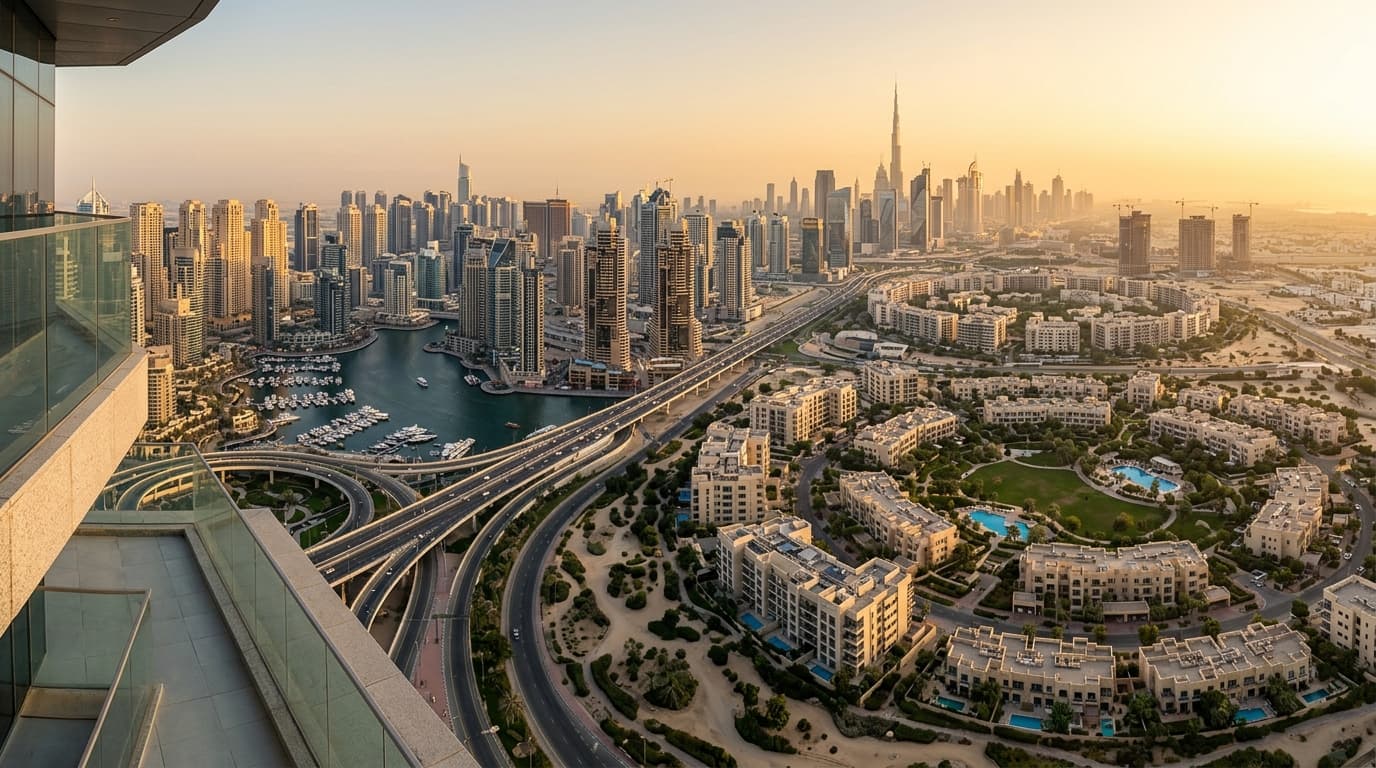
Dubai’s real estate cycle remains one of the world’s most closely watched, underpinned by strong population growth, robust infrastructure spending, and pro-investment policy. In Q3 2026, buyers are asking the same timeless question: is now a good time to buy—or should you wait?
This report distils what matters most for decision-making today: where prices are sitting relative to recent peaks, how mortgage rates are shaping affordability, what the supply pipeline looks like through 2027, and how different buyer profiles (end-users vs. investors) can position prudently. It’s not about calling the top or bottom; it’s about structuring a purchase that works in multiple scenarios.
Q3 2026 Market Snapshot: What’s Driving Sentiment
Dubai’s housing demand continues to be powered by net migration, business formation, tourism, and ongoing government investment in infrastructure and lifestyle assets. From an investment lens, three levers dominate sentiment in Q3 2026:
- Prices: Prime and established freehold areas typically trade at higher price-per-sqft, while emerging communities offer lower entry points. Across the city, apartment yields commonly sit in the mid-single digits, with some mid-tier districts achieving higher, and villas typically a bit lower—ranges vary by micro-location and building quality.
- Rates: UAE mortgage pricing is linked to EIBOR; retail fixed and variable packages generally sit in mid-single digits in normal conditions. Even small shifts in rates can change monthly affordability meaningfully.
- Supply: Handovers from launches in recent years are phasing in through 2026–2028. Deliveries tend to be uneven—some quarters feel tight, others see more keys. Localized supply can soften short-term rents/prices in specific pockets while the citywide picture stays resilient.
Bottom line: the current environment rewards careful micro-market selection, realistic yield assumptions, and financing structures that build in rate flexibility.
- End-user affordability hinges on both price-per-sqft and financing costs.
- Investors should underwrite with conservative rent and cost contingencies.
- Community selection often matters more than broad city averages.
Prices and Affordability: Reading Today’s Levels
Headline indices can mask wide dispersion. Within the same district, two buildings with similar sizes can transact at materially different prices due to age, views, amenities, service charges, handover quality, and developer reputation.
- Apartments: Typical gross yields are often in the 5–8% range in mid-market communities, with prime cores lower and select lease-driven pockets higher. Treat these as indicative, not promises.
- Villas/Townhouses: Yields commonly price lower than apartments, reflecting owner-occupier depth and land value. Capital preservation can be strong in established family areas.
Affordability checklist for Q3 2026:
- Stress-test mortgage at 1–2% above your quoted rate to gauge payment resilience.
- Include service charges and sinking fund in your annual cost model.
- For investors, assume conservative vacancy and realistic rent growth; avoid relying on best-case re-letting.
- View-to-price and building management quality drive resale liquidity.
- Service charges can materially impact net yields—ask for recent statements.
Mortgage Rates and Financing Structures
UAE home loans are typically offered on fixed teaser periods that roll to variable rates linked to EIBOR. In Q3 2026, packages vary by bank and profile; the key is structuring for flexibility rather than optimizing a single headline rate.
Practical tips:
- Compare fixed vs. variable vs. hybrid; match to your holding period and risk appetite.
- Check lock-in clauses, early settlement penalties, and repricing options.
- If you expect income in foreign currency, consider FX volatility and buffers.
Cost reminders (indicative):
- DLD transfer fee: 4% of the purchase price (for both ready and off-plan at registration stage).
- Mortgage registration: typically 0.25% of the loan amount plus admin.
- Agency commission: commonly up to 2% on secondary transactions; new launches may have different fee structures.
For off-plan, developer payment plans can ease cash flow, but ensure construction-linked schedules and handover timelines fit your financing window.
- Pre-approval first: it clarifies budget and speeds up conveyancing.
- Ask lenders about switching options if rates move.
Supply Pipeline and Handover Dynamics
Dubai’s pipeline remains active across apartments and townhouses, with major developers (e.g., Emaar, DAMAC, Sobha, Nakheel) delivering in waves. Handovers from recent launch cycles are expected to phase through 2026–2028.
What this means for buyers:
- Established cores with limited new plots often hold pricing power, especially for quality assets.
- Emerging corridors with several projects completing around the same time may see short-term competition for tenants, potentially moderating rents or incentivising landlords.
- For investors, handover timing matters: buying ahead of a supply wave requires stronger underwriting; buying after keys start flowing can improve selection and negotiation leverage.
- Track building-specific completion progress, not just community headlines.
- Plan for potential snagging and initial occupancy lead times post-handover.
Off-Plan vs Ready in Q3 2026: Which Fits Your Strategy?
Both can work—your horizon and risk tolerance should decide. Here’s a simple side-by-side to frame trade-offs:
| Factor | Off-Plan | Ready/Secondary |
|---|---|---|
| Entry Price | Often lower per sqft in emerging areas | Reflects current market; pay for immediacy |
| Cash Flow | No rent until handover; staged payments | Immediate rental income or end-use |
| Flexibility | Choice of units early; finishes vary by developer | What-you-see-is-what-you-get |
| Risk | Construction/hand-over timing risk | Lower delivery risk; building history available |
| Fees/Costs | 4% DLD at registration; developer/admin charges vary | 4% DLD on transfer; service charges known |
| Financing | Mortgage closer to completion; bridging options limited | Full mortgage at transfer; clear valuation comps |
Decision rule of thumb: shorter hold and income focus lean to ready; longer horizon and capital appreciation potential can suit quality off-plan with strong developers.
Is Now a Good Time to Buy? A Buyer-Type Playbook
End-users (primary residence):
- If you’ve secured stable financing and found a home that fits your 5–7 year life plan, buying can hedge rent inflation and personalize your living. Prioritise location, commute, school catchments, and building management.
Yield-focused investors:
- Target buildings with proven tenant demand and sensible service charges. Underwrite using conservative rent and 1–2% higher rates. Look for modest value-add: furniture upgrades, minor refurb, or better listing exposure to lift occupancy.
Capital appreciation seekers:
- Consider high-quality off-plan or upgrade-submarket assets tied to new infrastructure or amenity catalysts. Diversify handover years to avoid concentration risk.
International buyers hedging currency:
- Time remittances and consider multicurrency accounts. A slightly better FX can offset thousands in closing costs—plan early with your bank.
- Match hold period to product: apartments (income), villas (end-use/lifestyle).
- Quality and micro-location trump chasing the lowest ticket.
Transaction Timeline and Key Costs
A typical ready-property purchase can complete in a few weeks once financing is in place; off-plan reservations occur quickly, with formal Sales & Purchase Agreements following developer timelines.
Core steps for a ready purchase:
- Mortgage pre-approval and budget confirmation.
- Offer and Memorandum of Understanding (MOU).
- Valuation (if mortgaged) and final offer confirmation.
- No Objection Certificate (NOC) from the developer.
- Transfer at the DLD Trustee Office and key handover.
Budgeting guide (indicative):
- 4% DLD transfer fee on the purchase price.
- Mortgage registration fee typically 0.25% of the loan amount plus admin.
- Agency commission (often up to 2%).
- Developer NOC and trustee/admin charges (fixed amounts vary by project).
- Keep a 2–3% contingency for incidental costs and initial fixes.
- Verify service charge status to avoid inheriting arrears.
Policy, Visas, and Ownership Rules That Matter
Foreigners can purchase freehold in designated areas across Dubai. Title is registered with Dubai Land Department (DLD). For off-plan, registration occurs via Oqood, then converted to title deed at completion.
Golden Visa: Property investors may qualify for long-term residency subject to prevailing regulations. A widely used pathway is property ownership meeting the minimum threshold (commonly AED 2 million in property value) and other conditions as set by the authorities. Always confirm current criteria at the time of application.
Landlord-tenant: RERA regulations govern leasing, with the Rental Index and formal contract registration. Understand notice periods, renewal norms, and deposit handling to avoid disputes.
- Keep all payments via approved escrow/trustee channels.
- Confirm freehold status and any developer restrictions before committing.
Risk Management in Today’s Market
No market is risk-free. In Q3 2026, sensible guardrails can protect outcomes:
- Avoid over-leverage: Keep debt service within comfortable ratios even if rates rise.
- Don’t overpay for hype: Let recent comparables and building quality guide you.
- Diversify exposure: Different communities, handover years, and asset types.
- Maintain liquidity: Reserve for service charges, maintenance, and vacancy.
- Professional snagging and due diligence: Small issues at purchase can be costly later.
- Use realistic exit timelines; illiquid assets need patience.
- Focus on total return: net yield + prudent appreciation, after all costs.
Common Mistakes to Avoid
- Chasing headline yields. Ignoring service charges and realistic vacancy can turn a ‘high-yield’ promise into an average net return.
- Skipping pre-approval. Shopping before financing clarity risks missed deals or last-minute rejections.
- Neglecting micro-location. Two streets apart can mean different rents, demand, and resale liquidity.
- Underestimating handover risk in off-plan. Timelines can shift; match payments and mortgages to realistic delivery windows.
- Forgetting total cost of ownership. Maintenance, fit-out, and minor snag rectifications add up quickly.
Conclusion
Is Q3 2026 the right moment to buy in Dubai? If your financing is sound, you’ve identified a quality asset in a demand-resilient micro-location, and your plan works under conservative assumptions, the answer can be yes. For others, patience, better comparables, and clearer rate trends might pay off. Either way, make the decision on fundamentals—not headlines—and structure it to succeed across cycles. Binayah can help you source, underwrite, and execute with discipline.