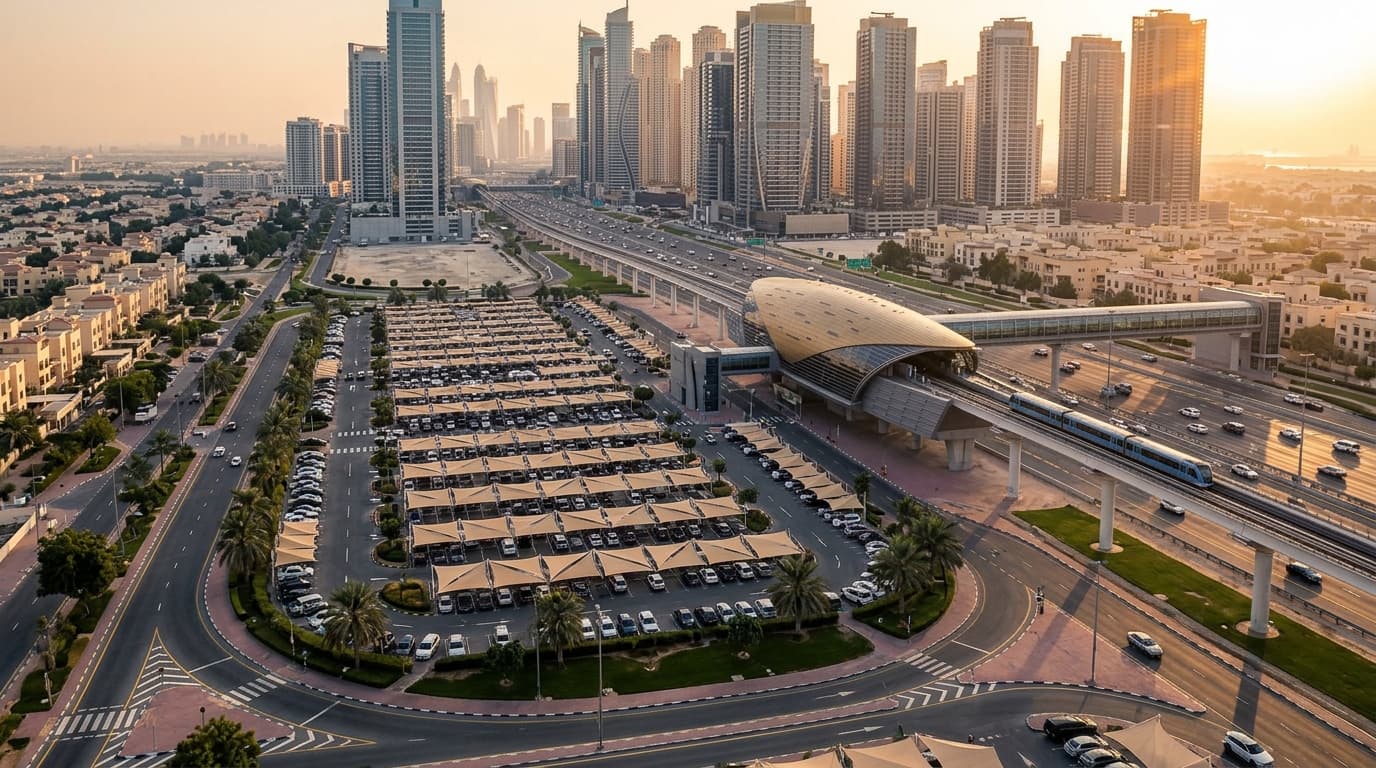
Metro access is a premium amenity in Dubai. For many residents and commuters, the question is not only how close a home or office is to a station, but also how easy it is to park and transfer to the Metro. Smart use of RTA Park-and-Ride, public parking zones and building-allocated bays can slash commute times, reduce driving costs and improve daily convenience.
This guide explains how Metro station parking works in Dubai, where Park-and-Ride facilities are typically found, what rules and tariffs to expect, and how these factors translate into property value, rental premiums and investment strategy.
How Metro station parking works in Dubai
Dubai’s Metro ecosystem blends several parking options:
- Park-and-Ride: Large, purpose-built RTA facilities near select stations, primarily at end-of-line or major interchange stops. Typically free for genuine Metro users (subject to RTA validation rules) and chargeable if you do not use the Metro.
- Public paid parking zones: On-street and surface lots adjacent to many stations, operated by RTA with hourly tariffs. Often high-demand zones with time limits during peak periods.
- Multi-storey public car parks: RTA buildings near key hubs, generally subject to tariffs that can apply beyond normal street-parking hours.
- Building-allocated parking: Bays assigned within residential or commercial buildings. Allocation is governed by the title deed (owners) or your tenancy contract (tenants).
Each option has different costs, time limits, and eligibility rules. For daily commuters, Park-and-Ride plus a Nol card is often the most cost-effective combination; for residents, a dedicated building bay offers predictability and resale/rental appeal.
Where Park-and-Ride is typically available
RTA concentrates Park-and-Ride at strategic stations to intercept car traffic and encourage Metro use. Examples include major termini and interchange areas such as Centrepoint (Rashidiya, Red Line), Etisalat by e& (Al Qusais, Green Line), and stations serving the Jebel Ali/Expo City sector. Facilities and access arrangements can evolve as the network expands, so always check the latest RTA station details.
What to expect at Park-and-Ride:
- Multi-storey or large open lots with hundreds to thousands of spaces
- Nol-based validation for Metro users
- Clear pedestrian links to the station concourse
- Feeder bus stops, taxi ranks, and often e-scooter/bike parking
Tip: Arrive early on busy weekdays; Park-and-Ride areas closest to central employment corridors can reach high occupancy during peak hours.
Tariffs, permits and operating hours
Paid public parking around Metro stations follows RTA zone rules. Key points:
- Tariffs and timing: RTA sets hourly tariffs by zone (e.g., premium areas closest to stations often have higher rates). Paid hours typically run from morning to late evening Monday–Saturday; Sundays are generally free except in multi-storey car parks that may operate 24/7 tariffs. Always verify the specific signboard or RTA app for the exact schedule.
- Park-and-Ride charging: Usually free for genuine Metro users within the same day when you validate with your Nol journey; non-Metro users may be charged. Rules can vary by facility.
- Time limits: Some on-street spaces near stations have maximum stay limits to encourage turnover.
- Residential permits: In designated neighborhoods, RTA offers resident parking permits for on-street bays. These are area-specific and do not universally apply across all station environs.
- Payment methods: Nol, SMS, RTA app, and pay-and-display machines are commonly accepted.
Note: Enforcement is active around stations. Overstaying, improper bay use, or parking in restricted areas can result in fines or towing.
Property value and rental demand: how parking near Metro moves the needle
Proximity to a Metro station tends to lift both end-user appeal and rental demand, especially for professionals who value predictable commute times. Parking availability layers on top of that premium:
- Buildings with assigned parking plus a short walk to the Metro often command stronger resale and rental outcomes than comparable stock without parking.
- Tenants frequently prioritise a guaranteed bay; a second bay can widen your tenant pool for larger units.
- In dense business/retail nodes, units without parking can still perform if they are steps from the station and supported by reliable public parking—but pricing typically reflects the trade-off.
- For investors, a parking bay is not just convenience; it can be a value component on the title deed, improving liquidity and marketability.
Indicative effects vary by community. Established transit-served districts such as Dubai Marina/JLT, Business Bay, and Al Furjan show strong absorption for units combining walkable Metro access with secure parking.
Choosing the right parking solution: a comparison
| Option | Typical User | Cost Profile | Pros | Cons |
|---|---|---|---|---|
| Park-and-Ride | Daily commuters | Often free with Nol-validated Metro use; chargeable otherwise | Large capacity; close to stations; reduces driving time and fuel costs | Can fill early; not ideal for late-night returns in some areas |
| Public Paid Parking | Short-stay visitors, flexible users | Hourly tariffs by RTA zone | Widely available; simple app/SMS payment | Ongoing cost; time limits; peak scarcity |
| Multi-Storey Public Car Park | All-day parkers near hubs | Structured daily/hourly tariffs; often extended hours | Weather-protected; predictable capacity | Higher cumulative cost; weekend/late fees may apply |
| Building-Allocated Bay | Residents/office tenants | Included in purchase/lease; service charge implications | Guaranteed bay; enhances asset value and tenant appeal | Limited quantity; additional bay may be costly or unavailable |
Strategies for residents, landlords and offices near Metro
- Residents/end-users:
- Prioritise a deeded bay when buying; confirm exact bay number and location on the title plan.
- As a tenant, ensure your contract specifies the bay count and any access devices (remote, card) and fees.
- If relying on public parking, validate that your building’s street is not a premium short-stay zone with strict limits.
- Landlords/investors:
- Market the “three-minute walk to Metro + allocated parking” combo prominently—this is a proven driver of enquiry.
- Consider acquiring an extra bay (where developers/buildings allow) for larger units to widen tenant appeal.
- Provide clear visitor parking instructions in handover packs to reduce HOA friction and improve tenant satisfaction.
- Offices/retailers:
- Blend a limited number of reserved bays with staff Park-and-Ride policies.
- Promote first/last-mile options (feeder buses, scooters) for staff and customers to mitigate peak-time pressure.
First/last-mile options that complement station parking
Dubai supports multimodal transfers at and around Metro stations:
- Feeder buses linking nearby communities
- Taxi ranks and ride-hailing pick-up zones
- E-scooter and bicycle parking in designated areas
- Pedestrian bridges and shaded walkways in high-footfall districts
Combining a short drive to Park-and-Ride with a quick Metro hop often beats cross-city driving during peak hours, while cutting Salik and fuel outlay.
Due diligence when buying or renting near a Metro station
- Verify the parking allocation on the title deed (owners) or in the tenancy contract (tenants): bay count, size, and location.
- Ask the HOA/building management about visitor parking, guest hours, and fines for misuse.
- Check RTA zone maps for your street: tariff band, hours, and any maximum-stay rules.
- Visit at peak times (weekday 8–10am, 5–8pm) to assess real parking demand and walking routes to the station.
- For EV drivers, confirm if the building or nearby public car parks host charging points; availability varies by area.
Illustrative daily cost scenarios
Costs vary by zone and facility and change over time. As an illustration only:
- Park-and-Ride commuter: Drive to an end-of-line Park-and-Ride, validate a Nol Metro trip, pay minimal or no parking fee, and reduce Salik/fuel compared with a full cross-city drive.
- On-street parker near a central station: Pay hourly tariffs during paid hours; viable for short meetings but expensive for full-day stays.
- Resident with allocated bay: Fixed convenience; costs embedded in purchase price and service charges rather than daily outlay.
Always consult the latest RTA tariff schedules before budgeting.
Common Mistakes to Avoid
- Assuming all station parking is free. Park-and-Ride is typically free only for genuine Metro users; other facilities are chargeable.
- Not securing a deeded bay when buying. Title-deeded parking often underpins resale value and buyer confidence.
- Ignoring time limits in premium zones. Overstaying near stations can lead to fines or towing.
- Relying on outdated tariff info. RTA zone pricing and hours can change; always verify in the app or on signage.
- Overlooking visitor parking rules. Buildings and HOAs enforce specific guest policies that affect tenants and resale experience.
Conclusion
For many Dubai residents and investors, the winning formula is simple: pair reliable Metro access with the right parking solution. Whether you commute via Park-and-Ride, rely on public parking for short visits, or secure a deeded bay in your building, thoughtful planning reduces costs, eases daily life and enhances property value. If you are weighing communities or specific buildings, assess parking and Metro access together—they are two sides of the same mobility coin.