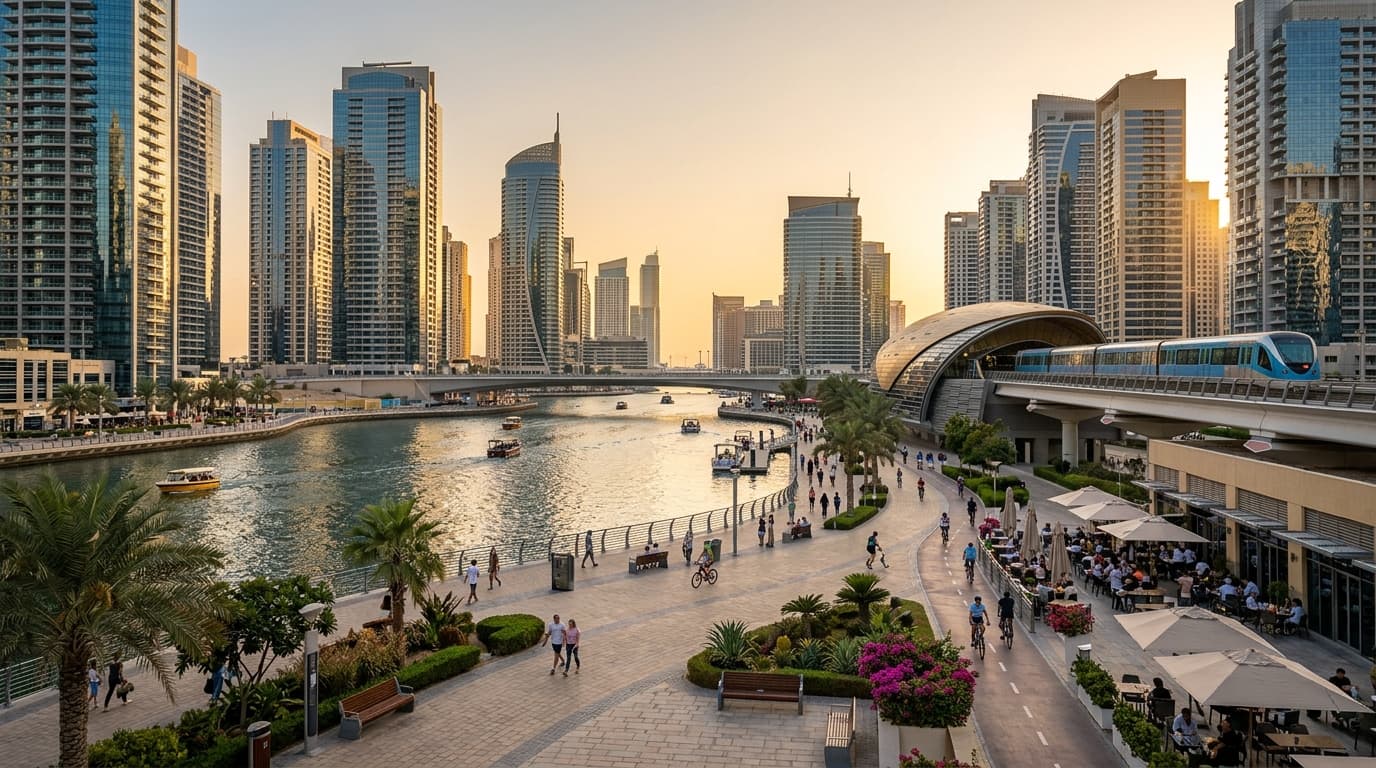
Dubai is famously car-friendly, but you can absolutely live well—and invest smart—without owning a vehicle. If you prioritise a short commute, easy access to daily amenities, and predictable monthly costs, focusing on transit-rich, walkable communities can deliver real lifestyle and financial advantages.
This guide outlines how to live car-free in Dubai, the best neighbourhoods connected by the Metro, Tram and buses, what to look for in a building, and common pitfalls to avoid—plus tips for investors targeting high tenant demand near stations.
Why Go Car-Free in Dubai?
Choosing a home in a walkable, transit-connected enclave can simplify daily life and free up budget for better location or finishes.
- Predictable monthly costs: Metro/Tram/bus passes can be easier to budget than fuel, insurance, Salik, and maintenance.
- Time efficiency: Station-adjacent living reduces commute variability and parking headaches.
- Health and lifestyle: More walking, less time behind the wheel.
- Investment angle: Properties near stations typically enjoy strong tenant demand and resilient occupancy, especially in established business and leisure hubs.
How Dubai Supports Car-Free Living
Dubai’s integrated public transport network covers key residential and commercial corridors.
- Dubai Metro: Red and Green Lines connect major employment districts, malls, and older city centers. Trains are frequent, air-conditioned, and interlinked with buses and marine transport through a unified Nol card system.
- Dubai Tram: Serves Dubai Marina, JBR and Al Sufouh, with interchanges to the Metro around Sobha Realty/DMCC. Ideal for beach, dining and last-mile links.
- Buses: Fill network gaps and link communities to nearby Metro stations. Many routes run at high frequency during peak hours.
- Marine transport: Ferries, abras and water taxis serve Marina, Dubai Creek and selected coastal stops—useful for leisure and certain commutes.
- First/last-mile options: Station feeder buses, designated e-scooter zones in parts of the city, bike lanes in select areas, and plentiful taxis/ride-hailing when needed.
Tip: A Nol card provides seamless payment across Metro, Tram, buses and most marine services.
Top Areas in Dubai to Live Without a Car
- Downtown Dubai: Walkable core around Dubai Mall and Burj Khalifa with extensive retail, dining, and services. The Burj Khalifa/Dubai Mall Metro Station connects via a climate-controlled walkway; frequent buses circulate internally. High lifestyle convenience, premium rents.
- Business Bay: Minutes from Downtown; Business Bay Metro Station anchors the northern side. Many towers are walkable to cafes, grocery, gyms and the Canal promenade. Select buildings sit a 5–12 minute walk to the station—check the exact tower location.
- Dubai Marina & JBR: Among the most walkable districts with the Dubai Tram linking to multiple Metro interchanges (e.g., Sobha Realty, DMCC). Beach, retail promenades, supermarkets and clinics are accessible on foot. Vibrant day-to-night environment.
- Jumeirah Lakes Towers (JLT): Two Metro stations (DMCC and JLT) serve a cluster of mixed-use towers around lakeside promenades. Numerous cafes, gyms, clinics, nurseries and supermarkets; strong value compared with Marina/Downtown.
- Al Barsha (near Mall of the Emirates): Dense amenity base with Mall of the Emirates Metro Station and extensive bus connectivity. Good for families seeking larger units with walkable daily needs.
- Deira & Bur Dubai (including Al Karama): Green/Red Line coverage, abundant buses, and highly walkable retail streets. Strong value-for-money, diverse dining, and community services.
- Dubai Internet City/Media City edges: Residential pockets like The Greens & The Views are walkable and connect via short bus hops to Dubai Internet City Metro; lush landscaping and community retail.
- City Walk & Jumeirah Street corridor: Highly walkable mixed-use street grid, strong retail and dining. Metro is reachable via short bus/taxi hops; best for those prioritising street-level lifestyle.
Emerging options: Expo City Dubai is purpose-built around the Expo 2020 Metro Station, with increasing amenities; best suited for those working along the Red Line corridor.
Quick Comparison of Car-Free Hotspots
| Area | Metro/Tram Access | Walkability to Daily Needs | Lifestyle Vibe | Typical Rent Premium vs Wider City |
|---|---|---|---|---|
| Downtown Dubai | Direct Metro + extensive buses | Excellent (mall, clinics, services) | Urban luxury, events | Higher |
| Business Bay | Metro (select towers walkable) | Very good (varies by cluster) | Mixed-use, canal-side | Mid–High |
| Dubai Marina & JBR | Tram + Metro interchanges | Excellent (beach, retail) | Leisure, waterfront | High |
| JLT | Two Metro stations | Excellent (value-dense) | Community/business mix | Mid |
| Al Barsha (MoE) | Direct Metro | Very good (malls, schools) | Family-friendly | Mid |
| Deira/Bur Dubai/Karama | Red/Green Lines + buses | Excellent (high street retail) | Traditional, budget-friendly | Lower |
| The Greens & Views | Bus to Metro (short) | Very good (community centers) | Leafy, quiet | Mid |
What to Look For in a Car-Free-Friendly Building
- Distance to station: Target within a 3–8 minute walk for daily convenience; beyond ~12 minutes often requires a bus link.
- Shaded, continuous sidewalks: Colonnades, trees, canopies and air-conditioned links help year-round walkability.
- Onsite essentials: Grocery, pharmacy, cafes, clinic and daycare within 200–500 meters reduce reliance on taxis.
- Building amenities: Co-working lounges, gyms, pools and parcel lockers cut extra trips.
- 24/7 security and lobby access: Smooth delivery access for groceries and e-commerce.
- Sound insulation and double glazing: Important along busy transit corridors.
Investor Angle: Why Transit Proximity Matters
Homes within easy reach of a Metro/Tram stop typically benefit from deeper tenant pools—young professionals, couples, and students—who value car-free living. This can translate into lower vacancy and faster leasing velocity in most cycles. Short-let demand near beach and leisure hubs (Marina/JBR, Downtown) can also be resilient when tourism is strong.
- Expect indicative gross yields in transit-rich pockets to vary by building age, floor plan, and view. Newer, well-managed towers near stations often command a rent premium and better absorption.
- For long-term holds, prioritise quality of the pedestrian realm and the reliability of first/last-mile options (tram interchanges, feeder buses), not just the straight-line distance to a station.
Daily Logistics Without a Car
- Groceries: Choose buildings with a supermarket or community mart onsite or across the street; many offer delivery within 30–60 minutes.
- Commuting: Combine Metro/Tram with feeder buses for door-to-door reliability. Factor in station peak times and platform crowding during the workweek.
- School runs: In family areas, confirm school bus routes and pickup points; many schools cover major transit-oriented districts.
- Healthcare: Map nearest clinics and hospitals; key hubs like Dubai Marina, Al Barsha, and Downtown host multiple options.
- Occasional car trips: Use RTA taxis or ride-hailing for bulky errands; most lobbies have taxi lay-bys.
Cost and Time Planning
- Budgeting: A monthly transit budget is often lower than owning and operating a car when you account for fuel, insurance, Salik, parking, and maintenance. Exact savings vary by commute length and household size.
- Peak vs off-peak: Travel times are predictable, but allow extra minutes at interchanges during weekday peaks.
- Weather: In hotter months, prioritise shaded routes, enclosed walkways and tram-to-metro interchanges to stay comfortable.
Common Mistakes to Avoid
- Picking a tower far from the station. A 15–20 minute walk in winter can feel impractical in summer; target 3–8 minutes or a reliable feeder bus.
- Ignoring the pedestrian realm. Lack of shade, crossings or continuous sidewalks can undermine otherwise good locations.
- Overlooking first/last-mile options. Check tram links, feeder buses, e-scooter zones and taxi lay-bys before you sign.
- Assuming every building near a station is equal. Sound insulation, lift speeds, retail mix and management quality vary widely.
- Not mapping daily errands. Clinics, nurseries, gyms and supermarkets within 200–500 meters save time and taxi fares.
Conclusion
Living in Dubai without a car is not only feasible—it can be an upgrade in convenience and cost control if you choose the right community and building. Focus on true walkability, dependable Metro/Tram access, and onsite essentials. Whether you’re renting, buying a home, or investing for yield and occupancy, transit-oriented areas like Downtown, Business Bay, Dubai Marina/JBR, JLT, and Al Barsha consistently deliver strong day-to-day livability and broad tenant appeal.