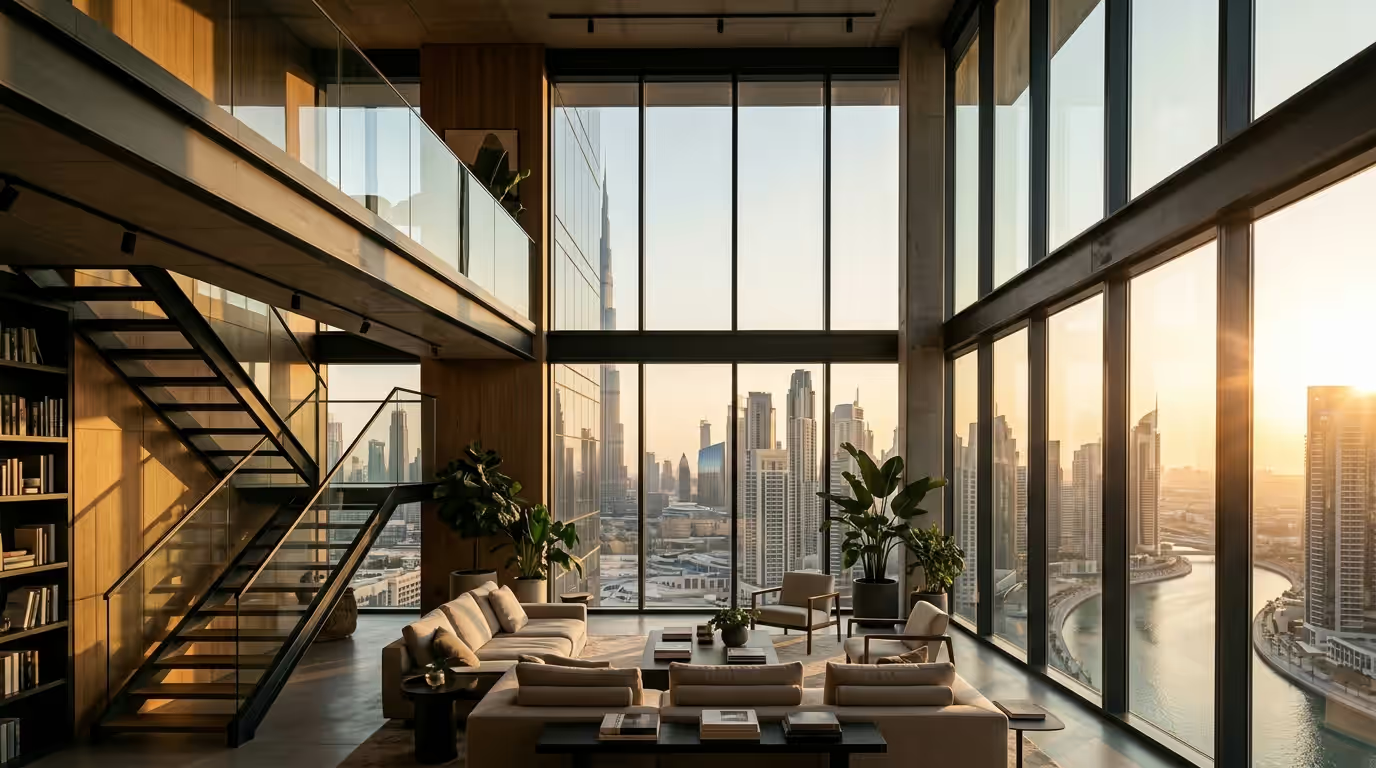
Loft apartments are a striking category of urban living defined by double‑height ceilings, open mezzanine levels and large windows. Popular with design‑forward end‑users and investors seeking differentiation, lofts in Dubai blend New York–style volume with modern tower amenities.
This guide explains what a loft apartment is, how it compares to studios, duplexes and one‑bedrooms, who it suits, the pros and cons, typical costs and fees in Dubai, and where to find them across the city.
What is a Loft Apartment?
A loft apartment is a unit with a double‑height main living space (often ~4.5–6.0 metres) and an open mezzanine platform that overlooks the area below. The mezzanine commonly hosts the bedroom or study, while the ground level houses the living/dining, kitchen and a bathroom. Unlike traditional one‑bedroom apartments, internal walls are minimised to maximise volume and light.
In Dubai, most lofts are purpose‑built in residential towers rather than converted warehouses. You will find them in select high‑rise buildings and mixed‑use districts, often marketed as “loft”, “sky loft” or “double‑height 1BR”.
- Defining features: double‑height void + mezzanine
- Open-plan living with minimal partitions
- Large glazing for light and views
- Industrial or contemporary finishes depending on developer
Loft vs Duplex vs Studio vs 1BR: Key Differences
Use this quick comparison to understand how a loft contrasts with other common layouts:
| Type | Levels | Typical Bedrooms | Key Traits | Privacy |
|---|---|---|---|---|
| Loft | 1.5 (mezzanine) | Studio–1BR equivalent | Double‑height volume, open mezzanine | Lower (open sleeping zone) |
| Duplex | 2 full floors | 1–3+ | Full second level with enclosed rooms | Higher |
| Studio | 1 | 0 (open plan) | Single level, compact, no bedroom wall | Moderate |
| 1BR | 1 | 1 enclosed | Separate bedroom, standard ceiling height | Higher |
A loft prioritises vertical space and visual drama over enclosed rooms. If you want separation for families or frequent guests, a duplex or standard 1BR may suit better.
Who a Loft Suits (and Who It Doesn’t)
- Design‑minded singles or couples who value volume, light and a statement living area.
- Home‑office creatives who can use the mezzanine as a studio or workspace.
- Investors targeting tenants who pay a premium for unique layouts in prime, view‑oriented towers.
May not suit:
- Families requiring enclosed bedrooms and acoustic privacy.
- Those sensitive to sound transfer between levels.
- Residents who prefer easily cooled, energy‑efficient compact spaces.
Benefits and Trade‑offs of Loft Apartments
Benefits:
- Dramatic sense of space: double‑height ceilings and tall windows provide a luxury feel and better daylight.
- Flexible mezzanine: versatile for sleeping, office or hobby space without increasing footprint.
- Strong resale and rental differentiation: unique layouts can reduce direct comparables and support premium positioning in the same tower.
Trade‑offs:
- Acoustic and visual privacy: open mezzanines reduce separation from living areas.
- Climate control: greater air volume can increase cooling costs; shading and smart thermostats help.
- Furniture planning: requires scale‑appropriate pieces and tall window treatments.
- Safety: open stairs and balustrades may not suit small children or pets.
Where to Find Loft Apartments in Dubai
Lofts are concentrated in urban, mixed‑use districts with skyline or waterfront views. Availability varies by building and developer; always verify exact ceiling heights and mezzanine size on the floor plan.
Notable areas and developers offering loft‑style units include:
- Downtown Dubai and Business Bay: double‑height units in select towers by Emaar and other prime developers.
- DIFC and surrounding urban pockets: contemporary lofts appealing to professionals.
- Dubai Marina and JBR: sea or marina‑view lofts in select towers by established developers such as Select Group.
- Dubai Creek Harbour and MBR City: modern interpretations by Emaar, Sobha and others.
- JVC/JVT and Jumeirah Village Triangle: boutique buildings occasionally include loft‑style 1BRs.
Tip: In listings, “loft” may be used loosely. Confirm true double‑height voids, mezzanine usability and the void percentage stated on the plan.
Pricing, Rents and Returns (Indicative Only)
Pricing for loft apartments varies widely by location, view, tower quality, and size. As a general observation:
- Sale price positioning: lofts can command a premium of roughly 10–25% over comparable single‑level units in the same building due to volume and uniqueness, though this is not universal.
- Price per square foot: prime, view‑led towers typically trade above their submarket averages; emerging districts may offer more accessible entry points.
- Rental demand: tenants often pay a modest premium for true loft features, especially in lifestyle districts with F&B and transport access.
- Gross yield ranges: in Dubai’s established rental areas, many investors target indicative gross yields in the ~5–8% range for well‑located apartments; individual results vary by building, management and market timing.
Always underwrite on actual recent transactions in the specific tower and stack, not just area averages.
Ownership, Fees and Transaction Costs in Dubai
Foreigners can purchase freehold property in designated Dubai freehold zones. When buying a ready loft apartment, budget for the following typical costs:
- Dubai Land Department (DLD) transfer fee: 4% of the purchase price.
- Registration/trustee office fee: typically around AED 2,000–4,000 depending on value and property type.
- Agency fee: commonly around 2% of the purchase price (varies by agreement).
- NOC fee to developer: often several hundred to a few thousand dirhams depending on the developer.
- Service charges: billed annually per net internal area; in modern high‑rise towers, indicative ranges can be around AED 15–30 per sq ft per year, higher in ultra‑prime or amenity‑heavy buildings.
- Utilities and chiller: double‑height spaces can increase cooling costs; ask for historic DEWA/chiller bills where possible.
For off‑plan purchases, the 4% Oqood registration fee applies at sale registration with DLD, plus any developer admin. Review the payment plan, escrow details and anticipated service charges.
Financing and Golden Visa Considerations
UAE banks typically treat lofts as standard apartments for mortgage purposes. Actual eligibility depends on your profile and bank policy.
- Residents: typical maximum loan‑to‑value ratios can be up to 80% for a first home up to certain property values, with higher down payments for higher‑priced properties or second homes.
- Non‑residents: typical maximum LTVs are lower (often up to around 60%), implying larger down payments.
- Valuation: lenders rely on valuer reports; premiums for double‑height units should be supported by comparables.
Golden Visa: A property with a value of AED 2,000,000 or more (meeting Dubai Land Department criteria and other program rules) can qualify an owner for a 10‑year Golden Visa. The loft’s eligibility is based on its registered value, ownership status and compliance with current regulations.
Design and Living Tips for Loft Owners
- Plan the mezzanine: decide early whether it’s a bedroom, office or lounge; power and data points matter.
- Manage climate: use ceiling fans, smart thermostats, layered shading and UV films to reduce cooling load.
- Acoustic zoning: area rugs, fabric panels and bookcases help absorb sound.
- Safety and compliance: any glazing enclosure or mezzanine modification requires building management approval and the relevant permits; obtain an NOC before works.
- Scale furniture to height: tall art, lighting and drapery accentuate proportions without cluttering the void.
Buying Process Snapshot for a Loft Apartment
- Select the building and stack: verify true double‑height void on plan, void percentage, and structural constraints.
- Offer and Form F/MOU: agree price, inclusions and timelines; include any snagging or modification clauses.
- No Objection Certificate (NOC): seller obtains from developer after clearing service charges.
- Transfer at Trustee Office: settle funds, pay DLD 4% and registration fees; title deed issued in your name.
- Handover and snagging: check balustrades, stair treads, glazing seals, HVAC zoning and window mechanisms specific to double‑height units.
Common Mistakes to Avoid
- Taking the word “loft” at face value. Some listings label high‑ceiling units as lofts without a usable mezzanine—always verify plans and ceiling heights.
- Underestimating cooling costs. Double‑height volumes can raise chiller/DEWA bills without shading and smart controls.
- Ignoring acoustics. Open mezzanines transmit noise; plan rugs, soft finishes and layout to mitigate.
- Skipping permit checks. Enclosing a mezzanine or altering balustrades requires approvals and NOCs.
- Overvaluing on area averages. Loft premiums vary tower‑to‑tower; rely on recent transactions in the same building.
Conclusion
A loft apartment delivers volume, light and a distinctive lifestyle that can also differentiate your investment. In Dubai, true lofts are found in select towers across prime urban districts, often commanding a premium for their drama and views. Verify the floor plan, budget realistically for fees and cooling, and lean on building‑specific data when pricing or underwriting. With the right due diligence, a loft can be both a design statement and a resilient asset.