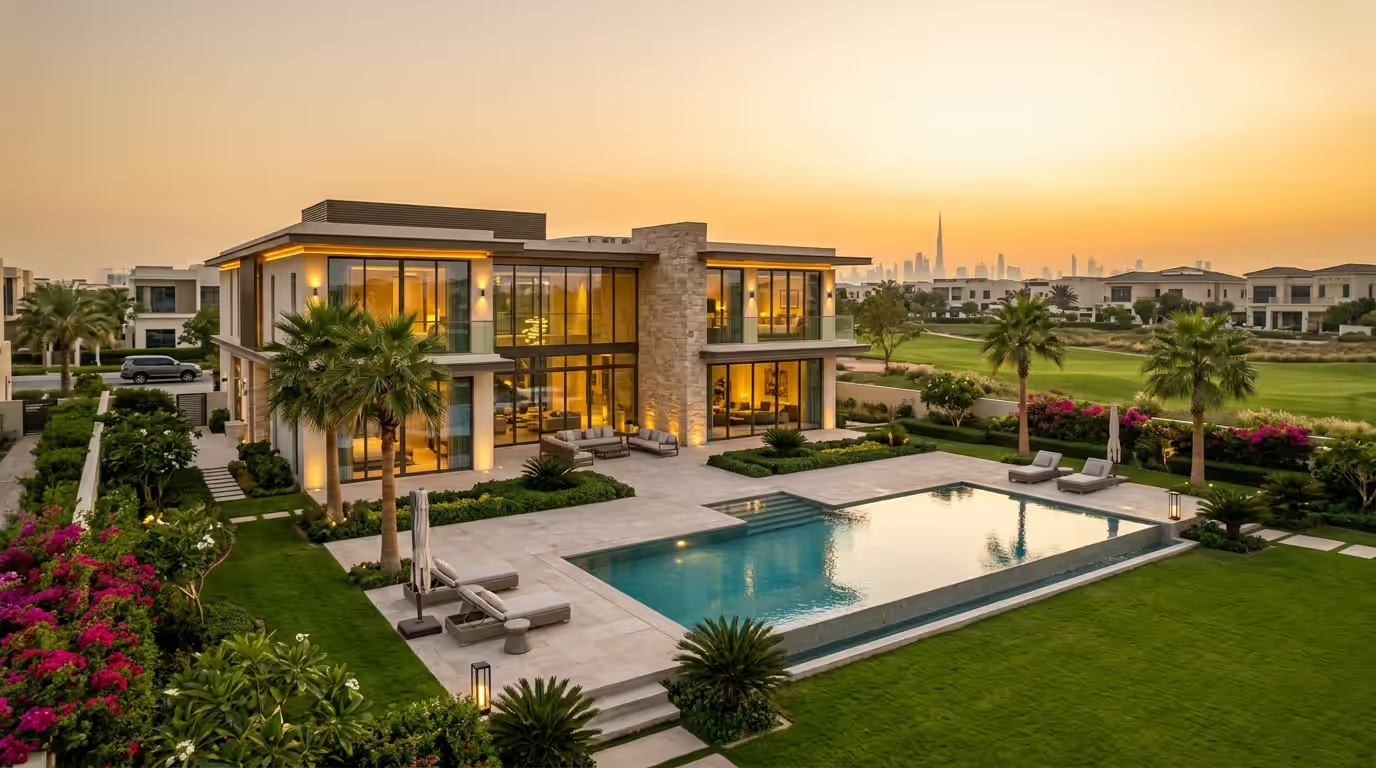
Owning a villa in Dubai offers space, privacy, and strong long‑term appeal—but it also comes with ongoing costs that differ from apartments. Beyond utilities, villa owners budget for community service charges, garden and pool care, preventive maintenance, and occasional major works.
This guide breaks down the typical yearly and lifecycle costs for Dubai villas, explains what is covered by community fees versus the owner, and offers practical ways to forecast and control spend. Figures are indicative ranges based on market norms; your actual costs will vary by villa size, location, age, specification, and usage.
What Villa Maintenance Actually Covers
Villa upkeep in Dubai is split between (a) owner-paid items within your plot or building and (b) community service charges that fund shared areas.
Owner-paid (inside your boundary):
- HVAC servicing and repairs (ducted/split AC units or district cooling billing where applicable)
- Plumbing and electrical maintenance
- Waterproofing, roof and facade works
- Painting, caulking, grouting and minor masonry
- Landscaping/irrigation, pool care, external cleaning
- Pest control and periodic deep cleaning
- Home insurance (building/contents) and appliance replacements
Community service charges (paid to the Owners’ Association/management):
- Master and sub‑community security, landscaping and lighting
- Roadways, parks, shared facilities, clubhouse and community pools (if applicable)
- Association management, cleaning, lifeguards, reserve/sinking funds as budgeted
Recurring Annual Costs: Typical Ranges
Budgeting bands below are indicative for commonly transacted villas (roughly 3–6 bedrooms). Newer, well‑insulated homes in established communities tend to run lower; large plots and private pools trend higher.
Service charges (community fees):
- Villas usually pay a lower AED per sq ft rate than apartments, often based on plot or built‑up area depending on the community’s rules. Indicative combined master and sub‑community charges can range roughly AED 2–10 per sq ft per year. A mid‑size villa might see AED 8,000–25,000 annually. Always confirm the latest published budget from the Owners’ Association.
Utilities (DEWA water/electricity; AC type dependent):
- Individual AC (most villas): cooler months AED 800–2,000/month; peak summer AED 1,500–4,000/month depending on size, thermostat settings, and insulation.
- District cooling villas/townhouses (select communities): a fixed capacity component billed monthly plus consumption. Total AC bills can vary widely; owners commonly see several hundred to low‑thousands of dirhams per month in peak season depending on tonnage and usage. Request the recent 12‑month bill history before purchase.
Preventive maintenance contracts (PMCs/AMCs):
- Annual packages covering AC, plumbing and electrical with scheduled visits: roughly AED 2,500–10,000+ depending on villa size, number of AC units, and inclusions (emergency callouts, parts discounts, etc.).
Garden and irrigation:
- Basic lawn/shrubs maintenance: AED 300–1,500/month depending on plot size and frequency.
- Irrigation system tune‑ups and periodic repairs: a few hundred dirhams per visit when needed.
Private pool maintenance (if applicable):
- Cleaning and chemicals: AED 300–800/month for typical villa pools; more for larger or heated pools.
Pest control and cleaning:
- Pest control (quarterly/biannual): AED 200–600 per visit depending on treatment scope.
- External window/pressure washing: AED 200–1,000 per visit depending on access and size.
Insurance:
- Building and contents cover for villas typically totals AED 1,500–5,000+ per year depending on declared rebuild value and contents limits.
Move‑in deposits and admin (one‑time on first setup):
- DEWA refundable security deposit for villas: AED 4,000 (refundable when accounts close, net of dues).
One‑Off and Lifecycle Costs to Expect
Plan a sinking buffer for items that don’t recur annually but arrive in cycles:
- Interior/exterior repainting: commonly every 3–6 years; small to large villas can run from AED 8,000–30,000+ depending on scope and materials.
- Waterproofing/roofing repairs: often on a 5–10 year horizon; allow a contingency in the tens of thousands of dirhams for larger works.
- HVAC overhaul or compressor replacement: varies by number and age of units; set aside a multi‑thousand dirham reserve per major unit over its life.
- Appliance replacements (fridges, ovens, pumps): create a modest annual reserve to smooth lumpy spend.
- Landscaping refresh or hardscape repairs (pavers, pergolas, decking): highly variable; phased upgrades help manage cash flow.
How Community Service Charges Work for Villas
Service charges are set annually by the Owners’ Association based on approved budgets and are payable by owners regardless of occupancy. For villas, charges may be calculated on either built‑up area or plot/developer-declared area depending on the community’s governing documents. Budgets typically include a reserve (sinking) fund for long‑term community assets.
What to check before buying:
- Current AED per sq ft rate and total annual amount for the specific villa
- Whether charges are split between master and sub‑community
- Any planned major works that could affect future budgets
- Payment schedules, late fee policies, and if there are past due balances on the unit
Owners can review the service charge index and community budgets published via the relevant Dubai authorities and association manager. Remember: service charges cover shared areas; private plot upkeep remains the owner’s responsibility.
- Confirm the basis of calculation (plot vs built‑up area).
- Ask for last two years’ budgets and actuals.
- Verify if the reserve fund is adequately funded.
District Cooling vs Individual AC: Cost and Practical Differences
| Aspect | District Cooling Villas/Townhouses | Individual AC (Split/Ducted) |
|---|---|---|
| Billing structure | Fixed capacity fee plus consumption; billed monthly by the cooling provider | All electricity consumption via DEWA; no separate cooling provider |
| Seasonal variability | More predictable due to fixed component, though consumption still rises in summer | High summer spikes tied to thermostat settings and insulation |
| Maintenance | Chilled water interface inside the villa needs periodic servicing; central plant is provider’s responsibility | Full AC system (compressors/air handlers/ducts) maintained by owner or AMC |
| Upfront setup | Provider registration fees and deposits may apply | No separate cooling account; DEWA only |
| Cost visibility | Request historic bills to gauge true annual total | Review DEWA history to separate AC draw from other loads |
Neither model is universally cheaper; total cost depends on home size, efficiency, usage habits, and tariff specifics. Always analyze recent 12‑month bills for the exact property.
Sample Annual Budgets (Illustrative Only)
These scenarios are for planning only—verify for your specific villa.
3–4BR townhouse (approx. 2,500–3,000 sq ft, small garden, no private pool):
- Service charges: AED 6,000–15,000/year
- Utilities (DEWA and cooling): AED 12,000–30,000/year depending on AC type and usage
- AMC (AC/plumbing/electrical): AED 2,500–6,000/year
- Garden care: AED 3,000–8,000/year
- Pest control/cleaning/insurance: AED 2,500–6,000/year
Approximate total: AED 26,000–65,000/year
5BR standalone villa (approx. 4,500–6,000 sq ft, larger plot, private pool):
- Service charges: AED 12,000–25,000/year
- Utilities (DEWA and cooling): AED 20,000–60,000/year
- AMC: AED 5,000–12,000/year
- Garden care: AED 6,000–18,000/year
- Pool care: AED 4,000–10,000/year
- Pest control/cleaning/insurance: AED 4,000–10,000/year
Approximate total: AED 51,000–135,000/year
Lifecycle reserve (both cases): It’s prudent to add an annual reserve (for paint, waterproofing, HVAC replacements) equal to a few dirhams per sq ft to smooth future capex.
Cost Control Without Cutting Corners
- Prioritize preventive maintenance: Quarterly AC servicing reduces breakdowns and peak‑season power draw.
- Smart thermostats and shading: Simple set‑points and window films can trim cooling loads notably.
- Drip irrigation audits: Fixing leaks and optimizing timers can materially reduce water bills.
- Bundle services: Annual maintenance, pest control, and pool packages often price better together—check response‑time SLAs.
- Insist on transparent scopes: For AMCs, define number of visits, inclusions, parts/labour caps, and emergency callout terms.
- Compare historic bills: Request the property’s last 12 months of utility and cooling bills to calibrate your budget before you buy.
- Plan capex: Repaint and waterproof on schedule; deferral often multiplies final costs.
Landlords vs End‑Users: Who Pays for What?
In Dubai, service charges are always paid by the owner. Within the villa, the split of day‑to‑day maintenance between landlord and tenant follows the tenancy agreement. Market practice often assigns minor consumables and small fixes to the tenant, with major repairs and system failures borne by the landlord; however, thresholds vary by contract, so clarity in the lease is essential.
For investment villas, also budget for compliance items like smoke detectors, pool safety measures, and periodic snagging between tenancies. Responsive maintenance reduces vacancy risk and supports stronger rents.
Common Mistakes to Avoid
- Underestimating service charges. Owners assume villas are always cheaper than apartments; some communities still have meaningful annual fees.
- Ignoring district cooling math. Focusing only on DEWA and forgetting fixed cooling capacity charges can skew budgets.
- Skipping preventive maintenance. Deferring AC and waterproofing leads to bigger repairs and higher summer bills.
- No lifecycle reserve. Painting, roof works, and HVAC replacements arrive in cycles; without a buffer, cash flow gets hit.
- Vague AMC contracts. Unclear scopes and slow SLAs lead to surprise add‑ons and long downtimes in peak season.
Conclusion
Villa living in Dubai is rewarding, but the numbers work best when you separate community fees, running utilities, routine upkeep, and cyclical capex. Use actual bill histories where possible, choose clear maintenance contracts, and set a realistic annual reserve. With disciplined planning, you’ll preserve comfort, control costs, and protect long‑term value—whether you’re an end‑user or an investor.