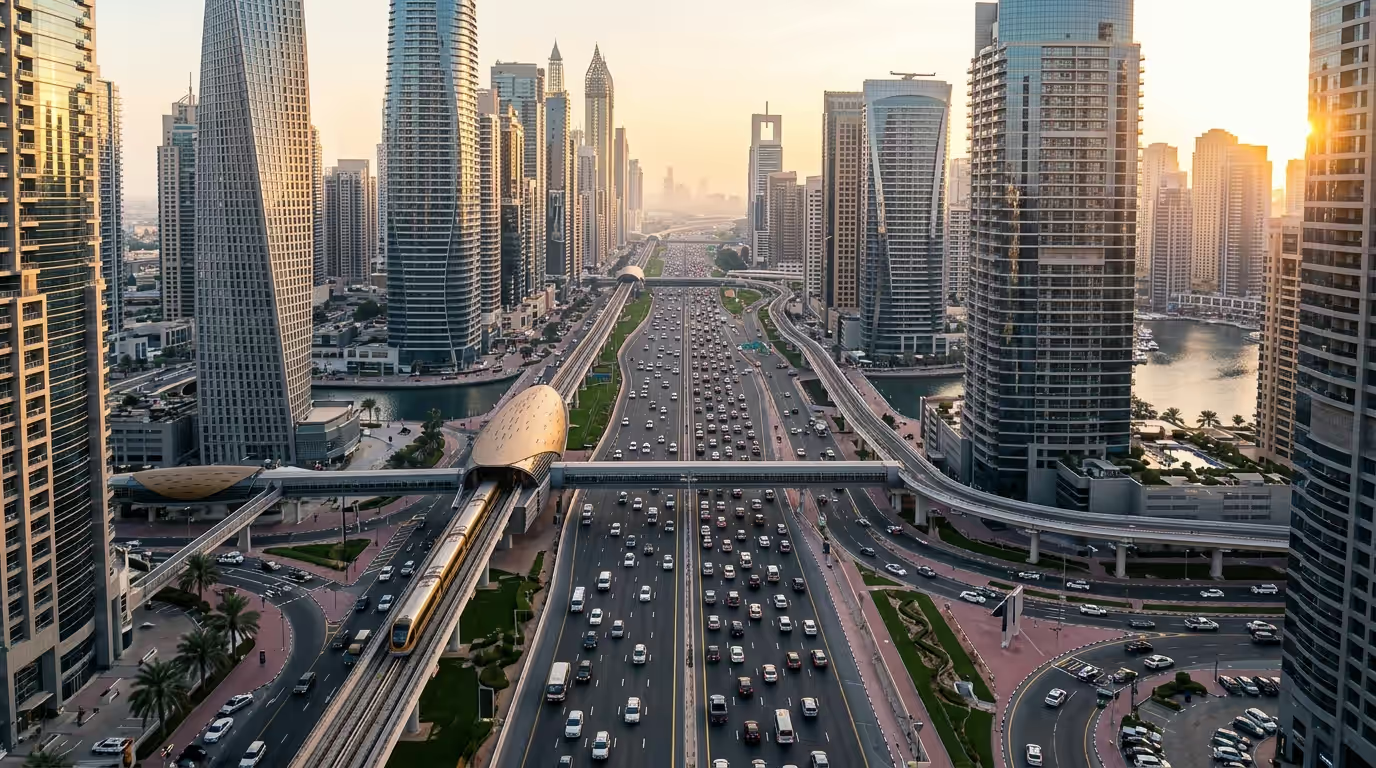
In Dubai, everyday commute realities can add or subtract hours from your week and thousands of dirhams from your annual budget. For buyers, tenants, and investors alike, rush hour isn’t just about traffic—it’s a property decision variable that shapes lifestyle, rents, yields, and resale demand.
This guide maps Dubai’s peak congestion windows, pinpoints transport corridors that move best, and highlights communities that consistently outperform on time-to-destination and commuting resiliency. Use it to align your home or investment with how the city actually moves.
What rush hour really looks like in Dubai
Dubai’s weekday rush stretches across two main peaks:
- Morning: roughly 7:15–9:30 AM as commuters head toward business districts and schools.
- Evening: roughly 5:30–7:30 PM as offices close and families move between work, malls, and after-school activities.
Congestion intensifies around business hubs (Business Bay, DIFC, Downtown, Barsha Heights), coastal arterials (Sheikh Zayed Road/E11), and bridges/tunnels across Dubai Creek. Fridays are typically lighter in the morning; school holidays and Ramadan shift patterns and often compress or ease peaks. Weekend evenings can resemble a mini-peak around leisure destinations.
- School run compounds AM congestion near major education clusters.
- Weather events and accidents can quickly ripple across E11 and Al Khail.
- Events at Expo City, Dubai Mall, or SZR corridor can trigger temporary surges.
Where congestion peaks—and the reliable escape routes
Typical weekday hotspots include inbound corridors into Downtown/DIFC via Financial Centre Road, Al Khail Road (E44) toward Business Bay and Dubai Design District, and Sheikh Zayed Road near Dubai Marina/JBR in the evening.
Relative pressure relievers:
- Metro Red Line parallel to SZR for Marina–Business Bay–DIFC–Deira corridors.
- Metro Green Line for Deira–Bur Dubai–Healthcare City with efficient Creek crossings.
- Parallel arterials: use Hessa Street, Umm Suqeim Street, and Al Khail Road to bypass certain SZR segments when appropriate.
- Water transport across Dubai Marina and the Creek can shortcut localized gridlock.
Your practical takeaway: the closer you are to a Metro station on a direct line to your workplace—or to a secondary arterial that parallels E11—the more predictable your commute becomes, especially when rain or incidents spike delays.
- Living within a 5–10 minute walk of a Metro station often saves 10–25 minutes at peak.
- Road toll gates apply on key corridors; frequent crossings add up for drivers.
Commute modes compared during rush hour
| Mode | Strengths | Watch-outs | Best for |
|---|---|---|---|
| Metro | Predictable timing, immune to road gridlock, cost-efficient | Transfers add time; last-mile walk/feeder buses | SZR/Business Bay/DIFC/Downtown/Deira corridors |
| Tram + Metro | Seamless Marina–JBR link to Red Line | Extra transfer; slower than Metro | JBR/Marina residents commuting to Business Bay/DIFC |
| Driving | Door-to-door, flexible scheduling | Peak delays, parking cost/availability, tolls | Off-peak workers, suburban families, multi-stop days |
| Taxis/e-hail | No parking hassle | Surge pricing and queue times at peak | Occasional commuters and visitors |
| Cycling/e-scooters (localized) | Fast for short hops, predictable | Heat in summer, limited safe corridors | Last-mile in Marina, JLT, Downtown clusters |
- Hybrid routines (drive to a park-and-ride, then Metro) often minimize time plus cost.
- If you need guaranteed punctuality, rail-first itineraries outperform at peak.
Communities that consistently beat the rush
These areas tend to deliver resilient peak-hour access thanks to rail adjacency, grid street networks, or multiple arterial choices:
- Downtown Dubai & DIFC: Walkable to offices, Red Line access at Burj Khalifa/Dubai Mall and Financial Centre. Peak car congestion exists, but walk/Metro options offset it.
- JLT & Dubai Marina: Dense, mixed-use, with Tram and Red Line connectivity. Walking and micro-mobility can outperform cars for local moves.
- Dubai Hills Estate: Multiple access points to Al Khail, Umm Suqeim, and SZR; schools and retail are within the community reducing cross-city trips.
- Dubai Silicon Oasis & Academic City belt: Self-contained amenities; proximity to schools and universities reduces AM cross-town travel.
- MBR City/Business Bay fringe: Fast access to Al Khail and Downtown with strategic building exits avoiding main choke points.
- If your office is on SZR, a Red Line address usually beats any single-lane shortcut.
- Families often prefer master communities that compress school, sports, and shopping within 10–15 minutes.
Buying or renting with commute in mind
Treat commute as a core due-diligence item alongside price and layout. Before you sign:
- Time the route both ways at true peak on a weekday. Test at least two variants (e.g., Al Khail vs SZR) and one rail option.
- Walk the last mile from the nearest Metro/Tram stop in summer conditions to confirm comfort and safety.
- Validate parking ease, building exit queues, and lift wait times in towers at 8–9 AM and 6–7 PM.
- Factor total mobility cost: fuel, toll gates, parking fees, and e-hail surcharges.
- If you’re mortgage-financed, remember commute savings can offset part of monthly costs over time. Prioritize location efficiency if budgets are tight.
For buyers, note transaction costs: Dubai Land Department levies a 4% transfer fee on property purchases, plus registration/admin and trustee office fees. If you’re targeting an AED 2 million+ purchase, you may also explore eligibility for long-term residency options such as the UAE Golden Visa (subject to prevailing rules). None of these replace commute math—but they can shape overall affordability and holding period strategy.
- A 20-minute daily saving equals roughly 160 hours a year—often worth a rental premium.
- If you WFH 3+ days weekly, widen your radius to value-rich suburbs without commute pain.
Investor lens: how rush hour shapes rent, yields, and voids
Transport proximity is a durable rental driver. Units within an easy walk of a Red Line station or with quick access to dual arterials typically command stronger inquiry volumes and shallower vacancy gaps.
- Demand resilience: Rail-adjacent stock often rents faster during market slowdowns due to predictable commute times.
- Premiums: Tenants may pay modest premiums for station proximity, shaded walkways, or proven exit routes. Treat these as indicative, not guaranteed.
- Furnished vs unfurnished: In transit-rich hubs (Marina, JLT, Downtown), furnished units can capture short-notice movers who prioritise time-to-keys and commute.
- Parking matters: Even with rail, one allocated space per 1-bed is often expected. Lack of parking can narrow your tenant pool unless location is ultra-central.
When underwriting, stress-test against peak-hour realities: assume conservative drive times and consider future infrastructure that could lift a micro-location’s appeal over a multi-year hold.
- Photos sell the sizzle; commute notes in listings close the deal. Message exact station distance in minutes.
- Avoid overpaying solely for a view if the address is a time sink at peak.
Infrastructure to watch: the projects that rewire commutes
Dubai continually upgrades mobility: road widenings, new interchanges, shaded sidewalks, cycling corridors, and additional public transport capacity. The Metro network has expanded over time, including the extension serving Expo City Dubai, improving the southwest corridor. Authorities have also announced plans for further Metro expansion corridors in the coming years, which, once delivered, can redraw commute maps and property demand.
Practical guidance:
- Map announced stations and interchanges near your target community; even pre-delivery, they can influence price trajectories.
- Shaded walkways and last-mile improvements materially change behavior—ask building management about planned enhancements.
- Major retail or school openings inside a master community reduce external peak trips, improving livability without new roads.
- Future rail within walking distance is a strong medium-term catalyst, though timelines can shift.
- Interchange upgrades can turn a ‘bottleneck’ tower into a commuter gem.
School runs, parking, and building operations at peak
Many families align home choice with school catchments; this compounds morning peaks on routes to major education clusters. If you’re a parent, probe:
- School bus routing and pick-up timing vs your building’s exit queues.
- On-site drop-off loops in villas communities to avoid curbside chaos.
- Secure, shaded, and plentiful visitor parking for nannies and tutors.
In towers, operational details matter at rush hour: lift wait times, security checks, and podium traffic all influence real door-to-desk timing. A quick building audit during peak reveals more than a brochure ever will.
- Ask neighbours about average lift waits at 8:30 AM before committing.
- For villas, dry-run the school loop on a weekday; weekends are misleading.
Your 30-minute commute game plan
To consistently keep door-to-desk near 30 minutes, layer these tactics:
- Live one transfer or less from your workplace by rail; aim for under 10 minutes of last-mile walking.
- If driving, choose a community with two viable arterials and a back-road escape.
- Stagger your start by 20–30 minutes where work permits; Dubai’s peaks are sensitive to small shifts.
- Batch errands within your community or along your route; avoid cross-city zigzags.
- Keep a rainy-day plan: rail-first route saved in your map app, umbrella, and a known park-and-ride lot.
Common Mistakes to Avoid
- Only testing off-peak. Viewing on a weekend afternoon hides weekday gridlock realities.
- Ignoring the last mile. A 3-minute Metro ride can be undone by a 20-minute hot walk.
- Underestimating parking friction. Peak exit queues and limited visitor spaces add daily stress.
- Buying on headlines, not timelines. Future infrastructure helps, but delivery schedules can shift.
- Overlooking school calendars. Term-time traffic patterns differ sharply from holidays.
Conclusion
Rush hour in Dubai is predictable enough to plan around and variable enough to punish the unprepared. If you anchor your search on rail adjacency, dual-arterial access, and honest peak-time testing, you’ll reclaim hours each week and hold an address that tenants and future buyers actively seek. Whether you’re moving next month or underwriting a five-year investment, commute intelligence is one of the most reliable edges you can build into your property decision.