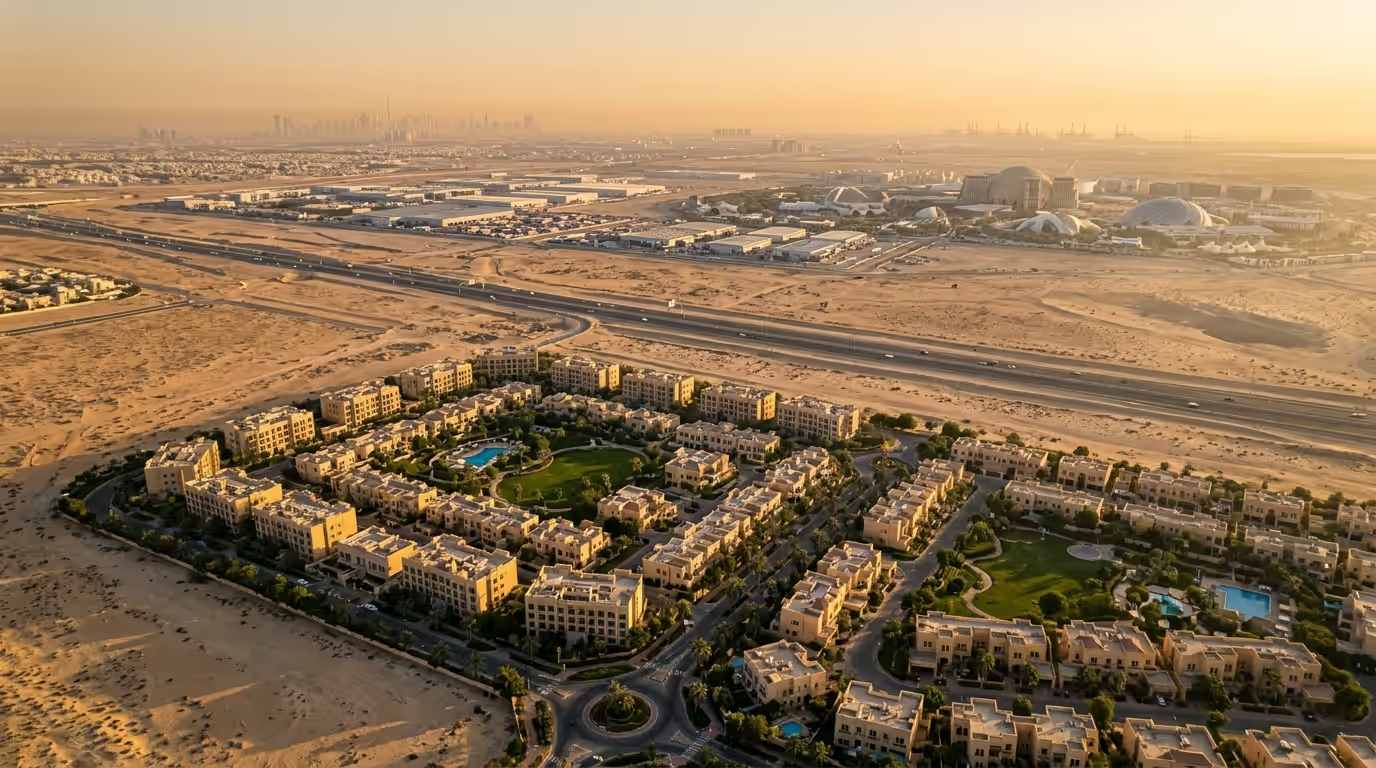
Straddling the Abu Dhabi–Dubai growth corridor, Al Ghadeer by Aldar is a master community designed for residents who want space, value, and quick access to two emirates. With apartments, townhouses, and villas across multiple phases, the community appeals to both first-time buyers and yield-focused investors.
This guide weighs the practical pros and cons of living in Al Ghadeer—from commute realities to amenities, ownership rules and costs—so you can decide if it fits your lifestyle or portfolio.
Quick Overview: What and Where Is Al Ghadeer?
Al Ghadeer is an Aldar freehold master development located near the Abu Dhabi–Dubai border, positioned to serve professionals working around Expo City Dubai, Dubai South, Jebel Ali, and KIZAD. It comprises low- to mid-rise apartments and a large supply of townhouses and villas arranged around parks, pools, and walking trails across earlier (Al Ghadeer 1) and newer (Al Ghadeer 2) phases.
Typical residents include airline and logistics staff, industrial and tech corridor employees, and families seeking quieter, lower-density living than inner-city areas.
- Developer: Aldar
- Ownership: Freehold for UAE and non-UAE nationals in designated zones
- Community type: Apartments, townhouses, villas
- Vibe: Suburban, family-friendly, value-focused
Location and Connectivity: Commute Pros and Cons
Al Ghadeer’s key advantage is its centrality to major employment hubs on both sides of the border. Access is typically via E11 or E311, with local routes linking to Dubai South and Jebel Ali.
Indicative drive times in normal traffic:
- Expo City Dubai / Dubai South: ~15–25 minutes
- Al Maktoum International Airport (DWC): ~20–30 minutes
- Jebel Ali Free Zone: ~25–35 minutes
- Abu Dhabi International Airport: ~30–40 minutes
- Dubai Marina / JLT: ~35–45 minutes
- Abu Dhabi Island (Corniche): ~45–60 minutes
Pros: balanced access to two emirates and airports. Cons: car dependency and peak-hour bottlenecks on the main highways; limited direct public transport.
Lifestyle and Amenities
Al Ghadeer is planned as a self-contained suburban community with daily conveniences and outdoor space. Residents typically find the basics within the masterplan, with more extensive retail, medical, and schooling choices in nearby Dubai South, Jebel Ali, and Abu Dhabi’s mainland.
What’s on hand in and around the community:
- Community retail and convenience stores; larger malls within a 20–40 minute drive
- Parks, pools, playgrounds, jogging/cycling paths
- Nurseries and early learning options within or near the community; a wider selection of K–12 schools within a 20–35 minute radius
- Clinics and pharmacies nearby; major hospitals reachable in ~25–45 minutes depending on direction
The overall feel is quieter than inner-city districts, suiting families, pet owners, and those who value outdoor space.
Property Types, Layouts, and Pricing Character
The community offers a broad mix, with many homes designed for functional, efficient living rather than ultra-luxury finishes.
- Apartments: Studios to 3-bed units with balconies and practical layouts. Often chosen by first-time buyers and investors.
- Townhouses: 2–4 beds with small gardens and carports; popular with families seeking value and space.
- Villas: Limited supply; larger plots and more privacy.
Relative pricing character (indicative, varies by phase, view, and finish): apartments and townhouses in Al Ghadeer typically transact below inner Dubai and central Abu Dhabi equivalents on a per-square-foot basis. Service charges are generally mid-market, reflecting low- to mid-rise buildings and townhouse communities.
For investors, gross yields have historically been attractive relative to more prime, inner-core neighborhoods—often seen in the mid-single to high-single digits depending on property type and purchase price. Treat these as indicative ranges, not guarantees.
Ownership, Fees, and Mortgages
Ownership: Non-UAE nationals can purchase freehold property in designated Abu Dhabi investment zones, which include Al Ghadeer. Title is registered with the Abu Dhabi authorities.
Key purchase costs in Abu Dhabi typically include:
- Property registration fee: commonly around 2% of the property value (paid to the relevant Abu Dhabi authority)
- Agency commission: typically in the 1–2% range (plus VAT) depending on agreement
- Developer NOC and administrative fees where applicable
- Service charges: vary by building and home type; review budgets before committing
Mortgages: UAE Central Bank regulations generally allow up to 80% loan-to-value for first-time expat buyers (higher for UAE nationals), subject to eligibility and lender policy. Buyers investing AED 2 million or more in property value may be eligible to apply for a long-term UAE residency (Golden Visa), subject to prevailing rules and documentation.
Who Al Ghadeer Suits (and Who It Doesn’t)
- Suits: Commuters to Expo/Dubai South/Jebel Ali/KIZAD, airline and logistics staff, families wanting space and value, investors seeking steady rental demand near logistics and aviation corridors.
- May not suit: Those who require Metro access or car-free living; residents who prioritize walk-to-work city living; buyers who want ultra-prime beachfront or marina views.
Pros and Cons at a Glance
| Factor | Pros | Cons |
|---|---|---|
| Location | Balanced access to two emirates; close to major job hubs | Longer drives to city centres; peak-hour congestion |
| Affordability | Generally lower entry prices vs inner-city cores | Capital appreciation may be steadier rather than explosive |
| Lifestyle | Quiet, low-density, family-friendly; outdoor amenities | Limited nightlife/entertainment on the doorstep |
| Transport | Easy highway access | Limited public transport; car dependency |
| Investment | Broad tenant base from logistics/aviation/industrial zones; potentially healthy yields | Yields and occupancy vary by unit type, condition, and market cycle |
| Supply Pipeline | Multiple phases for choice and liquidity | Ongoing construction in parts can affect views and noise in certain pockets |
For Investors: Demand Drivers and Risk Checks
Demand in Al Ghadeer is closely tied to employment growth in logistics, aviation, light industrial, and events sectors nearby. The dual-emirate catchment helps diversify tenant pools. Investors frequently consider apartments for liquidity and townhouses for longer tenancies.
Before committing, many investors will:
- Focus on buildings/phases with proven occupancy track records
- Stress-test yields for higher interest-rate scenarios and realistic service charges
- Compare new vs. resale options (handover timelines, snagging, interim rent)
- Review rental rules, notice periods, and tenancy caps under Abu Dhabi regulations
- Consider furnishing to boost rentability for short-notice relocations tied to nearby hubs
For End-Users: Daily Living Considerations
Plan around commuting windows. If you work shifts at DWC, Jebel Ali, or Abu Dhabi airport, the location is a strong fit. Families typically appreciate the parks, pools, and calmer streets. Weekly planning helps, as major malls, hospitals, and specialty schools are a drive away.
Checklist for viewings:
- Test-drive your commute at peak times
- Compare sun orientation, parking, and noise lines (pool, road, construction)
- Review service charge budgets and sinking funds
- Inspect storage, kitchen layout, balcony safety, and garden usability
- Confirm telecom options and mobile coverage within your specific building/cluster
Common Mistakes to Avoid
- Underestimating commute peaks. Travel times can stretch during rush hour and Sunday–Thursday mornings/evenings.
- Ignoring service charges. Fees vary by phase and building; they materially impact net yields and monthly costs.
- Buying before seeing handed-over stock. Layout efficiency, finishes, and views differ across phases—verify in person where possible.
- Over-optimistic rent assumptions. Factor realistic vacancy, furnishing needs, and seasonality in the corridor.
- Not checking future construction. New phases or road works near your plot can impact noise, dust, and access temporarily.
Conclusion
Al Ghadeer’s value proposition is clear: suburban space, practical layouts, and a strategic position between two emirates. For commuters to Dubai South, Jebel Ali, and Abu Dhabi’s northern employment zones—or investors seeking diversified rental demand—the community can be a strong fit. Balance the affordability and quiet lifestyle with car dependency and longer trips to major city centres, and you’ll know if Al Ghadeer aligns with your priorities.