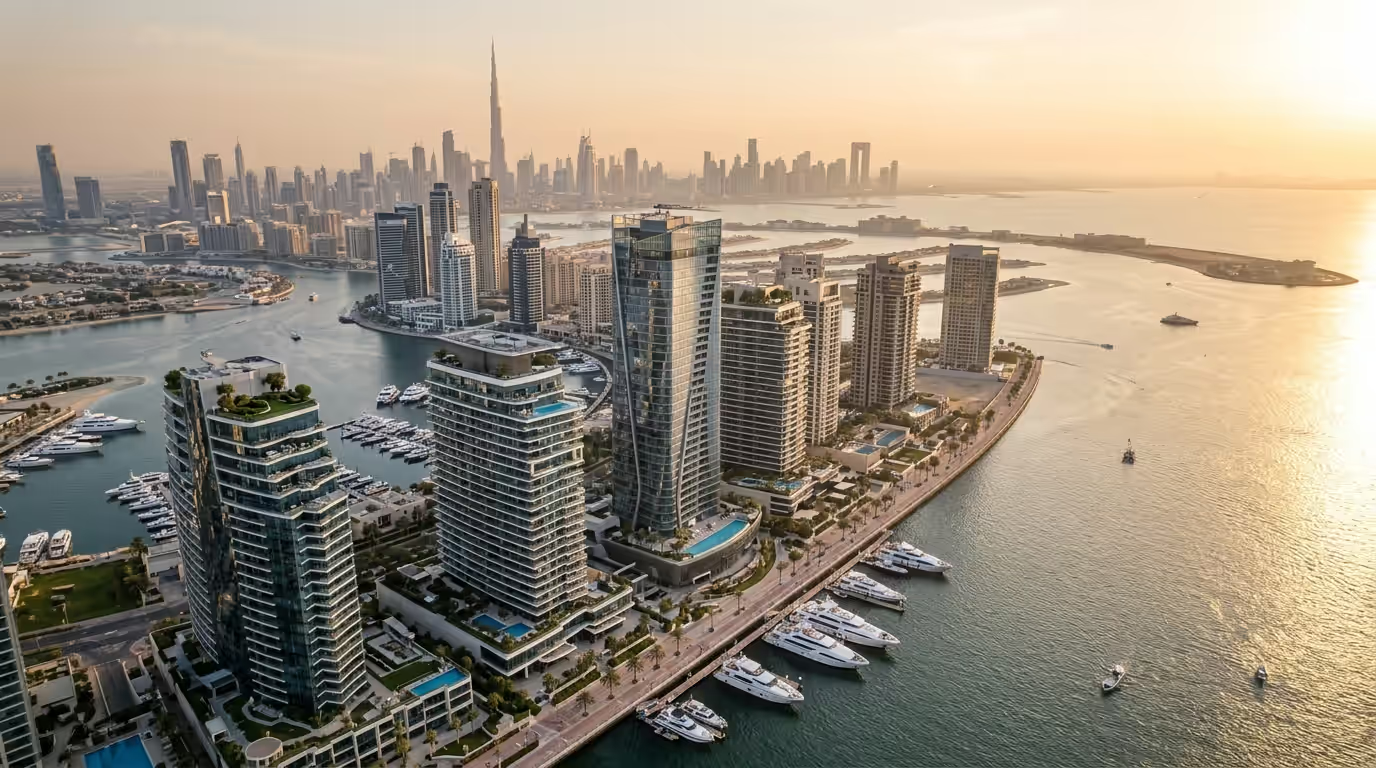
Dubai has become a global capital for luxury branded residences, where world-renowned hospitality and fashion names curate residential towers and villas with five-star design, services, and management. For investors, these homes can command price and rental premiums; for end-users, they offer a hotel-like lifestyle without compromising freehold ownership.
This guide explains how branded residences work in Dubai, realistic pricing and yield expectations, legal and cost considerations, how to evaluate a project, and the smartest paths to acquisition—whether you are buying off-plan or ready.
What Exactly Are Branded Residences?
Branded residences are homes developed in partnership with an international brand—often a luxury hotel or design house—where the brand influences architecture, interiors, amenities, and long-term service standards. Residents typically access concierge, valet, spa, F&B privileges, and curated lifestyle programming, with the brand overseeing quality through management agreements.
Key formats in Dubai include:
- Branded residences with full-time residential licensing (you live in them like a normal home)
- Serviced/branded apartments with hospitality-style services
- Hotel-branded residences adjacent to or within a hotel complex (with shared amenities)
Branding does not change ownership: foreigners can freehold in designated areas, and title deeds are issued via Dubai Land Department (DLD).
Why Dubai Leads the Branded Residence Trend
Dubai combines strong developer partnerships, global brand appetite, and destination appeal. Multiple prime waterfront and urban master plans (Palm Jumeirah, Downtown Dubai, Dubai Marina, Business Bay) provide flagship locations where brands can deliver statement architecture and curated amenities.
For investors, demand from international tenants and end-users supports liquidity and premiums over comparable non-branded stock. For end-users, Dubai’s service culture, high-quality facilities, and extensive dining/wellness scene align naturally with branded living.
- High tourism and executive relocation underpin rental demand
- Multiple trophy locations for view-centric residences
- Strong developer ecosystem: Emaar, DAMAC, Sobha, Omniyat, and others
- Brand breadth: hospitality, fashion, automotive, design houses
Price Premiums and Value Drivers
Branded residences in Dubai often transact at a premium versus non-branded peers in the same micro-location. Typical premiums vary by brand equity, specification, view, amenity density, and supply in the sub-market.
Indicatively (not a guarantee):
- Launch and resale premiums can range from a modest uplift to a material step-up depending on brand strength and location.
- Gross rental yields for prime branded apartments typically fall in the mid-single digits (for example, many investors underwrite around 4–6% in established prime areas), while non-branded prime stock can sometimes show a slightly wider range depending on building age and service charges.
Factors that sustain premiums:
- Brand credibility and global recognition
- Architecture, interior design, and private amenities (residents’ lounges, signature spas, private dining)
- Professional, consistent management standards
- Scarcity of comparable view corridors (e.g., Palm crescent, Burj Khalifa views, marina waterfront)
Leading Brands and Developer Pairings You’ll See
Dubai hosts a broad mix of hotel, lifestyle, and fashion/design brands. While offerings change as new launches arrive, investors will commonly encounter collaborations such as:
- Hospitality: branded by renowned luxury hotel groups, often with optional access to hotel services and membership privileges
- Fashion and design: residences curated by couture houses or interior design icons, emphasising bespoke finishes and artful common areas
- Automotive and lifestyle: partnerships that reference performance design, wellness, or members’ club culture
Always review the specific management agreement and brand standards: some projects include comprehensive services in the service charge; others offer à la carte options with separate fees.
- Check whether amenities are residents-only or shared with a hotel
- Confirm if F&B discounts, spa access, and valet are included or chargeable
- Ask for sample finish boards and appliance schedules before committing
Ownership, Legal, and Cost Considerations
Freehold: Foreigners can buy freehold in designated areas. On ready property, the DLD transfer fee is 4% of the purchase price. For off-plan, registration is typically also 4% at Oqood/DLD, collected during the sales process.
Service charges: Branded residences usually carry higher service charges per sq ft than non-branded buildings due to elevated staffing, concierge, and amenity upkeep. Obtain the latest budget and compare against peer buildings in the same micro-location.
Short-term letting: Some branded projects allow professionally managed short-term rentals; others restrict to long-stay or owner-occupancy. Review building bylaws and the brand’s operating framework.
Resale: Many branded projects command deeper buyer pools at resale, especially for prime view lines and larger formats.
Golden Visa: Purchasing property valued at AED 2 million or more can make you eligible to apply for a 10-year Golden Visa, subject to ICP rules (valuation, ownership type, and financing criteria apply).
- Expect 4% DLD/Oqood registration on purchase price
- Allow for trustee/admin fees and NOC charges when applicable
- Confirm snagging, defect liability periods, and brand aftercare
Financing and Payment Plans
Mortgages are available for qualifying buyers. Banks commonly assess income, credit profile, and building status, with loan-to-value ratios varying by residency, price band, and whether the property is ready or off-plan. As an indicative guide—not a guarantee—buyers may see maximum LTVs in the range of roughly 50–75% depending on circumstances and lender appetite.
Off-plan payment plans are common in branded launches (for example, construction-linked instalments with a final payment at handover). Always map the plan to your liquidity, currency exposure, and projected rental start date.
- Secure pre-approval before reservation
- Stress-test interest rate scenarios
- Clarify whether the developer accepts early settlement or restructuring
End-User Benefits: The Daily Experience
Beyond the logo, the appeal of branded living is consistency: a staffed lobby, discreet security, valet, on-call maintenance, housekeeping options, curated wellness, and residents-only lounges. Many projects integrate signature restaurants, private beaches or marinas, kids’ clubs, and pet-friendly areas.
The difference shows in the details—arrival experience, lifts, corridor materials, pool deck acoustics, lighting, and scenting—elements that impact long-term satisfaction and resale appeal.
- Ask for a full amenities and services matrix
- Visit at peak times to assess lifts, valet, and traffic flow
- Review pet policy, guest rules, and event booking procedures
Due Diligence Checklist for Branded Purchases
- Verify developer track record for timely delivery and quality
- Review the brand management agreement term and renewal mechanics
- Compare service charges vs. similar branded and non-branded comps
- Confirm rental rules (short-term vs. long-term) and operator licensing pathways
- Study floor plans for efficiency, ceiling heights, and storage
- Identify view corridors and potential future obstructions
- Inspect MEP, façade systems, and acoustic insulation standards
- Stress-test ROI under conservative rents and realistic vacancy
- Check handover scope: appliances, wardrobes, window treatments
- Validate snagging process and warranty coverage
Off-Plan vs Ready: Which Route Fits You?
| Aspect | Off-Plan Branded | Ready Branded |
|---|---|---|
| Entry Price | Often lower at launch; staged increases through sales cycle | Market price; pay full upfront or via mortgage |
| Payment Flow | Construction-linked plans; lower near-term cash outlay | Lump-sum + mortgage; immediate DLD transfer |
| Customisation | Better choice of stacks/views early | Limited; what you see is what you get |
| Rental Income Timing | Starts at handover; carry timeline risk | Immediate post-purchase, subject to leasing |
| Price Upside | Potential for price appreciation through construction | Tied to market trends and building reputation |
| Visibility of Quality | Reliant on developer track record, show units | Full inspection possible before purchase |
Transaction Roadmap in Dubai
For ready property: reserve with a Memorandum of Understanding (MOU), secure financing if needed, obtain a No Objection Certificate (NOC) from the developer, then complete transfer at a DLD trustee office. Expect the 4% DLD transfer fee plus standard admin/trustee/NOC costs.
For off-plan: reserve the unit, sign the Sales and Purchase Agreement (SPA), pay as per the payment schedule, and register with Oqood/DLD (typically 4%). Handover occurs after completion, snagging, and settlement of final instalments and service charge prepayments.
- Ensure funds for all fees in addition to price
- Use escrowed, RERA-compliant projects for off-plan
- Keep timelines for mortgage approvals and valuation
Common Mistakes to Avoid
- Chasing the logo, not the location. A strong brand cannot fix a weak micro-location or obstructed view.
- Underestimating service charges. Premium staffing and amenities increase annual costs and impact yields.
- Ignoring rental rules. Some branded buildings restrict short-term lets; confirm before underwriting ROI.
- Overly optimistic rent assumptions. Underwrite conservative rents and realistic vacancy for safety.
- Skipping resale liquidity checks. Study past absorption, buyer profiles, and stack desirability before buying.
Conclusion
Branded residences in Dubai blend luxury design, reliable service, and prime addresses—qualities that support both lifestyle value and long-term liquidity. Whether you buy off-plan for early pricing or choose a ready unit for immediate use, focus on brand credibility, developer delivery record, location fundamentals, service charge sustainability, and clear rental policies. With disciplined due diligence, a branded home can serve as a trophy residence, an income asset, or both—anchored by Dubai’s deep demand and mature property ecosystem.