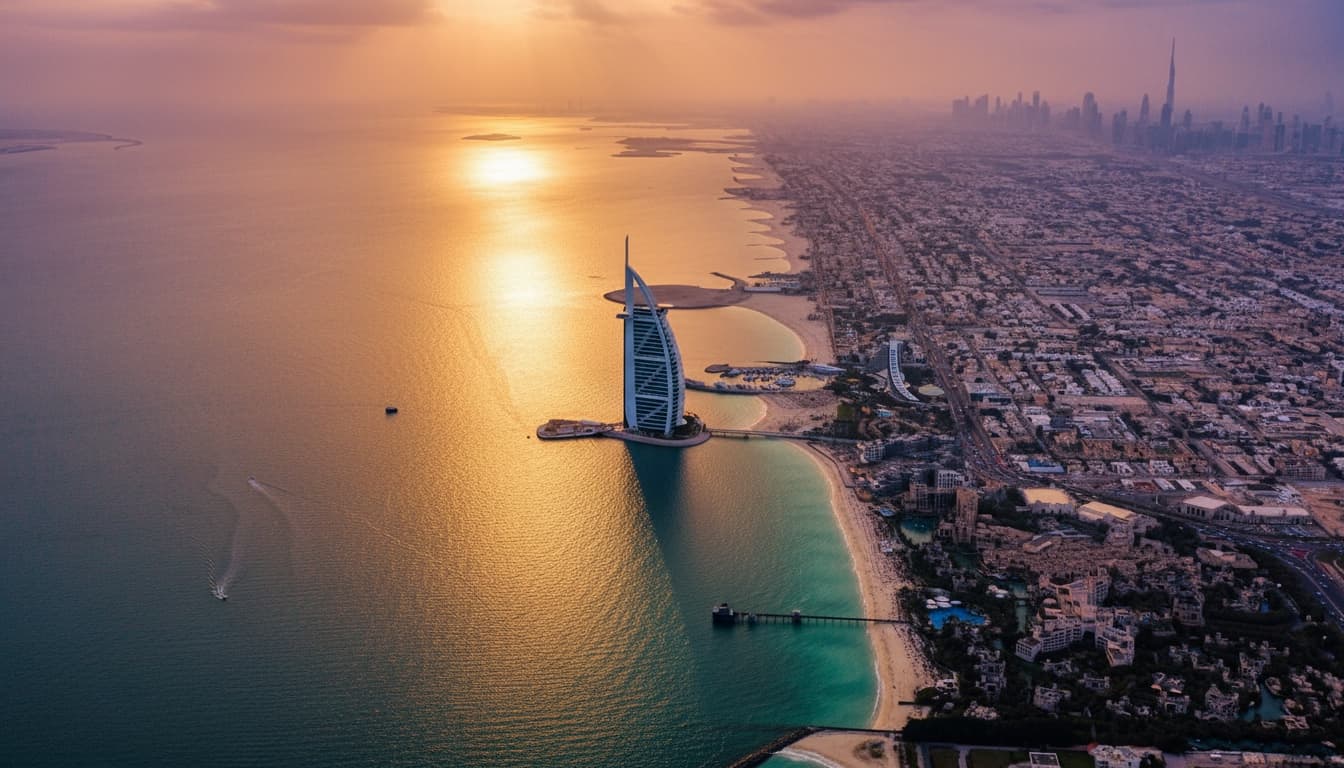
Where Is Palm Jebel Ali?
Palm Jebel Ali is a man-made island district on Dubai's far southwestern coast, set off Sheikh Zayed Road within the wider Jebel Ali area. It sits well to the south and west of the older, more central parts of the city — closer to Dubai's growth frontier than to its historic core. Where Palm Jumeirah anchors the established Dubai Marina and JBR beachfront, Palm Jebel Ali reaches into the corridor that Dubai has spent the past decade building outward toward: Dubai South, Expo City and the Al Maktoum International Airport.
That position is the single most important thing to understand about the island. It is a coastal, master-planned community facing open water, but it is a *southern* one. Buyers here are trading proximity to old Dubai for space, fresh beachfront and — at least at launch pricing — better value per square foot than the more central Palm.
Getting Around — Drive Times
Because Palm Jebel Ali connects directly to Sheikh Zayed Road, the main destinations most residents care about are a straightforward highway drive away — though every figure below should be read as approximate and heavily traffic-dependent. Dubai's peak-hour congestion can add fifteen or twenty minutes to any of these on a bad morning.
| Destination | Approx. drive time |
|---|---|
| Dubai Marina / JBR | around 25–30 minutes |
| Al Maktoum International Airport (DWC) | around 15–20 minutes |
| Expo City / Dubai South | around 15–20 minutes |
| Ibn Battuta Mall | around 15 minutes |
| Downtown Dubai | around 40–45 minutes |
| Dubai International Airport (DXB) | around 40–45 minutes |
For day-to-day life — the marina, the malls, the newer airport — Palm Jebel Ali is genuinely well placed. It is the trips into central and old Dubai that carry the longer drive, and that gap is the honest trade-off of a southern address. It is also worth remembering that the island itself is large; a villa on the outer fronds sits farther from the Sheikh Zayed Road connection than one near the trunk, so add a few minutes for the internal drive before you even reach the highway.
The Southern Growth Corridor
Palm Jebel Ali does not sit in isolation. It anchors the coastal edge of what is arguably Dubai's most deliberate expansion story: the southward corridor running from Jebel Ali down through Dubai South. This is where the emirate has concentrated its forward-looking infrastructure — the second international airport, the Expo 2020 site now reborn as Expo City, and large residential and logistics districts planned around them.
The significance for buyers is that Palm Jebel Ali is not a remote outpost that the city will slowly reach. It is being built *inside* the zone the city is actively pushing toward. As Dubai's population and its centre of gravity drift south and west over the coming decades, an address that looks peripheral on today's map is positioned to feel a good deal more central on tomorrow's. That is a very different proposition from buying into an already saturated district, where the growth story has largely played out and prices reflect it.
Airports & Key Landmarks
The nearest major airport is Al Maktoum International Airport at Dubai World Central — around fifteen to twenty minutes away, traffic depending — which Dubai has designated as its future primary aviation hub. Dubai International Airport (DXB), still the busier of the two today, is the longer haul at roughly forty to forty-five minutes.
Other landmarks sit comfortably within reach. Ibn Battuta Mall and the Dubai Marina cluster are short highway hops to the north; Expo City and the Dubai South business and residential districts are just inland. For residents, this means the everyday anchors of southern Dubai — retail, dining, the newer airport and the Expo district — are close, even as the older icons of Downtown and Deira remain a deliberate drive away.
The Location Trade-Off
Honesty about location is what separates a good buying decision from a disappointing one. Palm Jebel Ali is further from central "old" Dubai than Palm Jumeirah — that is the plain reality, and it is the main reason the island prices where it does. If your daily life is rooted in Downtown, DIFC or the older neighbourhoods, the commute will feel long.
What you gain in exchange is substantial: far more beachfront, larger plots and villas, a genuinely fresh master plan, and entry pricing that reflects a location the market has not yet fully caught up with. For buyers whose lives orbit the marina, the new airport or the southern business districts — or for investors betting on the corridor's long-run direction — the trade reads very favourably.
Future connectivity only strengthens that case. Dubai's road network keeps extending southward, and the emirate's long-term transport plans — including proposed metro and mass-transit expansion along the growth corridor — point toward an island that becomes progressively better connected over time. As with any long-horizon plan, timelines can shift, so it is wise to treat present-day drive times as the baseline and any future links as upside.
Where to Read Next
If you are weighing Palm Jebel Ali on the numbers, the Palm Jebel Ali Investor Guide walks through pricing, payment plans and the investment case in detail. And if you are directly comparing the two islands, Palm Jebel Ali vs Palm Jumeirah sets the location trade-off alongside price, product and lifestyle so you can judge which fits your plans. For a tailored view of availability and drive-time realities from a specific plot, the Binayah team can talk you through current options on the island.