Dubai renewable energy impact on real estate and investors
Dubai renewable energy is emerging as a strategic growth pillar, shifting the emirate's economy beyond real estate, tourism, trade and finance.
Dubai's economy has long leaned on property, tourism, trade and financial services as the main drivers of growth. The recent emphasis on renewable energy signals a deliberate move to diversify the economic base and to add a new industry cluster that will interact with infrastructure, utilities and real assets.
For property owners and capital allocators, the rise of renewable energy in Dubai changes demand vectors for offices, logistics, industrial land and residential stock. It also introduces different cost structures and tenant needs, making energy strategy a factor in asset valuation and occupier decisions.
Why is renewable energy important for Dubai's economy?
Why is renewable energy important for Dubai's economy? Key Data
Historic drivers
Real estate, tourism, trade, finance
New focus
Renewable energy
Policy aim
Economic diversification
Impact area
Jobs and infrastructure
Renewable energy matters because it broadens Dubai's economic base beyond its historic reliance on real estate, tourism, trade and financial services. It creates a complementary sector that supports jobs, infrastructure and new forms of demand for property types from industrial land to specialised office space.
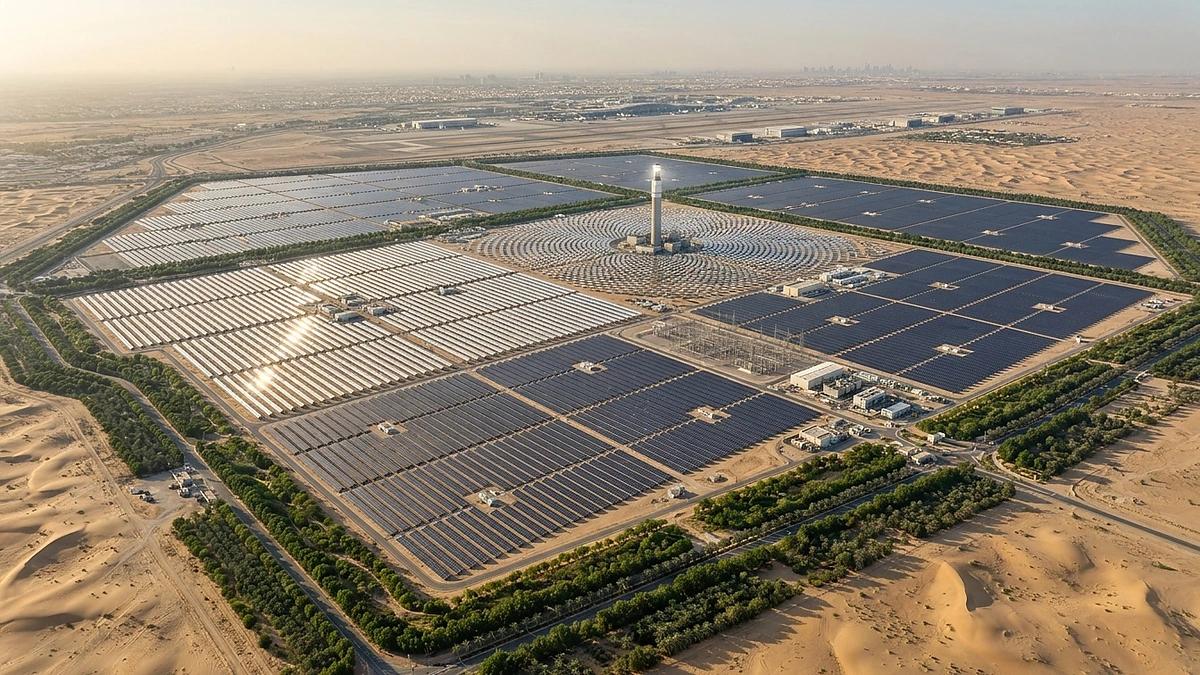
The strategic value is in diversification and resilience. Renewable projects drive demand for grid connections, utility-scale land parcels, energy-efficient buildings and logistics hubs that store and move equipment. For an economy that has grown on property and services, renewables provide both construction-phase activity and ongoing operational activity that can stabilise revenue streams across cycles.
The key nuance is timing and integration. Investors should assess how quickly projects move from planning to operation and how the new energy infrastructure coordinates with urban planning. Where renewable facilities cluster, they create positive spillovers; where they are isolated, they may require extra public investment to unlock property value.
What does Dubai renewable energy mean for real estate investors?
Renewable energy influences investor returns by shifting demand toward assets that support clean energy production and efficient consumption, such as industrial land, logistics, data centres and energy-smart office buildings. Investors should view renewables as an element that alters long-run cash flows and occupier behaviour.
The implications vary by strategy. Core landlord investors may see stable, long-term tenants in energy service companies and operators of battery storage or microgrids. Opportunistic buyers may target land near planned energy infrastructure. For residential exposure, areas with modern energy systems and lower operating costs can see different tenant preferences as occupiers prioritise energy efficiency and resilience.
Risk allocation matters. Investors must judge how policy, grid upgrades and permitting influence project delivery and occupier take-up. Where the public sector leads planning, private investors can benefit from clearer pipelines. Where projects depend on nascent technologies, investors should build in operational flexibility and consider energy performance when modelling future rents and vacancy.
| Strategy | Typical target assets | Investor consideration |
|---|---|---|
| Core income | Energy-efficient offices, long-lease industrial | Tenant credit and long-term cash stability |
| Value-add | Retrofits, energy upgrades, mixed-use conversions | Capex planning and short-term repositioning |
| Opportunistic | Land for utility-scale projects, specialist logistics | Planning risk and permitting timelines |
"Renewables change the fundamentals that underpin demand for industrial and commercial assets, and they make energy strategy part of due diligence."
, Binayah Research Team
How are developers and occupiers responding to Dubai renewable energy?
Developers and occupiers are adapting by embedding energy efficiency and future-proofing in project design, and by exploring new asset types that support renewable deployment. This includes integrating rooftop and façade solar readiness, higher insulation standards and grid connectivity options for large sites.
Occupiers are increasingly demanding buildings that reduce operating costs and support corporate sustainability goals. Logistics users and data centre operators favour sites with reliable power and potential for co-located renewable generation. Developers respond by offering flexible power arrangements and by designing buildings that can accept on-site generation or battery storage in the future.
The response is uneven across the market. Where tenant demand and policy signals are clear, developers move faster. Where demand is less certain, upgrades are incremental. Investors should assess whether a developer's sustainability measures are substantive operational improvements or marketing features, and prioritise assets with measurable energy performance.
- Design shifts: Rooftop and façade solar readiness
- Occupier demand: Preference for lower operating costs
- Asset types: Logistics and industrial gain strategic value
What risks and timelines should investors consider with Dubai renewable energy?
The main risks are policy execution, grid readiness and technology adoption timelines, which affect when and how renewable projects translate into property demand. Investors should factor these implementation risks into valuations and stress-test assumptions about occupier uptake and infrastructure delivery.
Timelines vary by project type and approvals. Utility-scale projects require grid upgrades and land assembly, while distributed generation and efficiency retrofits can move faster but have different revenue profiles. Investors must watch permitting processes, interconnection queue times and municipal planning priorities that determine how quickly projects shift local demand for land and buildings.
A practical approach is to map holdings against planned infrastructure and to model alternate scenarios for delivery speed. Where projects are pipeline-backed with coordinated public investment, the path to demand is clearer. Where projects depend on experimental technologies or fragmented approvals, expect greater uncertainty and allow for longer absorption periods.
Key Insight
Investors should stress-test asset valuations for slower policy execution and delayed grid upgrades. Build contingency in capex and allow longer leasing timelines where infrastructure delivery is uncertain.
- Policy risk: Execution and permitting
- Infrastructure risk: Grid and interconnection readiness
- Technology risk: Pace of adoption and operational maturity
Dubai's pivot to renewable energy is changing the economic backdrop that has long supported real estate and services. The practical effect is a reweighting of demand toward energy-ready industrial, logistics and resilient commercial assets, and a need for investors to model policy and infrastructure delivery when valuing property in the emirate.
Binayah Editorial
Property Market Analyst
Our editorial team researches Dubai's real estate market, tracking recorded sales, developer launches, and investment trends to keep buyers and investors informed.
Ready to Invest in Dubai?
Speak with our analysts about the best opportunities in today's market, free consultation.