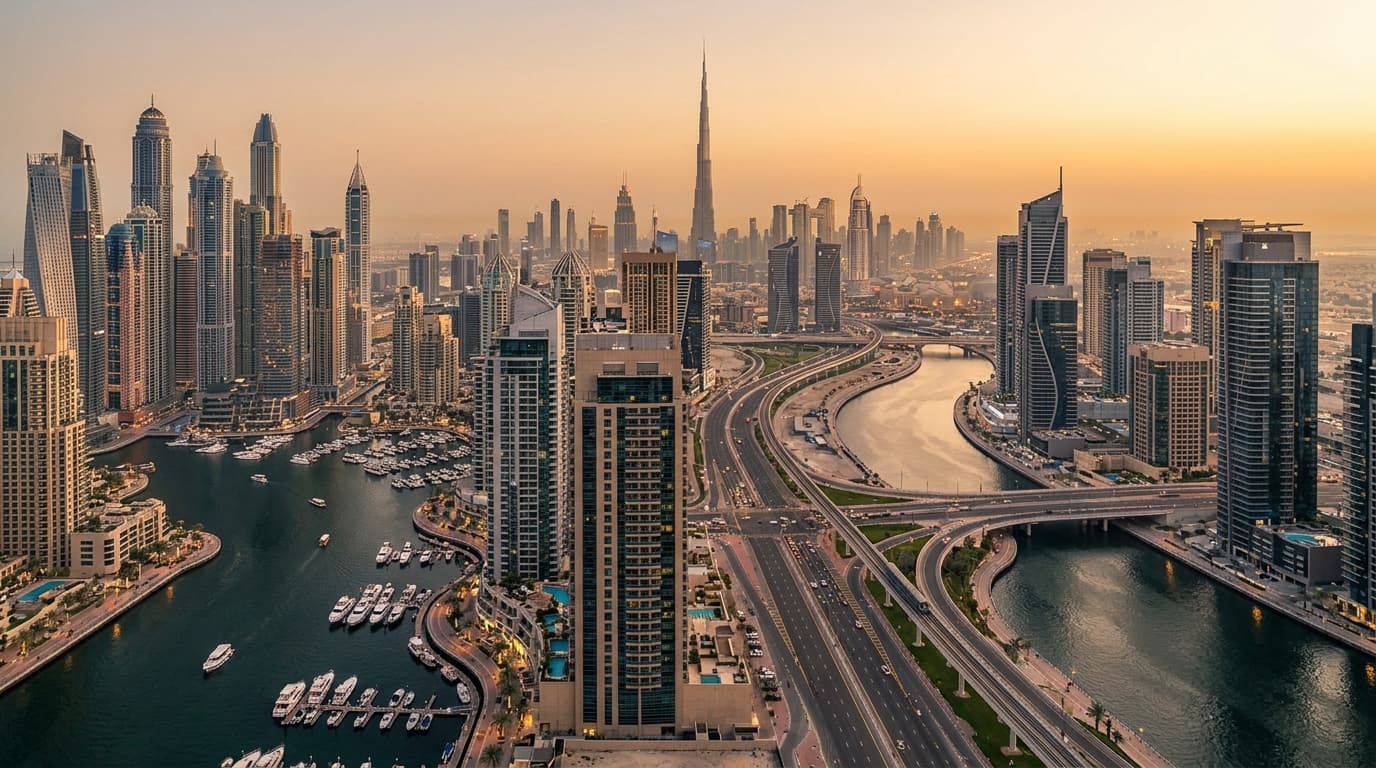
Dubai’s real estate market offers a rare blend of investor-friendly regulation, strong infrastructure, and global demand. Whether you’re targeting income-generating apartments or land-banked villas, the key to consistent performance is a clear strategy aligned with the city’s fast-evolving sub-markets.
This guide breaks down how to invest in Dubai property the right way—what to buy, where, how to finance, the exact transfer process, the fees you’ll pay, and the common mistakes to avoid—so you can act confidently and protect your returns.
Why Dubai, Why Now
Dubai combines zero personal income tax, world-class infrastructure, and broad freehold ownership zones that welcome international capital. The market is transparent by regional standards, with a digital title system, escrow-backed off-plan sales, and clear fee schedules. Rental demand is underpinned by population growth, business relocations, and a thriving tourism/short-stay ecosystem.
Typical investor outcomes are driven by asset type and location: apartments in core urban districts often deliver higher gross yields, while villas and townhouses may offer stronger capital preservation and lifestyle utility. Price cycles are influenced by global liquidity, oil-linked sentiment, and new supply deliveries—plan your entry and exit around these drivers rather than headlines.
- Freehold property open to non-UAE nationals in designated areas
- Digital title deeds issued by Dubai Land Department (DLD)
- Active leasing markets across long-term and short-stay segments
Define Your Investment Strategy
Start with the outcome you want. Are you optimizing for income, appreciation, diversification, or personal use with rental upside? Your answer determines asset class, community, and financing.
- Income-led: Urban apartments near business and leisure hubs; furnish for long-let or short-stay depending on building rules.
- Appreciation-led: Master-planned phases from tier-1 developers (Emaar, Dubai Properties, Meraas, Sobha, DAMAC) with strong handover pipelines and infrastructure upgrades.
- Balanced: Townhouses and mid-rise apartments in growth corridors (e.g., JVC, Dubai Hills Estate fringes) with improving amenity density.
- Lifestyle-plus-yield: Branded residences, waterfront units, or golf communities that can be rented seasonally.
Indicative ranges only, not guarantees: apartments often show gross yields around the mid-to-high single digits, while villas/townhouses typically run lower on yield but can outperform in tight supply phases.
- Match holding period to asset type (shorter for rental apartments, longer for development-phase communities)
- Stress-test rent and service charges to estimate net yield
- Have a clear exit thesis: resale to end-users, bulk disposal, or refinance
Freehold vs Leasehold and Ownership Basics
Dubai permits foreign nationals to own freehold property in designated areas across the emirate. Freehold confers full ownership of the unit and a share in the common areas where applicable. Leasehold (less common for new launches) typically grants long-term rights (e.g., 99 years) but not the land.
Ownership can be in an individual’s name, jointly, or via a UAE entity. Many investors buy personally for simplicity; some use corporate structures for estate planning or operational reasons. If you plan short-stay operations, check the building community rules and licensing requirements before you commit.
All-In Costs: What You’ll Actually Pay
Budget for more than the headline price. Your cash outlay includes government fees, advisory costs, and setup expenses.
- DLD transfer fee: 4% of the purchase price (payable on secondary and usually on off-plan at registration)
- Agency commission: commonly around 2% of the purchase price (plus VAT), negotiable and indicative
- Trustee office/registration fees: typically a few thousand dirhams depending on property value and transaction type
- Mortgage registration fee (if financed): 0.25% of the loan amount, plus administrative charges
- Developer NOC fee (secondary sales): generally a few thousand dirhams, varies by developer
- Service charges: paid annually; apartments often fall within an indicative AED 10–30 per sq.ft. range, villas/townhouses can be lower on a per sq.ft. basis but vary by community
- Utilities setup and deposits: DEWA and cooling deposits/activation fees apply
For off-plan, expect a payment schedule (e.g., construction-linked or milestone-based) and developer registration charges (Oqood/registration) in addition to the DLD fee.
- Model both acquisition and running costs to estimate true net yield
- Confirm HOA/community rules for short-stay or pets if relevant
Off-Plan vs Ready: Which Suits Your Goals?
Both paths can work—your horizon and risk tolerance decide. Off-plan offers staged payments and entry at today’s prices for tomorrow’s product; ready units deliver immediate rent and visibility on actual finishes.
| Factor | Off-Plan | Ready/Secondary |
|---|---|---|
| Cash Flow | No rent until handover; staged payments | Immediate rental income post-transfer |
| Price Discovery | Launch/early-phase pricing; potential premiums on completion | Transparent comps; negotiate on condition and urgency |
| Risk | Construction/hand-over timing; market shifts during build | Lower development risk; building/maintenance risk visible |
| Financing | Lower LTV during construction; bank approvals vary | Established mortgage options; valuation-driven |
| Customization | Early selection of layouts/views; new amenities | Limited; what-you-see-is-what-you-get |
Mitigate risk by focusing on reputable developers, escrow-compliant projects, and communities with proven demand drivers.
Financing and Mortgage Essentials
Dubai’s mortgage market is competitive. For resident and non-resident buyers, banks typically lend against completed property valuations, with lower maximum LTVs for non-residents and luxury price bands. As a broad reference (verify with your lender): first-home LTVs for expatriates can be up to around 80% for mid-priced completed properties, stepping down for higher ticket sizes; off-plan financing is usually more conservative and may be limited until completion.
Key points:
- Get a pre-approval before shopping; it sets your ceiling and speeds closing.
- Expect mortgage registration at DLD of 0.25% of loan amount plus admin charges.
- Rate types: fixed (1–5 years common) then reprice to a variable benchmark; compare total cost of credit, not just the headline rate.
- Early settlement and partial prepayment fees apply—factor them into exit planning.
- Banks assess income, liabilities, and property valuation; non-resident documentation requirements can be higher
- Account for currency risk if your income is not in AED or USD-pegged
Step-by-Step Purchase Process
1) Strategy and Budget: Define goals, finance plan, and target communities.
2) Shortlist and Due Diligence: Inspect units (or view show apartments/master plans for off-plan), pull recent comparable sales, and review service charge estimates and building rules.
3) Offer and MOU (Form F): Agree price, inclusions, and timelines; execute the RERA Memorandum of Understanding (Form F) for secondary sales. For off-plan, sign the developer’s Sales & Purchase Agreement (SPA).
4) Deposit: Typically a 10% security cheque in secondary transactions held per agreed terms. For off-plan, follow the developer payment schedule to the project escrow.
5) NOC and Bank Steps: For secondary, obtain the developer NOC; if mortgaged, coordinate valuation, final offer letter, and bank settlement/clearance (including seller’s mortgage if applicable).
6) Transfer at Registration Trustee: Attend the DLD-authorised trustee office with IDs, manager’s cheques/bank instruments, and approvals. Pay the 4% DLD transfer fee and applicable trustee/registration fees. Title deed (digital) is issued post-transfer.
7) Handover/Move-In: For ready, arrange utilities and snag if needed. For off-plan, complete final payments, snagging, and collect keys upon completion.
- Use RERA standard forms (A, B, F) in secondary transactions
- Escrow accounts are mandatory for compliant off-plan projects
Underwriting ROI: What to Check Before You Buy
Treat each asset like a business. Build a base case and stress case using conservative rents and realistic service charges.
- Rent comps: Use at least three comparable leases in the past 3–6 months; adjust for floor, view, and furnishing.
- Vacancy and leasing costs: Include marketing, leasing fees, and expected downtime.
- Service charges and sinking fund: Verify latest invoices; older towers can carry higher OPEX.
- Capex buffer: Budget for appliances, minor refurbishments, and post-handover fixes.
- Yield math: Model gross vs net; apartments often show higher gross yields than villas, but net can compress with amenities and chiller-inclusive buildings.
- Short-stay option: Only if building and licensing allow; factor operator fees, linen, utilities, and tourism dirham where applicable.
Regulations, Taxes, and Visas
Dubai’s framework is straightforward for private investors. There is no recurring municipal property tax on freehold property in Dubai, and rental income at the individual level is not subject to local personal income tax. Government fees apply at purchase/registration, and VAT can apply to certain services and commercial property transactions.
Property-linked residency: The UAE Golden Visa is available via property investment with a qualifying property value of at least AED 2 million, subject to prevailing regulations. Terms evolve (e.g., eligible asset types, financing conditions, and documentation), so confirm current criteria and processing steps before planning residency around a purchase.
- Keep your Ejari (tenancy registration) current for long-let units
- Short-stay operations require permits and adherence to building/DM rules
Leasing and Asset Management
Decide early between long-let and short-stay. Long-let provides predictable occupancy and lower operational complexity; short-stay can lift gross income but demands active management, higher wear-and-tear, and operator oversight.
Best practices:
- Professional photos, neutral interiors, and durable furnishings
- Clear tenant criteria and documented handover condition
- Preventive maintenance schedule; track warranties and appliance ages
- Annual rent reviews within RERA guidelines and index frameworks
- Insurance: consider landlord contents and liability cover
Risk Management and Exit Strategies
Mitigate concentration by diversifying across districts and asset types. Stagger handover years if building an off-plan portfolio. Use conservative LTVs and maintain liquidity for market swings.
Plan exits around catalysts: infrastructure completions, building stabilisation post-handover, or peak seasonal demand. Alternatives to sale include refinancing to release equity or converting between long-let and short-stay depending on cycle conditions.
Common Mistakes to Avoid
- Chasing launch hype. Buying without comps, due diligence, or developer track record can compromise outcomes.
- Ignoring total cost of ownership. Service charges, vacancy, and maintenance materially impact net yield.
- Overleveraging. High LTVs reduce resilience to rate resets, valuation changes, or rent softness.
- Assuming all buildings allow short-stay. Community rules and permits can restrict operations.
- Skipping legal process details. Missing a developer NOC, escrow verification, or proper RERA forms risks delays and disputes.
Conclusion
Dubai rewards disciplined investors who match strategy to sub-market realities, buy quality assets with clear demand drivers, and respect the process. Build your plan, underwrite conservatively, know your fees—especially the 4% DLD transfer—and execute with precision. Whether you favour income today or appreciation tomorrow, a well-chosen Dubai property can be a durable anchor in a global portfolio.