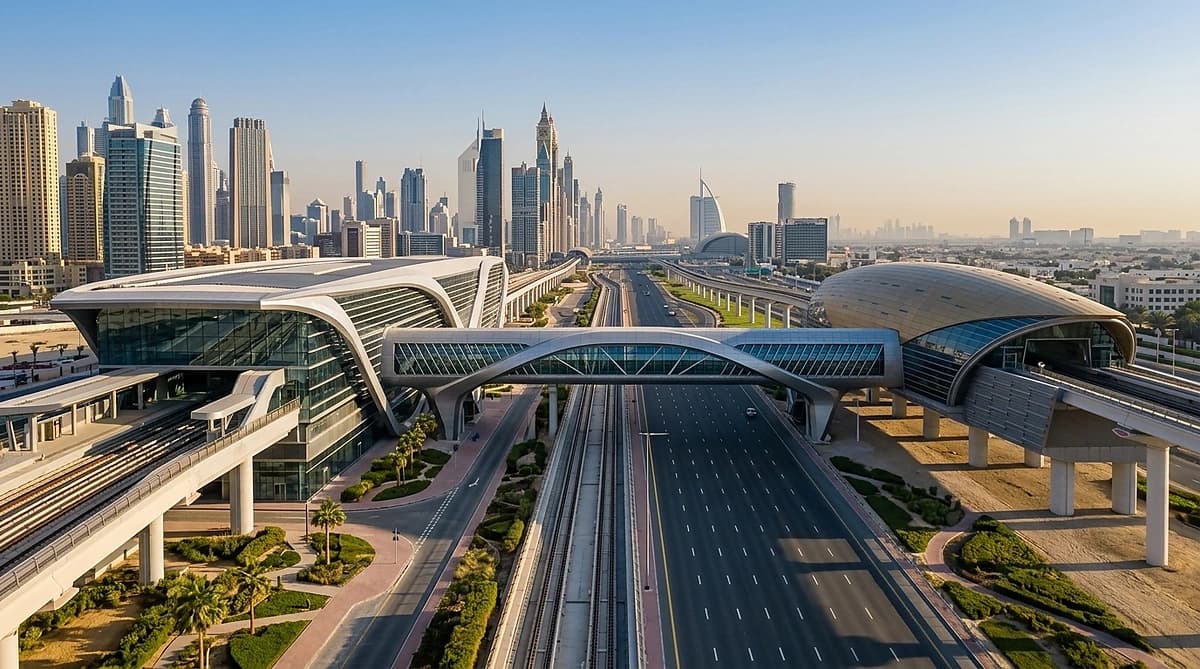
Etihad Rail Metro bridge: Dubai pedestrian transfer link
Etihad Rail Metro bridge now provides a direct pedestrian connection between Dubai’s railway and Metro, easing transfers for commuters and visitors.
The new pedestrian bridge links Etihad Rail and Dubai Metro platforms and includes moving walkways to help people walk quickly between services. The source notes the bridge removes the need for a taxi for many transfers, which shortens door-to-door journeys and makes multi-modal commutes more practical for daily travellers.
This change matters to property buyers, renters and investors because shorter, simpler commutes tend to widen the effective catchment area for homes and offices. For homeowners and renters, better public transport access can mean lower monthly transport costs and improved convenience. For investors, easier transfers can increase neighbourhood appeal without developers needing to change building design.
What is the Etihad Rail Metro bridge and where is it located?
What is the Etihad Rail Metro bridge and where is it located? Key Data
Feature
Pedestrian bridge connecting Etihad Rail and Dubai Metro
Moving walkways
Included
Transfer mode
Reduced need for taxis
Purpose
Multi-modal interchange
The Etihad Rail Metro bridge is a new pedestrian crossing that directly connects Etihad Rail with a Dubai Metro station, allowing interchanges without a taxi. The source describes it as a physical link between the two rail systems and highlights moving walkways that assist pedestrians along the route.
The bridge is designed for foot traffic and includes moving walkways to reduce travel time on the link, according to the source. It creates a continuous pedestrian path between Etihad Rail and the Metro, so commuters can transfer across modes more smoothly. The bridge therefore functions as a multi-modal interchange rather than a standalone station improvement.
For travellers the immediate benefit is clearer: fewer last-mile taxi trips and a more predictable transfer environment. For the city, the bridge helps knit Etihad Rail into Dubai’s existing Metro network, supporting integrated travel patterns and reducing pressure on road-based transfers. The source does not name the specific stations or provide opening dates, so local signage and operator announcements will confirm exact station connections.
How will the Etihad Rail Metro bridge affect property demand and commuting in Dubai?
The Etihad Rail Metro bridge is likely to improve commuting convenience and broaden catchment areas for nearby properties by making multi-modal transfers simpler. The source emphasises the reduction in the need for taxi transfers, which implies faster, cheaper commutes for people living near the linked stations.
Easier transfers typically encourage longer commutes that feel acceptable and can change buyer and renter behaviour. People value predictable door-to-door travel times more than raw distance; a direct rail-to-Metro link with moving walkways reduces variability caused by taxi waits and traffic, improving perceived accessibility. That can make neighbourhoods within a comfortable walk or short Metro ride more attractive to buyers and renters who previously avoided multi-leg journeys.
The source does not provide transaction data, prices or yield figures, so the market impact will depend on local supply and demand. Developers and agents should monitor listing interest and rental enquiries in adjacent communities after the bridge opens. Operators and city planners should track passenger flows to quantify how the link shifts modal share from taxis to rail.
| Group | Primary benefit | Practical outcome |
|---|---|---|
| Commuters | Faster transfers | Lower taxi use and shorter journeys |
| Renters | Improved accessibility | Greater neighbourhood choice |
| Investors | Higher appeal | Potential rental demand uplift |
| Developers | Stronger selling point | Marketing leverage for new projects |
"Integrated links between rail systems raise the effective accessibility of surrounding neighbourhoods and change travel behaviour, even without changes to housing stock."
, Binayah Research Team
What are the implications for developers, investors and renters?
What are the implications for developers, investors and renters? Key Data
Developer impact
Marketing and access advantage
Investor impact
Potential rental demand uplift
Renter benefit
Lower reliance on taxis
Data gap
No ridership or price figures in source
Developers, investors and renters should expect practical benefits from the Etihad Rail Metro bridge in the form of improved connectivity and appeal. The source highlights that the bridge reduces the need for taxis between rail services, which can lower transport friction for residents and tenants near the link.
For developers, the bridge is a marketing advantage that can be referenced in sales literature and site plans because it extends convenient access without adding building-level infrastructure. For investors, improved connectivity tends to support steady rental demand as commuters favour properties that minimise daily travel complexity. For renters, the main benefit is convenience: fewer transfers that depend on road conditions and taxi availability, replaced by predictable walking and rail transfers.
There are caveats: the source does not quantify ridership changes or the extent of demand uplift, so financial effects will vary by location, service frequency and local supply. Stakeholders should watch early occupancy and rental enquiry metrics, then compare them with pre-bridge baselines to measure real impact.
- Improved last-mile connectivity reduces transport friction
- Properties near linked stations gain practical appeal
- Developers can highlight multi-modal access in listings
What should residents and investors watch next for the Etihad Rail Metro bridge?
What should residents and investors watch next for the Etihad Rail Metro bridge? Key Data
Action
Check operator announcements for station names
Monitor
Passenger flows and enquiry levels
Timing
Source does not state opening date
Risk
Infrastructure influence varies by supply and cycle
Residents and investors should watch official station maps and operator announcements to confirm exact station names, pedestrian routing and opening details because the source does not list those specifics. The source confirms the link and moving walkways but leaves timing and precise station identities to subsequent announcements.
After opening, monitor passenger flows and local interest metrics such as rental enquiries, viewings and neighbourhood listing activity to see early market signals. Transport operators and municipal reports will also publish performance indicators; these will show whether the bridge shifts passengers from taxis to rail as the source anticipates. Tracking these indicators helps convert a connectivity improvement into an evidence-based investment judgement.
Be mindful that infrastructure alone does not guarantee immediate price changes. Local supply, project quality and broader market cycles influence outcomes. Use observed changes in commuter behaviour and property demand data after the bridge opens before making valuation assumptions.
Key Insight
Track usage data and local market indicators for 3 to 6 months after the bridge opens to see whether commuting patterns and rental demand shift materially.
A new pedestrian bridge now links Etihad Rail and Dubai Metro and includes moving walkways to reduce the need for taxi transfers. The source frames this as a practical connectivity improvement that should ease multi-modal commutes and broaden the appeal of nearby neighbourhoods, while local market data will be needed to confirm any measurable uplift in demand.
Binayah Editorial
Property Market Analyst
Our editorial team researches Dubai's real estate market, tracking DLD data, developer launches, and investment trends to keep buyers and investors informed.
Ready to Invest in Dubai?
Speak with our analysts about the best opportunities in today's market, free consultation.
Related Articles
 Market Report 7 min read
Oct 14, 2026
Dubai tech property market: impact on prices and investors
 Market Report 8 min read
Oct 13, 2026
World Green Building Week: Emirates Green Building Council (EGBC) BuildItReady
 Market Report 8 min read
Oct 13, 2026