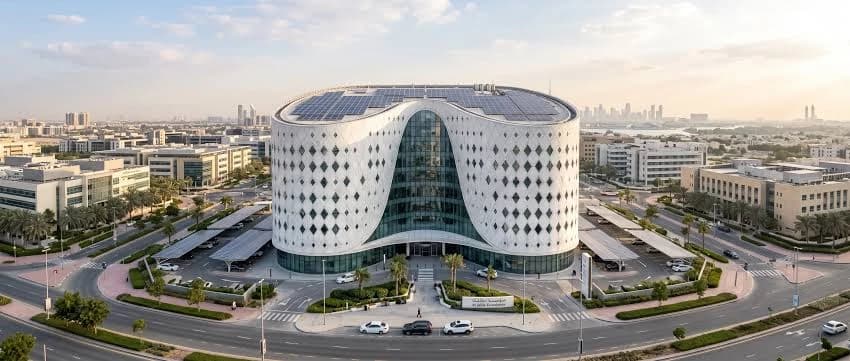
A Healthcare Philanthropy Goes Green
On 29 October 2026, the Al Jalila Foundation announced that its Dubai building had received LEED Gold certification from the US Green Building Council (USGBC). The rating recognises the building’s work to improve energy efficiency, manage resources responsibly and reduce its environmental impact.
The certification was awarded under the LEED Existing Buildings: Operations and Maintenance (EBOM) system. That detail matters. Most green building headlines celebrate new towers. This one is about a building that is already operating, and about how well it performs day to day.
Let’s understand what LEED Gold means, how the building earned it, the solar partnership behind it, and how it fits Dubai’s wider push toward sustainable buildings and the UAE’s Net Zero 2050 goal.
Quick facts
| Item | Detail |
| Building owner | Al Jalila Foundation, the philanthropic arm of Dubai Health |
| Certification | LEED Gold, awarded by the US Green Building Council |
| Rating system | LEED Existing Buildings: Operations and Maintenance (EBOM) |
| Assessment period | 12 months of operational performance |
| Water use in the period | Approximately 3.16 million gallons, meeting the benchmark required for Gold |
| Solar partner | Positive Zero (through its solar arm, SirajPower) |
| Announced | 29 October 2026 |
What Is LEED Certification?
LEED stands for Leadership in Energy and Environmental Design. It is the most widely used green building rating system in the world and is administered by the USGBC. Projects earn points for meeting sustainability requirements, and the total decides the certification level.
LEED certification levels
| Level | Points | Position |
| Certified | 40–49 | Entry level |
| Silver | 50–59 | Second level |
| Gold | 60–79 | Third level |
| Platinum | 80+ | Highest level |
LEED Gold therefore sits one step below the top tier. It signals strong, verified performance rather than a basic pass.
What is LEED EBOM (Operations and Maintenance)?
LEED O+M, often still called EBOM, is the rating system for existing buildings. It focuses on whole buildings and interior spaces that are fully operational and have been occupied for at least one year. Instead of judging design intent, it measures what the building actually does.
Under the current LEED v4.1 version, performance is tracked across areas including energy, water, waste, transportation and human experience such as indoor air quality and occupant satisfaction. Projects must also meet minimum performance levels across the core categories, which is why a Gold rating reflects balanced results rather than a single strong area.
Note: the announcements describe the system as LEED EBOM and do not state whether v4 or v4.1 was used, so this guide describes the system in general terms.
How the Al Jalila Foundation Building Earned LEED Gold
The certification followed a 12-month assessment of the building’s operational performance. The evaluation looked at energy and water consumption, waste management and indoor environmental quality.
1. Energy efficiency and clean power
- • Rooftop and carport solar: photovoltaic panels installed across the foundation’s buildings and parking areas.
- • LED lighting: energy-efficient fixtures connected to central controls.
- • Building management systems: monitoring and control of building systems.
- • District cooling: centralised cooling that cuts on-site cooling plant demand.
2. Water management
Water consumption during the assessment period totalled approximately 3.16 million gallons, which met the LEED benchmark required for Gold. Permanently installed meters tracked drinking water use each month, so the team could spot changes and manage consumption.
3. Waste management and recycling
• Dedicated storage areas for paper, cardboard, glass, plastic and metal.
• Separate storage for batteries and lamps so they are handled safely.
• Tracking of the waste generated and the amount diverted from conventional disposal.
4. Indoor environmental quality
• An occupant satisfaction survey.
• Tests measuring carbon dioxide and total volatile organic compounds (TVOCs).
• Documented green cleaning procedures, supported by checklists and regular floor cleaning.
The Solar Partnership with Positive Zero
The solar story began before the certification. In February 2024, Al Jalila Foundation and Positive Zero inaugurated a rooftop and carport solar project at the foundation’s premises.
• Structure: the project runs on a 20-year solar lease with SirajPower, Positive Zero’s distributed solar arm.
• No upfront cost: Positive Zero provided the financing, construction, long-term operation and proactive maintenance of the systems.
• Emissions impact: the project was reported to cut carbon emissions by 3,121 metric tons, comparable to planting about 51,600 tree seedlings.
In mid-2024 the two organisations went further with an MoU. Positive Zero agreed to assess current operations, improve energy efficiency and optimise energy use through a cooling-as-a-service model. Positive Zero CEO David Auriau said the first project showed that distributed solar without upfront costs can quickly deliver savings and emission reductions.
At the certificate presentation, Positive Zero chairman Mohammed Abdulghaffar Hussain handed the award to Dr Amer Al Zarooni, CEO of Al Jalila Foundation, during a visit by a Positive Zero delegation.
About Positive Zero
• Launched in 2022 by Creek Capital as an integrated energy transition platform, announced at COP27.
• Brings together SirajPower (distributed solar), Taka Solutions (energy efficiency) and Hypr Energy (clean electric mobility).
• Backed by an investment of up to USD 400 million from BlackRock in 2023, and a financing facility of up to USD 375 million announced in 2026.
• Reports more than 500 MW of distributed solar capacity in the GCC and more than 100 million kWh of energy saved for clients.
• Signed 43 new distributed solar projects across the GCC in 2024, and counts clients such as ADNEC Group, LuLu and AW Rostamani Group.
What Leaders Said
Dr Amer Al Zarooni said the certification reflects Dubai Health’s commitment to international standards in environmental sustainability and operational performance. He added that the foundation will keep adopting solutions that reduce energy consumption, improve resource use and minimise its environmental footprint, while providing a healthy and inspiring workplace.
David Auriau said the result shows the benefit of pairing on-site solar generation with energy-saving measures and smart building controls. He noted that integrated energy solutions can deliver measurable improvements in building performance and support the UAE’s sustainability ambitions.
About Al Jalila Foundation and Dubai Health
Al Jalila Foundation is a healthcare philanthropic organisation that leads the giving mission of Dubai Health. It was established in 2013 by His Highness Sheikh Mohammed bin Rashid Al Maktoum, Vice President and Prime Minister of the UAE and Ruler of Dubai, and is named after his youngest daughter, Sheikha Al Jalila. It is a member of the Mohammed Bin Rashid Al Maktoum Global Initiatives.
Dubai Health is the emirate’s first integrated academic health system. It includes six hospitals, 26 ambulatory health centres, 20 medical fitness centres, the Mohammed Bin Rashid University of Medicine and Health Sciences (MBRU) and the foundation. Its vision is to advance health for humanity through care, learning, discovery and giving.
Recent impact
• In 2025, donor contributions reached AED 435 million, supporting 13 major healthcare initiatives and 9,737 people across the UAE.
• The foundation awarded 44 scholarships and 24 research grants in 2025.
• On its 10th anniversary it reported more than 8,000 patients assisted through its programmes.
• Dubai Health launched The Child Fund by Al Jalila Foundation, an annual AED 50 million fund to treat 3,000 children a year.
Why It Matters: Dubai’s Green Building Landscape
Net Zero 2050 and existing buildings
The UAE was the first country in the Middle East to set a net zero emissions target for 2050. Buildings are central to that goal. Industry analysis notes that Dubai’s Net Zero 2050 plans include retrofitting 30,000 existing buildings for energy efficiency, because the footprint of existing stock outweighs new construction for decades.
That is why an operational certification such as LEED EBOM is significant. Most of the buildings that will stand in 2050 already exist.
Al Sa’fat and LEED
Dubai Municipality’s Al Sa’fat system became the emirate’s green building framework in 2016 and replaced the earlier Dubai Green Building Regulations and Specifications from October 2020. It is mandatory for new building permits, with Silver as the baseline. LEED sits alongside it as a voluntary international benchmark that investors, multinational tenants and ESG reporters recognise.
| Framework | Scope | Nature |
| Al Sa’fat (Dubai Municipality) | Dubai building permits, rated Bronze to Platinum tiers | Mandatory for new projects |
| Estidama Pearl (Abu Dhabi) | Abu Dhabi buildings | Mandatory in Abu Dhabi |
| LEED (USGBC) | Global; new and existing buildings | Voluntary, internationally recognised |
Healthcare is joining the green movement
The Al Jalila Foundation building is part of a broader pattern. Fujairah Hospital, under Emirates Health Services, received LEED Gold in March 2025, and Dubai’s Hamdan Bin Rashid Cancer Hospital, a project led by the Al Jalila Foundation, has been reported as achieving LEED Gold and meeting WELL Building Standard criteria. Healthcare facilities run around the clock and use large amounts of energy, so operational efficiency has an outsized effect.
Key Takeaways for Property Owners and Facility Managers
- Existing buildings can be certified. You do not need new construction to earn a respected green rating.
- Measurement comes first. Sub-metering and monitoring make savings visible and verifiable.
- Solar plus smart controls compounds gains. On-site generation, LED lighting and building management systems work best together.
- Financing models remove barriers. A lease or as-a-service model, as used here, lets owners adopt solar without upfront capital.
- Occupant health counts. Air quality testing, satisfaction surveys and green cleaning feed the rating.
- Partnerships speed delivery. An energy transition specialist can handle design, financing, operation and maintenance.
Frequently Asked Questions
What is LEED Gold certification?
It is the third tier of the USGBC’s LEED rating scale, awarded to projects scoring 60 to 79 points for strong verified environmental performance.
Which LEED rating system was used for the Al Jalila Foundation building?
LEED Existing Buildings: Operations and Maintenance (EBOM), the system for buildings that are already operating.
Why did the building earn LEED Gold?
It was recognised for energy efficiency measures, water monitoring, waste management and indoor environmental quality over a 12-month assessment.
Who partnered on the solar energy project?
Al Jalila Foundation partnered with Positive Zero. Its solar arm, SirajPower, financed, built, operates and maintains the systems under a 20-year lease.
How much water did the building use?
Approximately 3.16 million gallons during the assessment period, which met the benchmark for Gold.
Is LEED mandatory in Dubai?
No. Al Sa’fat is the mandatory system for new buildings in Dubai. LEED is a voluntary international certification that many owners pursue alongside it.
What is Positive Zero?
A GCC energy transition platform that combines distributed solar, energy efficiency and clean mobility businesses.
Conclusion
The Al Jalila Foundation’s LEED Gold certification shows that measurable, operational sustainability is achievable in Dubai’s existing building stock. Solar generation, smart controls, careful metering, recycling and attention to indoor air all contributed. For owners weighing a green upgrade, it offers a practical template, and it supports the UAE’s wider sustainability goals.