Service charges are the single most underestimated cost in Dubai property ownership. First-time buyers often focus entirely on purchase price and DLD fees, then are surprised by an ongoing annual obligation that can run AED 8,000-80,000+ per year depending on property size and building. Unlike one-off transaction costs, service charges recur every year for as long as you hold the asset, and they tend to rise rather than fall. This guide gives you the framework to evaluate service charges before you buy, understand how they are regulated, and factor them correctly into your returns.
What Are Service Charges?
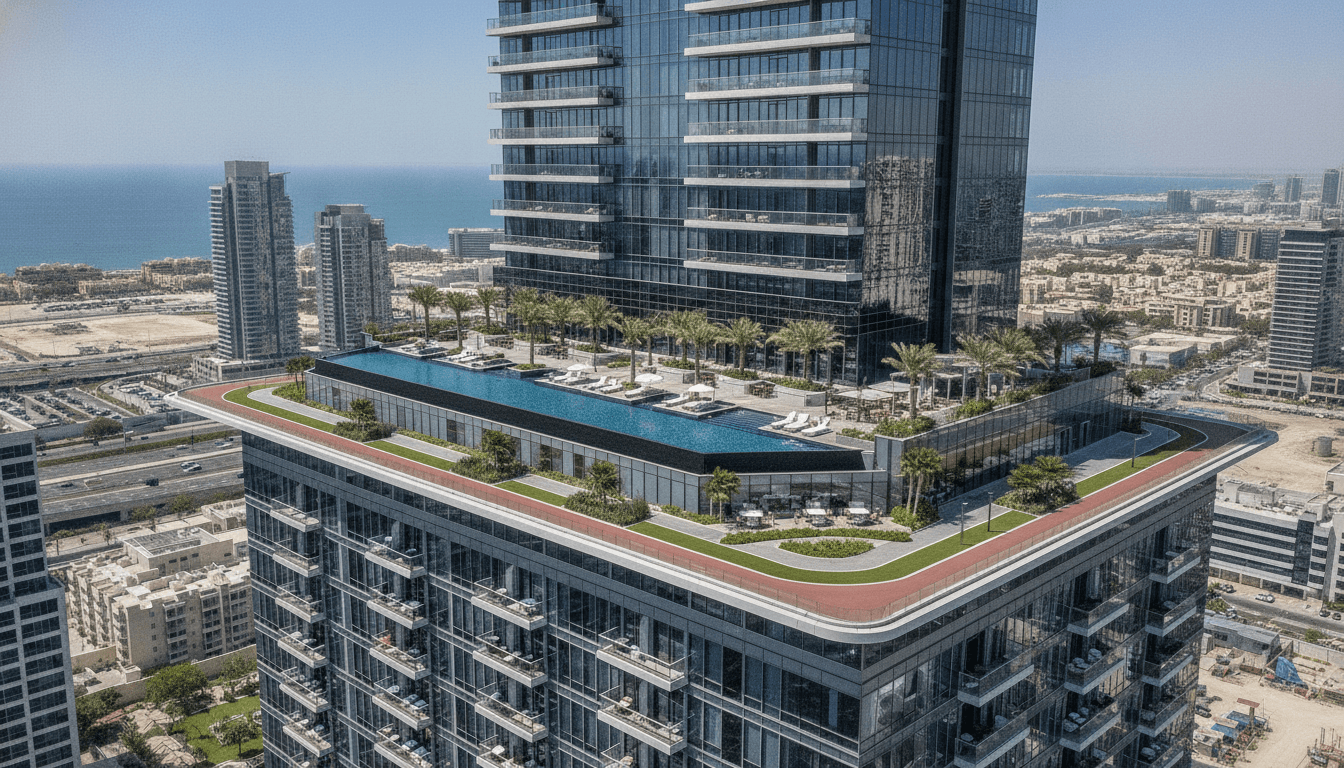
Service charges (also called "maintenance fees") are annual payments by property owners to their Owners Association (OA) or the master developer. They fund the upkeep of shared facilities: elevators, lobbies, pools, gyms, security, parking structures, landscaping, and common area utilities. In villa communities, they also cover road maintenance, community centres, and community management.
A well-run tower with reliable lifts, clean common areas, working amenities, and visible security holds its value and rental appeal, and the charge pays for that upkeep, shared proportionally among everyone who owns a unit.
Service charges are set annually by the OA or developer and can increase year-on-year. They are calculated per square foot of your unit's GFA (Gross Floor Area). Because the rate is applied to your area, two owners in the same building pay different totals depending on unit size, but at the same per-sqft rate.
How Are Service Charges Regulated and Collected?
RERA (Real Estate Regulatory Agency) introduced Service Charge Rate Indices in 2010 to provide a reference. RERA publishes annual benchmarks per community, the RERA Rate Calculator (available at dubailand.gov.ae) shows the approved rate for any registered building.
Regulation stops developers and OAs from setting charges arbitrarily. Every building's budget must be submitted to and approved by RERA before it can be levied on owners, so the rate you pay is an approved figure tied to a scrutinised budget rather than a number an OA invented.
Collection today runs through Mollak, the escrow-based system that governs how service charge money is invoiced, held, and released. Under Mollak, owner payments flow into a ring-fenced account rather than directly to the OA or a management company, and funds are only released against approved, audited expenditure. This protects owners: the money you pay can only be spent on your building's approved budget, with a transparent trail showing where it goes.
What Do Service Charges Fund?
Your annual charge is not a single lump for "maintenance", it splits across several categories that together keep the property running. Typical components include:
- Maintenance and repairs of common structures, systems, and equipment (lifts, HVAC, pumps, generators)
- Security including guards, access control, and CCTV
- Cleaning and landscaping of lobbies, corridors, gardens, and shared grounds
- Amenities such as pools, gyms, and shared recreational spaces
- Common area utilities including electricity and water for shared spaces
- Building insurance for the shared structure
- Management fees paid to the professional company running the OA
- The reserve (sinking) fund contribution for major periodic works
The exact split appears on the approved budget, one of the most useful documents a buyer can read before committing.
Service Charge Reserve Fund
In addition to the annual maintenance charge, most OAs maintain a Reserve Fund (also called a sinking fund) for major periodic expenses: elevator replacement, facade cleaning, major pump systems. The Reserve Fund contribution is typically included in your annual service charge invoice but shown separately. Reserve funds prevent special assessments (one-time levies) for large expenses.
A healthy reserve fund signals a well-managed building. When reserves are adequate, a major expense like replacing a bank of lifts is paid from money already set aside. When reserves are depleted, that same expense is recovered through a one-off special assessment charged to current owners, often unexpectedly and often substantial.
How Are the Rates Calculated?
Rates are expressed per square foot per year and vary widely by building type and location. This is why an apartment in a budget community and a signature Palm tower are not remotely comparable on a per-sqft basis.
Typical rates in 2026:
- Budget apartment buildings (JVC, Dubai South): AED 8-14/sqft/year
- Mid-market (Business Bay, Al Jaddaf, JLT): AED 12-18/sqft/year
- Premium (Marina, Downtown, DIFC): AED 16-28/sqft/year
- Ultra-premium (Palm Jumeirah signature towers, Bulgari): AED 25-50+/sqft/year
- Villa communities: AED 3-8/sqft of plot area/year
For a 1,000 sqft apartment in Business Bay at AED 15/sqft: AED 15,000/year.
For a 1,000 sqft apartment on Palm at AED 30/sqft: AED 30,000/year.
Why Do Charges Vary So Much?
The gap between a budget building and an ultra-premium tower comes down to what is being maintained. A building's per-sqft rate reflects the density and cost of its facilities and the standard of service expected. The main drivers are:
- Amenity load. Multiple pools, large gyms, concierge desks, valet, and landscaped podiums all cost money to run. A simple building with a single lift and no pool is far cheaper to maintain.
- Building age and complexity. Taller towers with more lifts, more sophisticated HVAC, and expensive facades cost more to service.
- Service standard. Premium communities staff more security, clean more often, and maintain higher finishes.
- Utility and insurance costs for large shared areas.
- Reserve fund contributions, which are larger where future major works will be expensive.
None of this means a high charge is bad or a low charge good. The charge should be judged against what it delivers and whether the building is properly maintained for the money.
Master Community Fees vs. Building Fees
In masterplan communities (Dubai Hills Estate, Arabian Ranches, Palm Jumeirah), you may pay two fees: (1) a building-level service charge for your tower's shared facilities, and (2) a master community fee to the master developer (Emaar, Nakheel, DAMAC) for the wider community (roads, parks, community pools). Both are annual. Master community fees are typically AED 3-6/sqft of unit GFA.
Buyers sometimes see only the building-level figure quoted and forget the master community layer, understating the true annual cost. Always confirm whether a quoted rate is the building charge alone or the combined obligation.
Who Pays, and the Impact on Net Yield
The owner pays service charges, not the tenant. This is the standard position across Dubai. Investors should factor service charges into their yield calculations. A gross yield of 7% on a AED 1.2M property might be AED 84,000/year rent, but after a AED 15,000 service charge and AED 5,000 in agent commission, the net yield is 5.3%.
This is the most important reason to take service charges seriously as an investor. The headline gross yield that dominates most listings ignores the recurring charge entirely, and because the owner absorbs the cost whether or not the unit is tenanted, charges hit hardest during void periods when there is no rent to offset them. Compare two properties net of service charges, otherwise a higher gross yield in a high-charge tower can quietly underperform a modest one in an efficient building.
Checking Service Charges Before You Buy
Always request the service charge statement for the past 2 years before purchasing any unit. Key things to verify:
- The annual rate per sqft and compare to RERA benchmarks
- Whether any arrears exist on the unit (unpaid service charges pass to the new owner in some circumstances)
- The OA reserve fund balance (a building with depleted reserves may levy a special assessment soon)
- Any pending major works (if a lift replacement is coming, a special levy may follow)
Binayah agents obtain this data during due diligence as a standard step.
Service Charges for Off-Plan Properties
Off-plan buyers should check the developer's indicative service charge rate. Developers are required to disclose the estimated service charge in the SPA (Sale and Purchase Agreement). Be aware that estimates can increase by the time the building opens, especially as operating costs become clearer.
Disputes and Non-Payment
Yes, service charges can be disputed. If your building's OA charges significantly above RERA's published rate without justification, you can file a complaint with RERA. RERA can audit the OA accounts and direct a charge reduction. In practice, disputes are uncommon but the mechanism exists.
Non-payment carries real consequences. Because charges are collected through the Mollak framework, unpaid amounts accumulate as arrears against the unit and OAs have formal routes to recover them, up to legal action and enforcement against the property. This is also why buyers must check for existing arrears, as unpaid service charges can pass to the new owner in some circumstances, meaning you could inherit someone else's debt.
Common Mistakes to Avoid
- Budgeting only for the purchase. Service charges are a permanent annual line item, not a closing cost.
- Quoting gross yield only. Always net-of-service-charges when comparing investment opportunities.
- Ignoring the master community fee in masterplan developments and understating the true annual cost.
- Skipping the reserve fund check. A depleted reserve is a warning sign of a looming special assessment.
- Trusting an off-plan estimate as final. Indicative rates can rise once the building is operating.
- Assuming the tenant pays. In Dubai, the owner carries the charge, tenanted or vacant.
The Bottom Line
Service charges are a real cost that can represent 1-3% of property value per year in premium locations. A penthouse buyer who ignores service charges may find their net rental yield is 2 percentage points lower than the gross headline number. Always net-of-service-charges when comparing investment opportunities.
Treated properly, service charges are not a nasty surprise but a knowable, regulated, and predictable part of ownership. Check the rate, read the budget, verify the reserve fund, confirm there are no arrears, and account for every layer of fee before you sign. Do that, and the annual charge becomes just another line in a well-run investment rather than the cost that erodes your return.