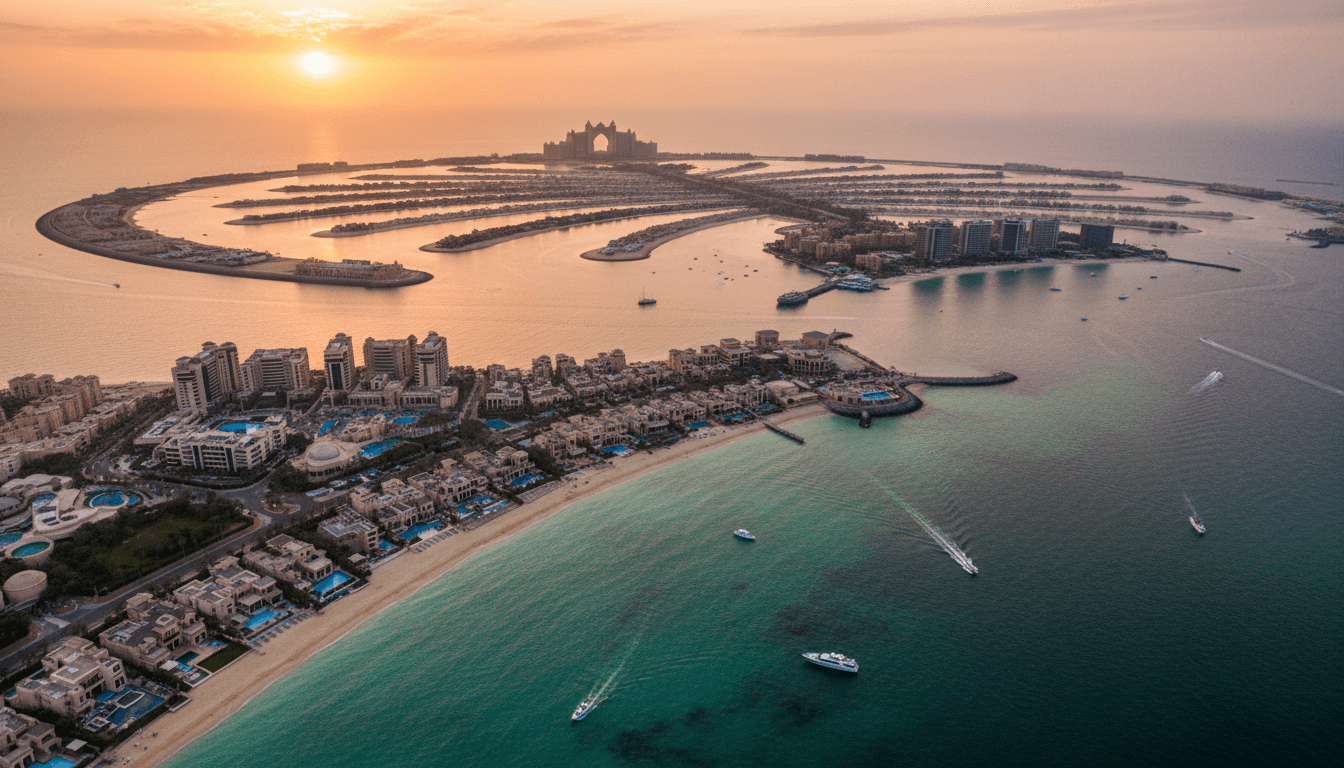
Palm Jumeirah at a Glance
Palm Jumeirah is Dubai's most recognisable address and one of the defining feats of modern engineering. Reclaimed from the Arabian Gulf by master developer Nakheel in the shape of a palm tree, the island is organised into three distinct parts: the trunk, which runs from the mainland out to sea and carries the island's spine of mid-rise apartment buildings, retail and hotels; the fronds, a series of gated residential branches lined with signature and garden villas that each open onto private beach; and the enclosing crescent, a breakwater that shelters the whole development and is home to the largest resorts and hotel-branded residences.
The result is a self-contained luxury enclave where nearly every home is either on the water or a short walk from it. Landmarks anchor daily life and weekend leisure alike: Nakheel Mall on the trunk, The Pointe and the boardwalk on the crescent, and the twin Atlantis resorts with their aquariums, waterpark and celebrated restaurants. Beach clubs, marina berths, five-star spas and fine dining are not amenities you travel to here — they are the neighbourhood. For a certain buyer, Palm Jumeirah is less a community than a lifestyle statement with a title deed attached.
The live data panel above this guide shows current price-per-square-foot, gross rental yield and recent transaction volumes for Palm Jumeirah, drawn directly from Dubai Land Department records. Treat those figures as the authoritative numbers; this guide focuses on the character, strategy and mechanics behind them.
Location and Connectivity
Palm Jumeirah sits off the coast between Dubai Marina and Jumeirah, midway along the city's prime coastal strip. Despite being an island, it is well tied into the mainland:
- A single connecting road links the trunk to Sheikh Zayed Road, Dubai's main arterial highway, placing Dubai Marina, JBR and Media City minutes away and putting Downtown Dubai and DIFC within a comfortable drive.
- The Palm Monorail runs the length of the trunk from the Gateway station at the mainland end out to Atlantis on the crescent, and connects toward the wider tram and metro network — a rare piece of dedicated island transit.
- Al Sufouh and the tram interchange sit just onshore, while both of Dubai's airports remain within a reasonable transfer for international owners and holiday guests.
The trade-off inherent in island living is real: everything funnels through the trunk, so peak-time traffic and event days at Atlantis or the beach clubs can slow movement on and off the Palm. For most residents this is a minor cost against the privacy, security and sense of arrival that the single controlled approach provides.
Who Palm Jumeirah Suits
Palm Jumeirah is an ultra-prime market, and the buyers it serves reflect that.
- Capital-preservation buyers treat a Palm home as a store of value — a trophy asset in one of the world's most sought-after locations, where scarcity of land supports long-term resilience.
- Lifestyle and end-user buyers want beachfront living with resort amenities on the doorstep, often as a primary residence or a Dubai base alongside homes elsewhere.
- Holiday-home owners use the island seasonally and let it out short-term when away, drawn by the global recognition of the address.
- Long-let landlords target affluent professional and family tenants who want prime beachfront but prefer to rent rather than commit the substantial capital required to own.
What unites them is a priority on quality, location and prestige over headline yield. This is not the community for a first investment or a purely income-driven strategy — it rewards buyers who value the asset itself.
Unit Types
The island offers a clear hierarchy of home types, each mapped to a part of the Palm:
| Home type | Where | Typical buyer |
|---|---|---|
| Beach-access apartments | Trunk buildings, crescent residences | Lifestyle owners, holiday-home and long-let landlords |
| Garden and signature villas | The fronds | Families, ultra-prime end users |
| Branded / hotel residences | Crescent | Hands-off owners wanting managed, serviced living |
| Penthouses | Top floors of trunk and crescent towers | Trophy-asset and capital-preservation buyers |
Apartments on the trunk and crescent range from functional one-beds to expansive sea-view units, many with shared beach and pool access — the most liquid and accessible way onto the Palm. Frond villas are the island's signature product: private-beach homes on gated branches, from garden villas to the larger signature villas with direct waterfront plots. Branded residences on the crescent pair ownership with hotel-grade service and rental programmes. Penthouses sit at the very top of the market, prized for views, floor area and rarity.
Off-Plan vs Ready Dynamics
Palm Jumeirah is, for the most part, a completed and mature island. The trunk, fronds and much of the crescent were built and handed over years ago, which means the majority of activity is in the ready, secondary market — you are buying a known, tangible home with an established rental history and visible condition.
That maturity is itself an advantage: no construction risk, no waiting for handover, and a deep track record of how buildings and villas hold value. It does, however, make off-plan opportunities scarce and highly sought-after. New launches on the Palm tend to be select branded-residence towers or premium redevelopments on the crescent, and they attract intense demand precisely because land is finite. When a genuine new launch appears, it typically sells at a premium and moves quickly.
For most investors the practical path is the resale market. Binayah's team can help you weigh a ready home with proven income against the occasional off-plan release, and our off-plan project listings flag new Palm launches as they come to market.
Rental Demand and Tenant Profile
Rental demand on Palm Jumeirah splits into two strong but different streams:
- Premium long-let. Affluent professionals, executives and families who want a beachfront address on an annual lease. Turnover among quality tenants tends to be low, and well-presented, sea-facing homes let readily.
- Holiday and short-let. The island's global brand recognition makes it a natural fit for premium short-stay rental, particularly furnished apartments and villas near the crescent and Atlantis. Seasonal peaks around Dubai's cooler months and major events support strong nightly rates for the right unit.
The short-let route can lift gross income relative to a straight annual lease, but it carries higher management overhead, furnishing and turnover costs, and is subject to holiday-home licensing rules. Many owners run a hybrid strategy or appoint a specialist operator. Whichever model you choose, the tenant here is discerning: presentation, view and building quality drive both occupancy and rate.
The Ultra-Prime Trade-Off
The central strategic point for any Palm Jumeirah investor is this: it is a trophy asset first and a yield play second. Scarcity — there is only one Palm Jumeirah, and its land cannot be extended — underpins price resilience and gives the island a capital-preservation quality that mainstream communities cannot match. Global demand for the address tends to hold up through cycles.
The counterweight is income efficiency. Because entry prices sit at the very top of the Dubai market, gross rental yields on the Palm generally run below the citywide average of roughly 4.7%. That is the normal shape of ultra-prime real estate the world over: you pay for the asset and the location, not the rent multiple. Investors chasing maximum cash yield will find stronger numbers in more mainstream districts; investors prioritising a scarce, resilient, globally recognised asset accept a lower running yield as the price of admission. The live yield figure above shows where Palm Jumeirah currently sits — read it in that context.
Key Risks and Considerations
- Very high entry price. Even the smallest apartments demand substantial capital, and villas sit at the extreme top of the market. This concentrates your exposure in a single high-value asset.
- Liquidity skewed to the top. The apartment segment is reasonably liquid, but the most expensive villas and penthouses trade in a thinner, buyer-specific market — selling a trophy home can take longer and depends on a narrow pool of ultra-prime purchasers.
- Service charges. Beachfront amenities, shared pools, security and the island's infrastructure carry meaningful service charges. Budget for them, as they directly affect net yield — always review the latest charges for a specific building or frond before committing.
- Island logistics. Single-access design means peak-time congestion, and coastal exposure means salt-air maintenance for villas and older buildings.
- Cyclicality at the top end. Ultra-prime can move sharply in both directions; long holding periods suit this market best.
How to Buy on Palm Jumeirah
The mechanics follow standard Dubai freehold practice, and the island is open to foreign ownership.
- Define the strategy — capital preservation, lifestyle, long-let or short-let — as it dictates whether you target an apartment, a frond villa or a branded residence.
- Arrange finance if needed. Mortgage LTV caps for expats are 80% on a first home up to AED 5M, 70% above that and 60% on a second or investment property, and banks typically lend less to non-residents; many Palm purchases are cash or low-leverage given the values involved.
- Budget the transaction costs: the 4% DLD transfer fee, roughly 2% agency commission, plus registration and any service-charge apportionment.
- Value the specific unit. Prices vary enormously by frond, building, floor and view — use Binayah's valuation tool and speak to our team rather than relying on island-wide averages.
- Complete via the DLD, transferring title and registering the property in your name.
A Palm Jumeirah purchase comfortably clears the AED 2M Golden Visa threshold for the 10-year residence visa (and any completed, title-deeded home also qualifies for DLD's 2-year Taskeen investor residence visa), and Dubai levies no annual property tax and no capital-gains tax on the eventual sale. To explore ready homes, upcoming off-plan releases or a valuation, start with Binayah's Palm Jumeirah listings and our specialist advisors — and check the live panel above for the current price and yield picture before you make your move.