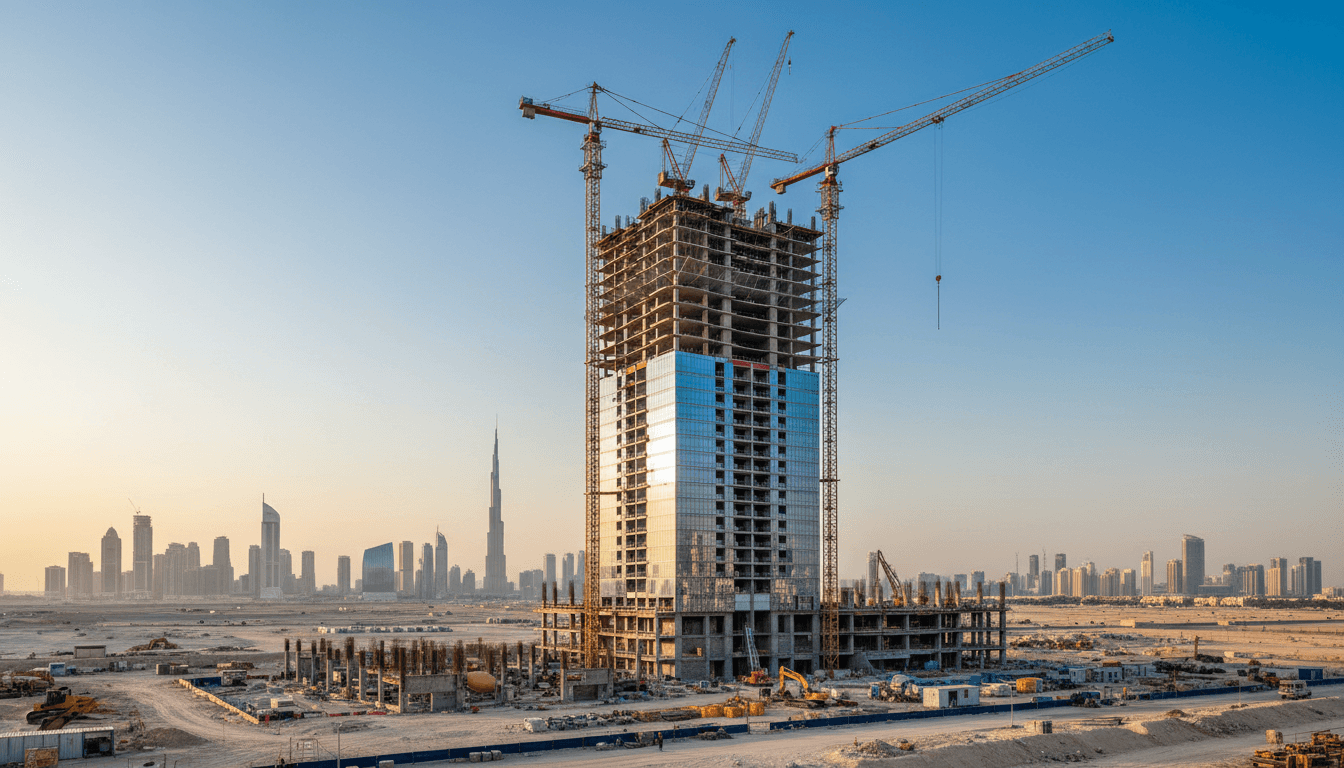
Buying off-plan — a property still under construction, or not yet built at all — is how most Dubai buyers now enter the market. Off-plan currently makes up around 72% of listings (roughly 65,300 off-plan against 25,400 secondary), and of the roughly 90,700 residential transactions recorded across Dubai in the first six months of 2026, a large share were off-plan sales. The feature that makes off-plan so accessible is the payment plan: instead of paying the full price up front, you pay in instalments spread over the build and, increasingly, well after handover. This guide explains how those plans work, how your money is protected, and how to judge whether a given plan is genuinely good value.
What an off-plan payment plan actually is
An off-plan payment plan is a contractual schedule, written into your Sales and Purchase Agreement (SPA), that breaks the purchase price into a series of instalments payable over time. You are buying directly from the developer, and the developer is effectively letting you fund the purchase in stages rather than in a single lump sum.
Two ideas sit at the heart of every plan:
- The construction period — instalments due between booking and the day the building is handed over to you.
- The post-handover period — instalments that some developers allow you to keep paying for months or years *after* you have collected the keys.
Not every project offers a post-handover component. When it does, you can move in, or start earning rent, while still paying off part of the price. Dubai has no annual property tax, no capital-gains tax, and no income tax on rental income, so rent received during a post-handover plan is yours to put straight toward the remaining instalments.
How construction-linked milestones work
The most buyer-friendly plans tie instalments to construction progress rather than to the calendar. Under a construction-linked plan, you pay a set percentage each time the developer reaches a verified building milestone — foundations complete, a certain number of floors cast, structure topped out, mechanical and electrical fit-out, and so on.
The advantage is direct: if the build stalls, your payments pause with it. You are not handing over money for a stage of work that has not been done. Construction progress is monitored and payments into the project account are released against it, which aligns your cash flow with real progress on the ground.
Contrast this with a time-linked plan, where instalments fall due on fixed dates regardless of how far the tower has actually risen. Time-linked schedules are simpler to budget for, but they carry more risk if the project runs behind, because you can be paying on schedule for a building that is not. Always check your SPA to see which type you are signing.
Common plan structures (a labelled example)
There is no single "standard" split in Dubai — developers compete on payment terms, and structures vary widely by project, developer, and how close the building is to completion. To make the mechanics concrete, here is a purely hypothetical, labelled example — not a market standard and not a quote for any specific project.
Illustrative example only — a 60/40 construction-linked plan on a hypothetical AED 1,500,000 apartment:
| Stage | Trigger | Share of price | Example amount (AED) |
|---|---|---|---|
| Booking deposit | Reservation / signing | 20% | 300,000 |
| Milestone 1 | Foundation complete | 10% | 150,000 |
| Milestone 2 | Structure to mid-rise | 10% | 150,000 |
| Milestone 3 | Structure topped out | 10% | 150,000 |
| Milestone 4 | Fit-out / MEP | 10% | 150,000 |
| Handover | Completion certificate | 40% | 600,000 |
| Total | 100% | 1,500,000 |
In this example, 60% is paid across construction and 40% falls due at handover. A post-handover variant might move part of that final 40% into instalments paid over a fixed number of months after you receive the keys, so that less is owed on the day you collect them.
Again: the percentages, milestones, and AED figures above are invented for illustration. The real split is whatever your developer offers and your SPA records. Treat any plan you are shown on its own terms.
Oqood registration, the DLD, and escrow protection
When you buy off-plan, you do not receive a title deed on day one — that comes at handover. Instead your purchase is registered as an Oqood with the Dubai Land Department (DLD). The Oqood is the interim registration that records you as the buyer of a specific unit in an under-construction project; a ready property, by contrast, has a full title deed. Insisting that your purchase is properly registered as an Oqood is a basic protection: it puts your claim to the unit on the official record.
The second layer of protection is the escrow account. Off-plan purchases in Dubai are protected by law through developer escrow accounts. In practice this means:
- Your instalments are paid into a project-specific escrow account, not into the developer's general operating funds.
- Money is released to the developer against verified construction progress, which is exactly why construction-linked milestones matter.
- If a project fails, escrow rules govern how buyer funds are handled, rather than leaving your money entangled with an unrelated part of the developer's business.
Between the Oqood registration and the escrow account, the regulatory framework is designed so that your money follows the building's progress. This is the single biggest reason Dubai off-plan has become mainstream rather than a gamble.
The booking deposit and the timing of the DLD fee
The booking deposit (also called the reservation deposit) is the first instalment and the moment you reserve the unit. It is typically the largest single early payment, and it is what takes the property off the market and triggers the drafting of your SPA. Because it is your first real commitment, do not pay it until you have seen the plan in writing and understood what you are agreeing to.
Separate from the price itself is the DLD transfer fee of 4% of the purchase price. This is a government fee, not part of the developer's payment plan, and it is one of the largest transaction costs you will face. Its timing matters:
- On many off-plan purchases the DLD fee (plus a registration/Oqood administration charge) is payable early, around the time of booking and registration — not deferred to handover.
- Some developers run promotions where they waive or absorb the DLD fee as an incentive; this is a genuine saving, but confirm it in writing rather than assuming it.
Budget for the 4% DLD fee as a real, near-term cost. On top of that, if you buy through a broker, standard agency commission is around 2% (plus 5% VAT). Neither of these is part of the instalment plan, so account for them separately when you work out what you actually need in cash up front.
Pros and cons for buyers
Pros
- Lower entry cost. You commit a booking deposit and stagger the rest, rather than needing the full price at once.
- Payments tracked to progress. Construction-linked plans mean you pay as the building rises.
- Potential for capital appreciation during construction. If the market moves up between launch and handover, that gain accrues to you.
- Post-handover flexibility. Where offered, you can occupy or rent the unit while still paying — and with no tax on rental income, the rent can service the plan.
- Escrow and Oqood protection. Your funds and your claim to the unit are both on the official record.
Cons
- Completion risk. Delays happen; you are buying a promise of a finished building, not a finished building.
- You cannot inspect the final product. You are relying on plans, renders, and the developer's track record.
- Financing limits. Mortgage loan-to-value caps set by the UAE Central Bank reach up to 80% on an expat's first home up to AED 5M but only 50% for off-plan, and banks typically lend less to non-residents — so expect to fund more from cash.
- Handover-day balance. A plan with a large lump due at handover (like the 40% in the example above) can strain your finances or your mortgage exactly when other costs land.
- Market risk cuts both ways. Prices can soften as well as rise between launch and completion.
How to evaluate a plan
Judge the plan and the developer together, not the headline percentages alone:
- Milestone vs calendar. Prefer construction-linked triggers over fixed dates, so payments follow real progress.
- Weight of the handover payment. A smaller lump at handover — or a genuine post-handover tail — is easier to fund than a heavy final instalment.
- Developer track record. Look at whether the developer has delivered previous projects on time and to spec.
- Escrow confirmation. Confirm the project account is a registered escrow account and that your instalments go into it.
- Total cost, not just instalments. Add the 4% DLD fee, any registration/Oqood charge, roughly 2% (+ 5% VAT) commission, and service charges after handover.
- Context of the market. With citywide average prices around AED 1,879 per square foot and average gross rental yields around 4.7%, sanity-check whether the price per square foot and the achievable rent make the numbers work for your goals.
- Golden Visa eligibility. If residency matters, note the property route to a Golden Visa at an AED 2 million threshold (10-year renewable), while a 2-year investor residence visa (DLD's Taskeen service) is open to owners of a completed, title-deeded property of any value, or co-owners whose share is worth at least AED 400,000 — an off-plan booking only qualifies once it is handed over and title-deeded — and check when in the plan you meet the qualifying investment.
What to check in the SPA
The Sales and Purchase Agreement is the document that governs everything. Before you sign, read for:
- The exact payment schedule — every trigger, percentage, and due date — and whether it is milestone- or time-linked.
- The anticipated completion date and the developer's obligations if it slips.
- Penalty and default clauses — what happens if you miss an instalment, including any grace period and the point at which you could forfeit sums paid.
- The escrow account details and confirmation that instalments are paid into it.
- The Oqood registration commitment and who bears the registration cost.
- Who pays the DLD fee and exactly when it falls due.
- Handover definition and snagging — what counts as completion, and your rights to have defects fixed.
- Post-handover terms, if any — the amount, frequency, and duration of instalments after you take the keys.
If a term you were promised verbally is not in the SPA, treat it as if it does not exist. As a RERA-certified brokerage, we would always advise getting the written contract reviewed before any money changes hands.
Common mistakes to avoid
- Paying the booking deposit before reading the SPA. The verbal pitch and the contract are not the same thing.
- Ignoring the 4% DLD fee timing. Buyers who assume it is deferred to handover can be caught short when it is due at booking.
- Under-budgeting the handover lump. A big final instalment is easy to overlook while construction feels far away.
- Assuming a "standard" split. There is no fixed market split; each plan is its own deal.
- Overlooking post-handover service charges. Once you own the unit, ongoing service charges begin regardless of your payment plan.
- Skipping the developer's track record. An attractive plan from an unproven developer is not a bargain.
- Forgetting financing caps. If you plan to mortgage, remember off-plan LTVs are typically lower, so the cash gap is bigger than for a ready home.
Conclusion
Off-plan payment plans are the mechanism that makes Dubai's largest market segment accessible: they let you buy into a rising, tax-friendly property market with a staged commitment rather than a single lump sum, while Oqood registration and mandatory escrow accounts keep your money tied to real construction progress. The plans themselves vary enormously, so the discipline is the same in every case — read the SPA line by line, favour milestone-linked schedules, budget the 4% DLD fee and other costs separately from the instalments, and weigh the developer's delivery record as heavily as the headline terms. Do that, and an off-plan plan becomes a genuinely powerful way to buy. If you would like a specific plan reviewed against your budget and goals, our RERA-certified team at Binayah can walk you through it.