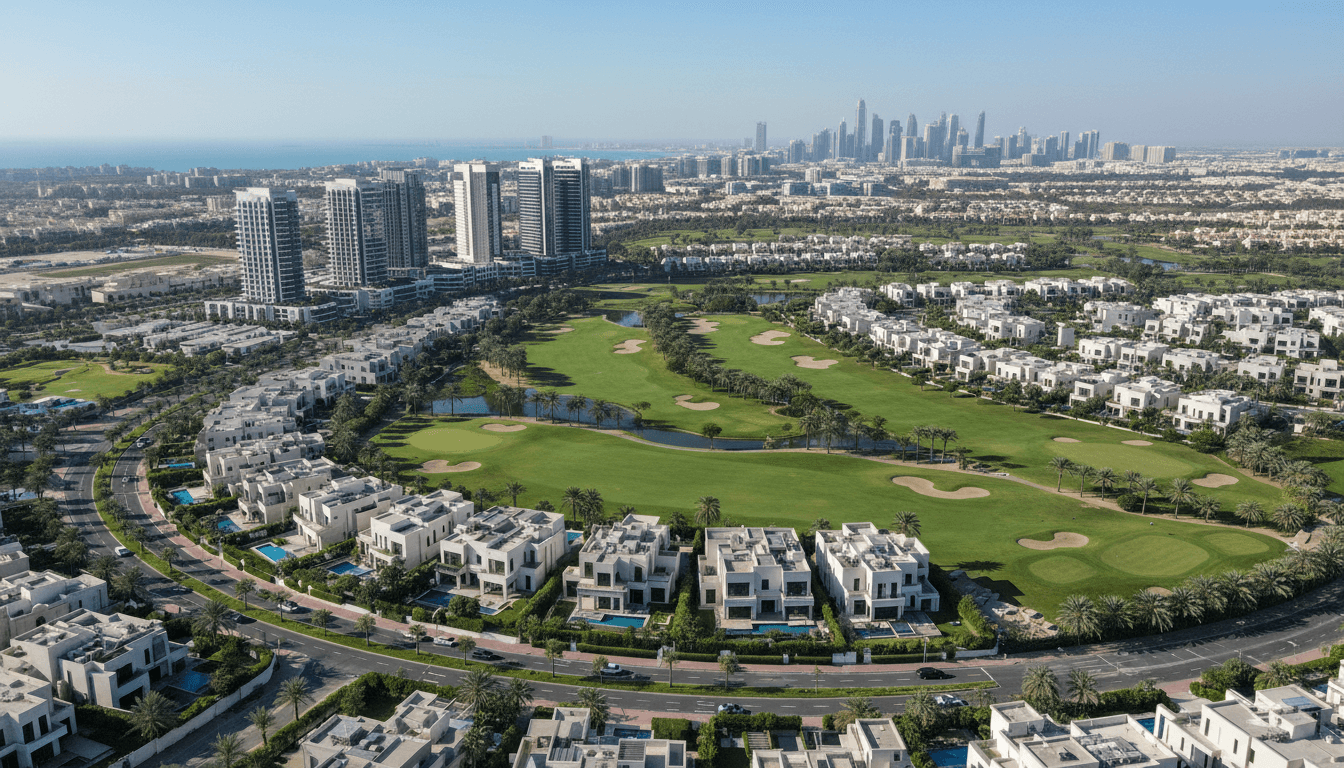
Dubai Hills Estate at a Glance
Dubai Hills Estate is one of the emirate's flagship master-planned communities, developed jointly by Emaar Properties and Meraas as the anchor district within the wider Mohammed Bin Rashid City. Conceived as a "city within a city," it is built around an 18-hole championship golf course, threaded with landscaped parkland, and served by its own retail, healthcare and education hubs. The result is a low-rise, green, family-first environment that feels distinct from the high-density towers of Downtown or the waterfront intensity of Dubai Marina.
The community mixes several product types under one plan — mid-rise apartment buildings, terraced townhouses, and large detached villas and mansions — so it appeals to a broad spread of buyers at very different price points. That mix is the single most important thing to understand before you read the numbers in the live panel above: because Dubai Hills spans everything from a one-bedroom apartment to a golf-facing mansion, the community-level averages blend two quite different markets. As you review the figures, treat price per square foot as the fair like-for-like measure rather than any headline total price.
Location and Connectivity
Dubai Hills Estate occupies a genuinely central position on the map, which is much of its investment logic.
- Al Khail Road runs alongside the community, giving direct arterial access in both directions without touching Sheikh Zayed Road's heaviest congestion.
- It sits roughly midway between Downtown Dubai and Dubai Marina / Dubai Internet City, so both the traditional business core and the newer tech and media clusters are short drives away.
- Dubai International Airport and the Expo / Al Maktoum corridor are both reachable via the surrounding highway network.
- A planned metro connection (part of the Etihad Rail and wider transit expansion serving the district) is a long-term catalyst that would further improve access for tenants who do not want to depend on a car.
For a family choosing a home, the appeal is that everyday life — school run, mall, park, clinic — can happen inside the community, while the wider city stays 15–20 minutes away. For an investor, that central-but-self-contained geography is what underpins durable end-user demand.
Who It Suits
Dubai Hills is, first and foremost, an end-user community, and that shapes the investment case.
- Families and owner-occupiers are the core audience: the greenery, the schools, the park and the mall are designed around them.
- Villa and townhouse investors are buying into scarcity and capital growth — landed homes in a mature, branded master community tend to be tightly held and to attract a stable, higher-income tenant.
- Apartment investors get a lower entry point and a more yield-oriented play, renting to professionals and smaller families who want the lifestyle without the villa price tag.
If your priority is the highest possible rental yield, note the citywide context: Dubai's average gross yield sits around 4.7%, and apartment-heavy or more affordable communities often print above that. A green, villa-inclusive community like Dubai Hills typically trades some running yield for capital appreciation and end-user resale depth — you are buying quality of demand, not just quantity of it. Always compare the live per-sqft figure above to the citywide average of roughly AED 1,879/sqft to see where the community sits on the premium spectrum.
Unit Types
| Product | Typical buyer | Character |
|---|---|---|
| Apartments | Yield-focused investors, first-time buyers, young families | Mid-rise buildings, often near the mall and park; the accessible entry into the community |
| Townhouses | Upsizing families, medium-term investors | Terraced landed homes with private outdoor space; a bridge between apartment and villa |
| Villas | End-users, capital-growth investors | Detached homes, many facing the golf course or parkland; the community's signature product |
| Mansions & premium villas | Ultra-prime end-users | Large plots, bespoke specification, the top of the local price range |
Because this range is so wide, two listings in the same community can differ enormously in total price while being much closer on a per-square-foot basis. This is exactly why the per-sqft lens matters when you interpret the live data.
Off-Plan vs Ready Dynamics
Dubai Hills is a maturing community with both a large stock of completed, occupied homes and an active Emaar off-plan pipeline as remaining plots and new phases come to market.
- Ready units let you inspect the actual home, see established landscaping and amenities, and begin earning rent immediately. Pricing reflects a proven, functioning neighbourhood.
- Off-plan launches from Emaar typically offer staged payment plans, the newest layouts, and entry ahead of completion — attractive for buyers who want to spread capital and target appreciation through the build cycle.
A practical consideration unique to a phased community: handovers are staggered. New clusters can hand over while surrounding plots are still under construction, so an early off-plan buyer may live alongside active building work for a period. Factor that into both your rental expectations and your resale timing. Our team can walk you through which phases are live and how current off-plan terms compare to buying ready — see our off-plan project pages for the latest Emaar releases.
Rental Demand and Tenant Profile
The tenant base here is defined by families seeking greenery, schools and amenities rather than transient or purely price-driven renters. That has two consequences worth weighing:
- Demand is sticky. Families with children in local schools tend to renew and to relocate less often, which supports lower vacancy and longer tenancies — a quieter, more predictable income stream.
- Tenants are quality-of-life buyers. They pay for the park, the mall, the safe streets and the community feel, which supports rent resilience through softer markets.
The trade-off, again, is that a lifestyle-led villa community usually delivers apartment-style yields only on its apartments, while its landed homes lean toward capital growth. Set your expectations by product type, and use the live gross-yield figure above as your community reality-check against the citywide ~4.7% benchmark.
Lifestyle and Amenities
Much of Dubai Hills' pricing power comes from amenities that are already built and operating:
- Dubai Hills Golf Club — the 18-hole championship course at the heart of the plan.
- Dubai Hills Mall — a major regional retail and dining destination inside the community.
- Dubai Hills Park — extensive green space, running and cycling tracks, and family recreation.
- Schools and healthcare — established education and medical facilities within or immediately adjacent to the community.
For an end-user community, having these in place — rather than promised — materially de-risks the demand story.
Key Risks and Considerations
No community is a one-way bet. The main things to weigh here:
- Higher entry for villas and mansions. The landed segment carries a substantial capital requirement, which narrows the buyer pool on resale and concentrates your position in the prime market.
- Staggered handovers and ongoing construction. Buying into an earlier phase can mean living or letting next to active building work until surrounding plots complete.
- Yield vs growth trade-off. Do not assume a green, family community will match the running yields of denser, more affordable districts — check the live figure above against the citywide average before you model returns.
- Blended community averages. With villas and apartments under one name, community-level headline prices are a mix; anchor your analysis on per-sqft and on the specific product you are buying.
How to Buy
Buying in Dubai Hills follows the standard Dubai freehold process, which is open to residents and overseas investors alike.
- Set your product and budget. Decide between apartment (yield-leaning), townhouse (balanced), or villa/mansion (growth-leaning), and confirm whether you are buying ready or off-plan.
- Arrange financing. Mortgage LTV caps for expats are 80% on a first home up to AED 5M, 70% above that and 60% on a second or investment property, and banks typically lend less to non-residents; the balance plus fees is your upfront cash.
- Budget the transaction costs. Expect the 4% DLD transfer fee and roughly 2% agency commission, on top of any mortgage and registration charges.
- Value the specific unit. Because per-sqft is the fair comparison here, benchmark your target against the live panel above and against comparable sales — our online valuation tool is a fast first check.
- Complete and register. Sign the sale agreement (or SPA for off-plan), settle the payment plan or mortgage drawdown, and register the title with the DLD.
On tax and residency, Dubai remains compelling: there is no annual property tax and no capital-gains tax, and ownership supports residency — a 2-year investor residence visa (DLD's Taskeen service) for anyone who owns a completed, title-deeded property, whatever its value, or a co-owner whose share is worth at least AED 400,000, plus the AED 2 million threshold for the 10-year Golden Visa. For most Dubai Hills villa buyers, and many apartment buyers, the Golden Visa threshold is comfortably in reach.
If you would like help shortlisting the right phase, product and price point in Dubai Hills Estate, our team can guide you through current listings, live Emaar off-plan terms, and a valuation on any unit you are considering.