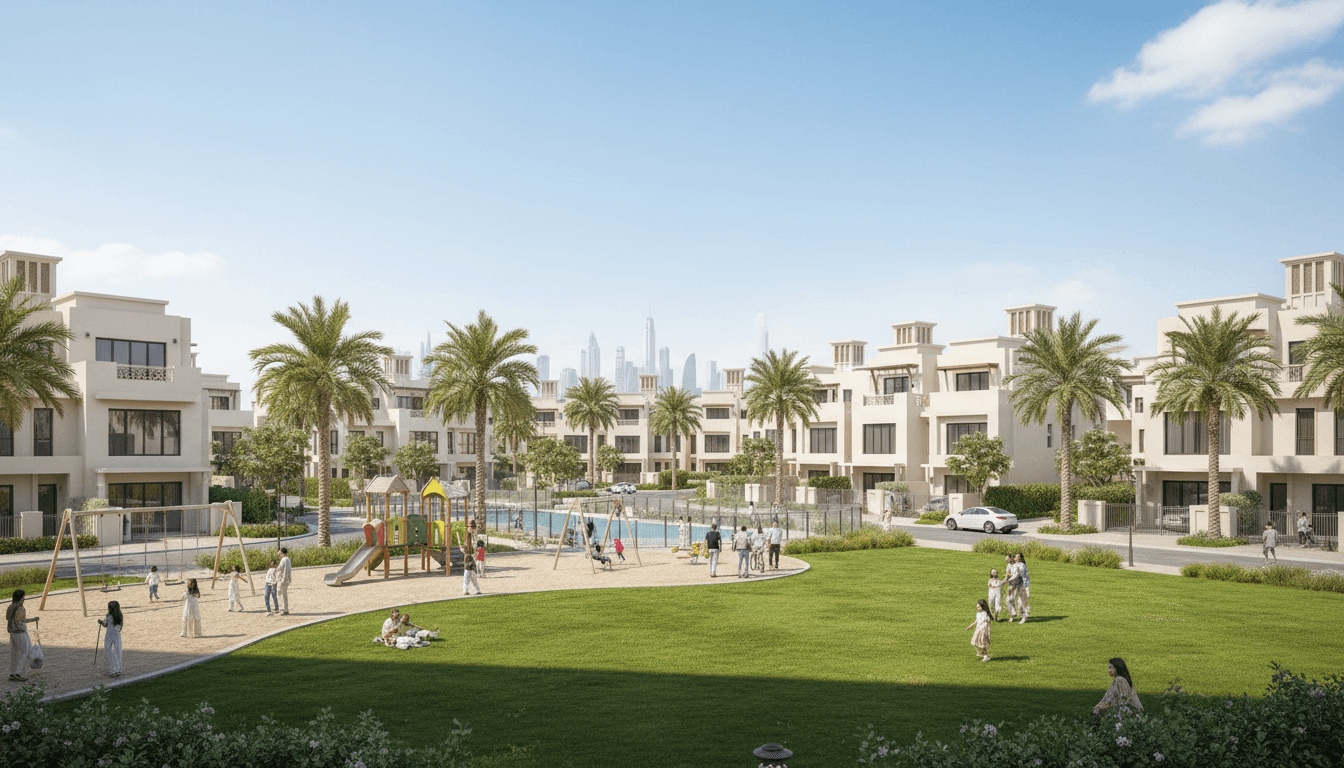
Choosing where to raise a family in Dubai is a different exercise from choosing where to invest or where to live as a single professional. A family is not optimising for a short commute alone, or a trophy address, or the sharpest rental yield. They are weighing a school run against a work commute, a quiet cul-de-sac against a lively high street, and today's budget against the next ten years of a child's life. Dubai rewards this priority-led search: the city has spent two decades building master-planned communities designed, quite deliberately, around families. The challenge is not finding a family-friendly area — it is matching the right one to your household.
This guide sets out what families prioritise, gives you a framework for comparing communities, and profiles several of the best-known family neighbourhoods so you understand their character before you book a viewing.
What families prioritise
Every household is different, but family buyers and renters in Dubai return to the same handful of concerns. Understanding them in order helps you filter a very large market quickly.
Schools and catchments
For most families this is the single biggest driver. Dubai does not operate strict residential catchment zones — in principle you can apply to any private school in the city — but proximity matters enormously in practice. A school five minutes away versus a forty-minute crawl across town is the difference between a calm morning and a daily ordeal, and it shapes friendships, after-school clubs and weekend logistics for years.
When you shortlist an area, map the schools inside or bordering it, check their curriculum (British, American, IB and Indian curricula are all widely available), and confirm current availability in your child's year group. Popular schools keep waiting lists, so a home near a school you cannot get into is not the same as a home near one your child will attend.
Parks, walkability and safety
Families want their children to be able to step outside: shaded pocket parks, safe internal roads with low through-traffic, cycle and pram-friendly pathways, and communal pools. Dubai is consistently regarded as one of the safest large cities in the world, which changes how parents let children move around a neighbourhood. Look for communities with genuinely traffic-calmed interiors rather than those bisected by fast arterial roads.
Villa and townhouse stock
Families gravitate toward ground-oriented homes — villas and townhouses with a private garden, a maid's or study room, covered parking and direct access to community greenery. Apartment living works well for families too, and many of the best value-for-space options are large three- and four-bedroom apartments, but the classic family search centres on low-rise housing. The mix an area offers — pure villa enclave versus a blend of townhouses and apartments — shapes its atmosphere.
Community amenities
The strongest family communities function as self-contained villages. A useful checklist: a supermarket within walking distance, a community centre or retail strip, clinics and a pharmacy, nurseries, sports facilities, mosques, and cafes. The point is to reduce how often you have to leave the community for ordinary daily needs.
Commute
The honest trade-off: the greenest, most spacious family communities tend to sit further from the central business districts. A home that gives you a garden and a great school may add twenty or thirty minutes to a working parent's commute. Test your realistic door-to-desk journey at actual rush hour before you commit — not the midday drive.
A framework for choosing a family area
Rather than starting from a list of names, start from your own constraints, in order.
- Fix your non-negotiables first. Usually the school (or shortlist of two or three) and a maximum acceptable commute for the working parent(s). These two constraints alone eliminate most of the map.
- Set a realistic total budget. For buyers, the purchase price is not the whole cost — see the budgeting section below. For renters, decide whether you can pay in one or two cheques, which materially affects the rent you are offered.
- Choose your housing type. Villa, townhouse or large apartment. Be honest about how much outdoor space you will genuinely use versus the interior space and short commute you need.
- Weight the soft factors. Rank walkability, amenities, quietness and social life. A family with toddlers weights parks and nurseries; one with teenagers weights schools, sports and independence.
- Shortlist three communities, then pressure-test them. Visit at different times — a weekday morning school run, a Friday evening, a weekend afternoon. Talk to residents. Check current availability and the direction of rents and prices, not last year's figures.
- Verify the specifics of the actual home. Service charges, the developer's maintenance record, the specific school's waiting list, and the exact commute from that street. Communities are averages; you rent or buy one particular home.
The "best" family area is personal: the right answer for a family whose priority is an IB school and a short Downtown commute differs from the answer for one that wants the biggest garden its budget allows.
Profiles of well-known family communities
The communities below are among the most established family names in Dubai. Treat these as descriptions of character, not a ranking — and always check live pricing and availability for any specific home, because those change constantly.
Dubai Hills Estate
A large, relatively central master-planned community built around a golf course and an extensive park network, anchored by a major shopping mall and served by well-regarded schools. It blends villas, townhouses and apartments, giving it a broad social mix and a more urban, amenity-rich feel than a pure villa enclave. It appeals to families wanting space and greenery without moving to the city's outer edge.
Arabian Ranches
One of Dubai's original villa communities and a benchmark for the suburban, low-density family lifestyle: detached villas, mature landscaping, community pools, retail centres, a golf course and established schools. It has a settled, grown-in character that newer developments take years to acquire, and suits families who want a quiet, purely residential villa neighbourhood.
Mirdif
An older, well-established residential district popular with families for its mix of villas and apartments, relative affordability, parks and community feel. Much of Mirdif is non-freehold, so it has historically been more of a rental and end-user area than an investor market — part of why it feels lived-in and unpretentious. It suits families wanting a mature neighbourhood in a more central-east location.
Jumeirah Village Circle (JVC)
A dense, centrally located community with a wide mix of apartments, townhouses and some villas, known for comparatively accessible price points and numerous parks scattered through its layout. It is busier and more built-up than the pure villa communities, and quality varies building to building, so due diligence on the specific development matters. It appeals to families who prioritise location and value over a suburban feel.
Town Square
A newer community built around a large central park, offering mostly townhouses and apartments at accessible price points, with a strong emphasis on outdoor amenities, cycling tracks and family programming. It sits further out, so the trade-off is commute for space and affordability. It tends to attract younger families buying their first home.
The Springs
An established townhouse and villa community set among landscaped lakes and greenery, long popular with families for its calm, low-rise character and proximity to schools and the wider Emirates Living area. Like Arabian Ranches, it has the settled feel of somewhere lived in for years, and suits families wanting a peaceful, ground-oriented home in a mature setting.
Renting versus buying for families
Families have a particular relationship with the rent-or-buy question because stability has a value a spreadsheet does not fully capture. Moving a child mid-school-year carries a real cost.
Renting offers flexibility and a lower upfront commitment — useful if you are new to Dubai, still testing which community and school suit you, or unsure how long you will stay. The trade-offs are less control over the home and exposure to rent reviews at renewal. Dubai protects tenants here: rent increases are governed by the RERA rental index, and a landlord must give 90 days' notice before a renewal that changes terms. Tenancies are registered via Ejari, which costs around AED 220.
Buying suits families who are settled, plan to stay several years, and want to lock in stability and control. Foreigners can own freehold homes in Dubai's designated freehold areas, and buying can open residency options: a 2-year investor residence visa (DLD's Taskeen service) is open to anyone who owns a completed, title-deeded property, whatever its value, or to a co-owner whose share is worth at least AED 400,000, with the Golden Visa's 10-year renewable residency available at an AED 2 million threshold. Against that, buying ties up capital and adds transaction costs you do not face as a tenant.
A rule of thumb: the longer and more certain your Dubai horizon, the more buying makes sense. A family confident of staying five-plus years and settled on a community and school is the classic buyer.
Budgeting context
Family homes — larger and often ground-oriented — sit toward the upper end of most budgets, so plan the full cost, not just the headline price. As citywide context, the average sale price in Dubai is around AED 1,879 per square foot per the latest DLD and market data. That is a whole-city average across every area and property type; family villa and townhouse communities can sit well above or below it, so use it only as a rough anchor and check live figures for the specific home.
For buyers, budget beyond the purchase price for these largely fixed costs:
- DLD transfer fee: 4% of the purchase price.
- Agency commission: around 2% (plus 5% VAT).
- Mortgage limits: expats can borrow up to 80% loan-to-value on a first home up to AED 5M, with lower caps for higher-value or off-plan homes; banks typically lend less to non-residents.
A labelled example: on a hypothetical AED 3,000,000 townhouse, the DLD transfer fee alone would be AED 120,000 (4%), with commission and mortgage costs on top — treat this only as an illustration of how the fixed percentages stack up.
Dubai's tax position is favourable for families settling long term: no annual property tax, no capital-gains tax, and no income tax on rental income. Budget instead for the annual community service charge, which varies by community and directly affects running costs — always ask for the current rate on the specific home.
Common mistakes families make
- Buying the home before securing the school. Confirm your child has an actual offer, not just that a good school is nearby. Waiting lists are real.
- Testing the commute at the wrong time. The midday drive from a viewing tells you nothing about the 7:45am reality. Drive it at rush hour.
- Ignoring service charges. Two similar homes can have very different annual running costs. Factor the service charge into affordability from the start.
- Over-indexing on the garden. Families routinely pay for outdoor space they rarely use while sacrificing commute and interior space they need daily. Be honest about your real lifestyle.
- Treating a whole community as uniform. Amenities, noise and quality vary street to street and building to building. Judge the specific home.
- Underestimating total transaction cost. The 4% DLD fee, commission and financing costs add up. Budget for them before you fall in love with a home.
Conclusion
There is no single best area for families in Dubai — there is the best area for your family, and finding it means matching your priorities to a community's character. Start from your non-negotiables, usually the school and the commute, then layer on housing type, amenities and budget. Use the communities profiled here to understand the range on offer, from settled villa enclaves like Arabian Ranches and The Springs to amenity-rich, central options like Dubai Hills Estate and more accessible newer or denser communities like Town Square and JVC. Then pressure-test your shortlist in person, at real hours, and verify the specifics of the actual home.
Dubai's family communities are among the most thoughtfully planned anywhere, and the city's safety, tax position and school choice make it a strong place to raise children. As a RERA-certified brokerage, Binayah can turn this framework into a shortlist, confirm current pricing and availability, and guide you through schools, financing and the buying or renting process.