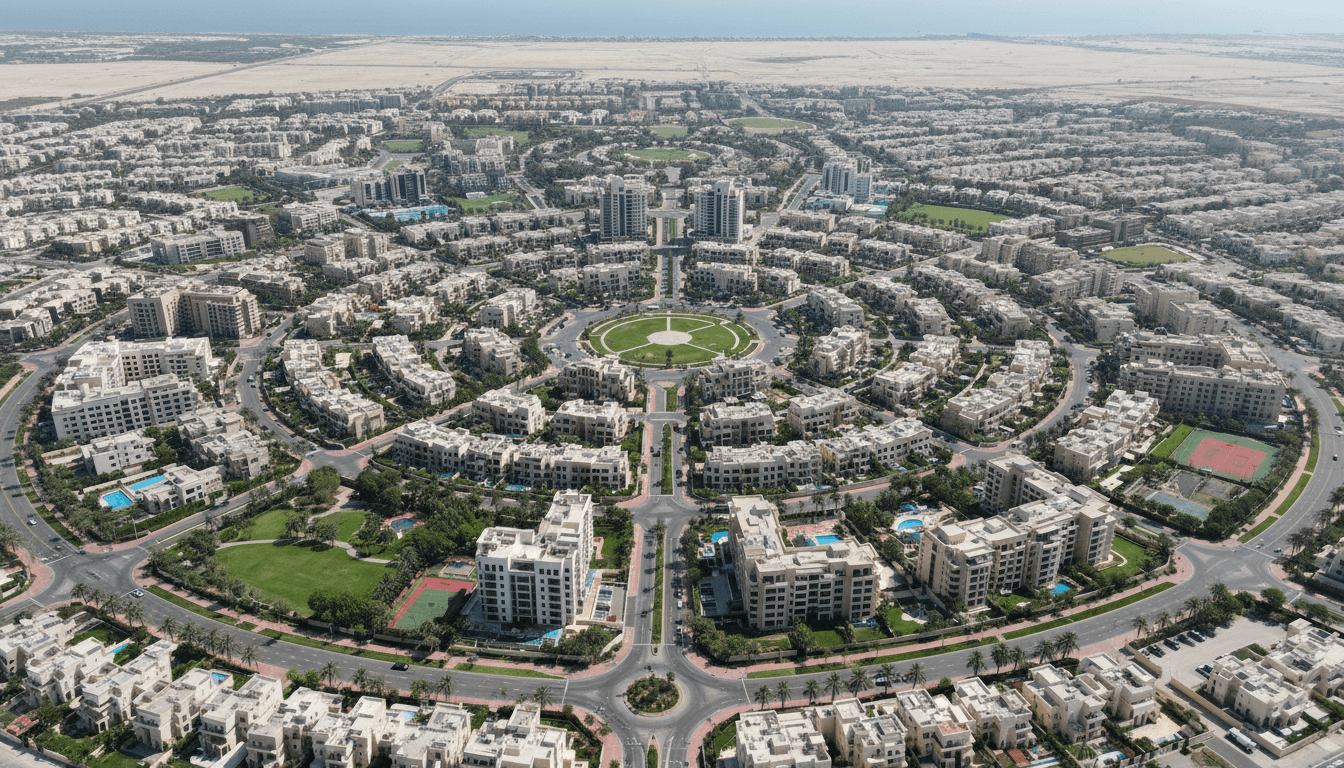
Jumeirah Village Circle at a Glance
Jumeirah Village Circle — universally shortened to JVC — is one of Dubai's largest and most recognisable master-planned freehold communities. Developed by Nakheel, the master developer behind Palm Jumeirah and other landmark projects, JVC was conceived as a self-contained, family-oriented "village" laid out in a broadly circular plan around a network of landscaped parks and tree-lined streets. Today it is among the most active residential districts in the emirate, home to a dense and still-growing mix of low-rise and mid-rise apartment buildings, townhouse clusters and a smaller number of standalone villas.
What makes JVC distinctive is its blend of scale, affordability and central location. It sits in the heart of "new Dubai" yet remains accessible to the older established districts, and it offers entry price points that are meaningfully below the city's prime waterfront and Downtown addresses. That combination has made it a magnet for two overlapping audiences: yield-focused investors chasing dependable rental returns, and value-seeking end-users who want a modern home with community amenities without paying a premium address's tariff. The live data panel above this guide shows the community's current average price per square foot, gross rental yield and recent transaction volumes — refer to those figures for the hard numbers, as they are drawn directly from Dubai Land Department records and kept up to date.
Location and Connectivity
JVC's central position is one of its strongest structural advantages. The community is bounded and served by two of Dubai's most important arterial roads:
- Al Khail Road (E44) runs along one flank, giving fast access toward Business Bay, Downtown Dubai and the older commercial heart of the city.
- Sheikh Mohammed Bin Zayed Road (E311) anchors the other side, connecting north toward Sharjah and south toward Abu Dhabi, and feeding the wider network of business parks and free zones.
This places JVC at a genuine crossroads between "old" and "new" Dubai. Residents can reach Dubai Marina, Jumeirah Lakes Towers (JLT) and the coastal strip in a short drive, while Downtown, DIFC and Business Bay are equally reachable in the other direction. Circle Mall sits at the community's core for everyday retail, dining and groceries, and the surrounding neighbourhoods — Dubai Sports City, Motor City, Jumeirah Village Triangle and Dubai Hills — add further amenities within easy reach.
The one honest caveat on connectivity is that JVC is not directly served by the Dubai Metro; residents rely on road links and feeder transport. For a car-owning household this is a non-issue, but it is worth factoring into the tenant profile you expect to attract.
Who JVC Suits
JVC is best understood as a volume-and-yield community rather than a trophy-asset one. It suits:
- Income-focused investors who prioritise consistent occupancy and gross rental return over headline capital appreciation. Affordable communities with deep tenant demand tend, as a category, to deliver rental yields above the citywide average gross yield of roughly 4.7% — precisely because entry prices are lower relative to the rents they command. The live panel shows where JVC currently sits.
- First-time buyers and value end-users who want to own a modern apartment or townhouse with parks, gyms, pools and retail on the doorstep, at a price point below the prime districts.
- Portfolio builders who want to add a liquid, easily-let unit in a well-known community where both leasing and resale markets are active.
It suits less well the buyer whose primary goal is rapid, prime-grade capital growth or a landmark waterfront address — those objectives point toward different communities entirely.
Unit Types and What You Can Buy
JVC's housing stock is deliberately varied, which is part of its appeal:
| Unit type | Typical buyer / tenant | Notes |
|---|---|---|
| Studios | Investors, single professionals, sharers | The most affordable entry point; strong rental liquidity |
| 1-bedroom apartments | Couples, small families, investors | The workhorse of the community's rental market |
| 2- and 3-bedroom apartments | Families | Larger floorplates in mid-rise buildings |
| Townhouses | Families wanting space without a villa budget | Clustered, community-managed |
| Villas | End-user families | A smaller share of the stock; more limited supply |
The predominance of studios and one-bedrooms is central to JVC's investment case: these are the units that let fastest, appeal to the widest tenant pool, and produce the highest gross yields relative to purchase price. Larger apartments, townhouses and the limited villa stock broaden the community's family appeal and give it a more balanced, mixed-use character than a purely investor-driven tower district.
Off-Plan versus Ready
JVC has one of the most active development pipelines in Dubai. New buildings launch and complete on a continuous basis, which means buyers face a live choice between off-plan and ready stock — each with a different risk-and-reward shape:
- Off-plan purchases in JVC typically offer lower entry prices, developer payment plans that spread cost over the construction period, and the newest specifications and amenities. The trade-off is construction and handover risk, and the fact that you are buying into a market where further supply will keep arriving.
- Ready units let you inspect the actual building, assess management quality, and begin earning rent immediately. You pay for that certainty, but you remove delivery risk and can underwrite the yield against real, observable rents.
Because the pipeline is so deep, JVC is a community where developer selection matters more than the community-level average. Build quality, service-charge levels and management standards vary noticeably from one building to the next. Browse Binayah's off-plan project listings for JVC to compare launches, and use the property valuation tool to sanity-check any asking price against the community's live benchmarks before you commit.
Rental Demand and Tenant Profile
JVC's tenant base is broad and resilient, which is the foundation of its yield story. Typical renters include:
- Value-conscious families who want space, parks and schools within reach at a rent below the coastal communities.
- Sharers and young professionals drawn to affordable studios and one-bedrooms with good road access to the business districts.
- Mid-market tenants relocating within Dubai who prioritise modern buildings and community amenities over a prestige postcode.
This mix gives landlords depth of demand across multiple unit sizes and price points, which supports occupancy and shortens void periods. The absence of a metro station skews the profile toward car-owning households, but that has not blunted demand — the community's affordability and central location continue to keep it well tenanted, as the transaction and rental activity in the live panel reflects.
Why Affordable Communities Favour Yield over Prime Growth
It is worth being clear-eyed about what an affordable, high-supply community like JVC does and does not do well. As a category, districts like this tend to deliver strong, dependable rental yields — often above the citywide average — because low purchase prices sit beneath robust rents. What they are less likely to deliver is the outsized, prime-grade capital appreciation associated with supply-constrained waterfront and Downtown addresses, where scarcity and prestige drive price growth.
That is not a weakness so much as a different investment mandate. If your goal is cash-on-cash income and liquidity, JVC's profile is a feature. If your goal is capital growth from a scarce landmark asset, you should weight your portfolio elsewhere and treat JVC as the income-generating counterweight. The right expectation is yield-led total return, not price-led.
Key Risks and Considerations
No community is without trade-offs. For JVC the main ones are:
- Heavy new supply. The same active pipeline that keeps the community fresh also means a continuous flow of new units. Sustained supply can cap rental growth and cap capital appreciation, particularly in the most heavily-built unit types. Underwrite conservatively and do not assume rents will only rise.
- Variable building quality. With dozens of developers active across the community, standards of construction, finish, maintenance and building management differ significantly. Two buildings on the same street can offer very different tenant experiences and service charges. Due diligence at the building level is essential.
- Service charges. These vary building to building and directly affect net yield. Always check the current charge before modelling returns.
- No direct metro link. A structural feature to weigh against the location's road advantages.
Mitigate these by focusing on established, well-managed buildings with a track record, verifying service charges, and stress-testing your yield assumptions against a scenario of flat rents.
How to Buy in JVC
The mechanics of buying in JVC are the same as anywhere in Dubai's freehold market, and the headline costs are fixed and predictable:
- Define your mandate and budget. Decide whether you are buying for yield, for own-use, or for a blend — and whether off-plan or ready fits your risk appetite.
- Get your financing in place. Mortgage buyers should note the loan-to-value caps: up to 80% for residents and 50% for non-residents, so budget for the corresponding cash deposit.
- Shortlist at the building level. Compare specific buildings, not just the community average — assess the developer, management, service charge and actual achievable rent. Binayah's JVC listings and off-plan pages are the place to start.
- Value the unit. Use the valuation tool and the live price-per-sqft benchmark above to confirm the asking price is fair before you offer.
- Budget the transaction costs. The 4% DLD transfer fee and roughly 2% agency commission are the main one-off costs, plus modest registration and, for mortgages, valuation fees.
- Complete and register. On a ready unit you transfer at the DLD; on off-plan you sign the sales agreement and follow the developer's payment plan through to handover.
Two structural advantages apply throughout: Dubai levies no annual property tax and no capital-gains tax, so your gross yield converts efficiently into net income. And qualifying purchases unlock residency — the AED 2M threshold for the 10-year Golden Visa and the AED 750K route for a standard property residence visa — which many JVC investors reach by aggregating units.
For help comparing buildings, sourcing off-plan launches, or valuing a unit against JVC's live figures, Binayah's community and buying guides are the natural next step.