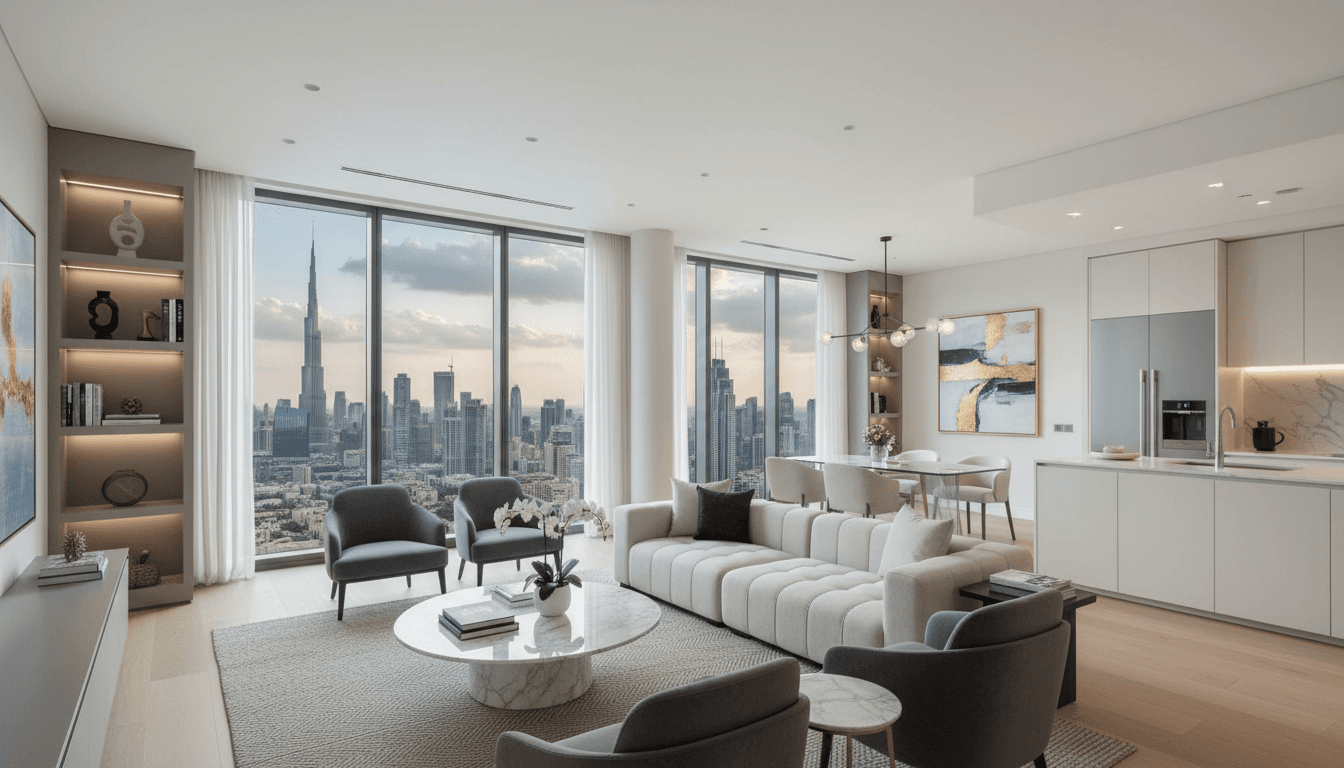
Selling a property in Dubai is refreshingly transparent once you understand the sequence. There is no capital-gains tax, no annual property tax, and no income tax on the money you walk away with — but there is a defined, government-supervised process that runs through a RERA-certified broker, a signed set of forms, a developer No Objection Certificate, and a final transfer at a Dubai Land Department (DLD) trustee office. Get the order right and a straightforward sale can complete in a matter of weeks. Get it wrong and you can lose months chasing paperwork.
This step-by-step guide walks you through the whole journey, from your first valuation to the moment the new title deed is issued.
Understand the market you are selling into
Before you price anything, get a feel for current conditions. On the latest DLD and market data, the citywide average sale price sits at around AED 1,879 per square foot, and the market has been highly active — roughly 90,700 residential transactions were recorded in the first half of 2026 alone. Around 72% of activity is off-plan (about 65,300 off-plan versus 25,400 secondary listings), which tells you something important: as a secondary (ready) seller, you are competing hard against brand-new launches with developer payment plans. That makes presentation and pricing decisive.
Gross rental yields citywide average around 4.7%, which matters if your likely buyer is an investor rather than an end-user — a well-tenanted unit at a healthy yield is a different proposition to a vacant home aimed at a family.
Step 1: Prepare to sell
Get a realistic valuation
Everything downstream depends on an honest opening number. Base your valuation on:
- Recent comparable sales in your building or community — actual transacted prices, not asking prices.
- Your unit's specifics — floor, view, layout, upgrades, and condition.
- The average price per square foot as a sanity check against the citywide benchmark above.
A RERA-certified agent can pull DLD transaction history for your exact building and produce a defensible price band. Beware the agent who "buys" your listing with an inflated valuation only to push for reductions weeks later.
Time it sensibly
There is no perfect month, but a few timing factors help:
- Mortgage status. If your property carries a mortgage, budget time to settle the outstanding liability before or during the sale (see Step 8).
- Tenancy. A vacant unit sells more easily to end-users; a tenanted one appeals to investors but restricts viewings. If the tenant is leaving, aligning the sale with vacancy can widen your buyer pool.
- Documents. Have your title deed, passport/Emirates ID, and any developer statements ready so you are not scrambling later.
Present the property well
Presentation is your cheapest lever. Declutter, deep-clean, fix the small defects buyers fixate on (chipped paint, silicone, a dripping tap), and let in light. Professional photography and, increasingly, a video walkthrough are expected. Given how much polished off-plan inventory buyers scroll past, a tired listing simply gets skipped.
Step 2: Choose a RERA agent and sign Form A
In Dubai, property brokers must be licensed and RERA-certified. Choosing the right one is the most consequential decision you will make.
When you appoint an agent, you sign Form A — the official RERA listing agreement between seller and broker. Form A:
- Authorises the agent to market your property.
- States the agreed price, the commission, and the listing period.
- Is registered on the DLD's Trakheed/listing system, which is what allows the agent to advertise the unit legitimately and generate a verified listing permit.
A tip worth its weight: insist your listing is advertised with a permit number. It signals a compliant broker and keeps your property out of the sea of duplicated, unverifiable ads.
Sole vs multiple agency. You can list with one agent (sole agency) or several. A single motivated agent on Form A often markets harder because the outcome is theirs to win; multiple agents widen reach but can create price confusion and duplicate listings. Many sellers start sole for a defined period, then broaden if needed.
Step 3: Set your pricing strategy
Pricing is where sellers most often sabotage themselves. Options:
- Price at market to attract serious offers quickly and hold negotiating strength.
- Price slightly above to leave negotiating room — but only slightly, or you vanish from buyers' search filters.
- Price to sell fast if speed matters more than squeezing the last dirham.
Whatever you choose, anchor it to real comparables and the price-per-square-foot benchmark, and agree with your agent on a review point — for example, revisiting the number if a fortnight of viewings produces no offers.
Step 4: Market the property
With Form A signed, your agent markets the unit across the major portals, their agency network, and their qualified buyer database. Strong marketing usually includes:
- Professional photos and a floor plan.
- A video or 360-degree tour.
- A crisp, honest description highlighting genuine selling points.
- Pre-qualification of buyers so viewings are with people who can actually transact.
Expect the agent to filter tyre-kickers, arrange viewings, and report back on feedback so you can adjust price or presentation with real information.
Step 5: Receive offers and sign the MOU (Form F)
When a buyer commits, the terms are captured in the Memorandum of Understanding, known as Form F — the RERA sale contract between buyer and seller. Form F records the agreed price, the parties, the commission, and the conditions of sale.
At signing, the buyer typically pays a deposit — commonly a security cheque of around 10% of the sale price, held by the registration trustee — which secures the deal and demonstrates commitment. This deposit is the mechanism that protects you if the buyer walks away without cause, and protects the buyer if you do.
Worked example (illustrative only). Suppose a ready apartment is agreed at AED 2,000,000. At Form F signing the buyer lodges a 10% security deposit of AED 200,000 with the trustee. The figure is a hypothetical to show the mechanics — your actual deposit is whatever you and the buyer negotiate into Form F.
Step 6: Apply for the developer NOC
Once Form F is signed, you (usually via your agent) apply to the developer for a No Objection Certificate (NOC). The NOC confirms that:
- There are no outstanding service charges owed on the unit.
- The developer has no objection to the transfer.
You will need to clear any unpaid service charges to obtain it, and the developer levies its own NOC fee. The NOC is mandatory — the DLD will not transfer the property without it — so factor its processing time into your timeline. Some developers issue within a few days; others take longer, which is often the single biggest variable in how fast a sale closes.
Step 7: Transfer at the DLD trustee office
With a valid NOC, the parties meet at a DLD-registered trustee office to complete the transfer. On the day:
- The buyer brings the balance of the purchase price, typically as a manager's cheque made out to the seller.
- Fees are settled (see below), and the trustee verifies all documents and identities.
- The old title deed is cancelled and a new title deed is issued in the buyer's name.
- You hand over keys, access cards, and any warranties.
For off-plan units that have not yet completed, the interest is recorded via the Oqood system with the DLD rather than a full title deed, and the developer's involvement in the transfer is typically greater; a completed, ready property transfers on its title deed. Purchases along the way are protected by developer escrow accounts.
Step 8: Selling a mortgaged (encumbered) property
If your property still carries a mortgage, there is an extra layer, but it is routine:
- Request a liability settlement letter from your bank stating the exact outstanding amount.
- The buyer's funds (or, if the buyer is also financing, the buyer's bank) settle your outstanding loan first.
- Your bank issues its own NOC and releases the mortgage registered against the title.
- Only once the bank's charge is lifted can the DLD transfer clean title to the buyer.
This is well-trodden ground for Dubai trustees and conveyancers, but it adds steps and time, so tell your agent up front if there is a mortgage on the property. Coordinating the bank's release with the developer's NOC and the transfer appointment is where good agents earn their fee.
Costs the seller typically bears
Dubai keeps seller costs modest compared with many markets, largely because there is no capital-gains tax and no income tax on the proceeds. As a seller you should nonetheless budget for:
| Cost | Who usually pays | Notes |
|---|---|---|
| Agency commission | Seller (by agreement) | Standard market rate is around **2% of the sale price, plus 5% VAT**. Confirm exactly who pays what in Form A/Form F. |
| Developer NOC fee | Seller | A developer-set administrative fee; varies by developer. |
| Outstanding service charges | Seller | Must be cleared to obtain the NOC. |
| Mortgage settlement / release | Seller | Only if the property is encumbered; includes the bank's own release process. |
| DLD transfer fee (4%) | Usually the buyer | The **4% DLD transfer fee** is customarily paid by the buyer, though this is negotiable and should be stated in Form F. |
Always confirm the split in writing. The 2% commission and 4% DLD fee are the two figures every party should agree on before signing.
Typical timeline
While every sale differs, a cash, unmortgaged, ready-property sale can be quick. A rough shape:
- Preparation, valuation, Form A: a few days.
- Marketing to accepted offer: highly variable — days to weeks depending on price and demand.
- Form F signing to NOC issuance: often one to a few weeks, driven mainly by the developer.
- NOC to DLD transfer: typically days, once the appointment is booked.
Add time if there is a mortgage to settle on either side. Setting expectations early prevents the panic that leads sellers to accept poor offers.
Common mistakes to avoid
- Overpricing then chasing the market down. You lose the crucial first weeks of buyer attention and often net less than a sharp opening price would have.
- Skipping the listing permit. Unpermitted ads mark a non-compliant broker and can stall you later.
- Ignoring service charges. Arrears block the NOC and can derail a transfer at the worst moment.
- Forgetting the mortgage lead time. Not requesting the liability settlement letter early is a classic delay.
- Weak presentation. Against 72% off-plan competition, a poorly photographed, cluttered unit simply gets scrolled past.
- Leaving fee responsibility vague. Nail down who pays the 2% commission and the 4% DLD fee in writing, before signing Form F.
Conclusion
Selling in Dubai rewards preparation and a compliant, capable agent. Price honestly against real comparables and the citywide benchmark, sign a proper Form A, market the property professionally, and lock in the deal with a clear Form F and deposit. From there the path is well defined: clear the developer NOC, settle any mortgage, and complete the transfer at a DLD trustee office where a new title deed is issued in the buyer's name. With no capital-gains or income tax to erode your proceeds and a government-supervised process protecting both sides, a well-run Dubai sale is one of the cleaner property transactions you can make — provided you follow the steps in order.
If you would like a current valuation of your property and a compliant, permit-backed listing, Binayah's RERA-certified team can guide you from first appraisal to final transfer.