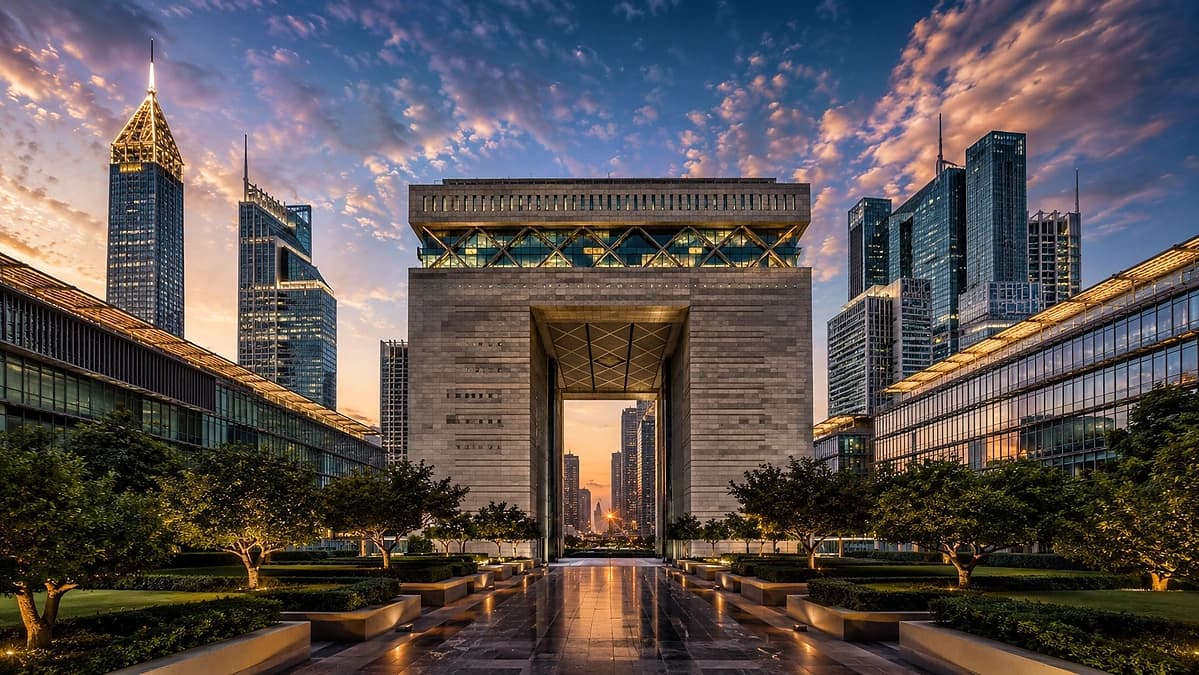
DIFC AI-native financial centre: what the announcement means
DIFC will embed artificial intelligence across regulation, services and city infrastructure, positioning the Dubai International Financial Centre as an AI-native financial centre.
DIFC’s announcement outlines a strategy to integrate AI into legal and regulatory frameworks, financial services, talent development, enterprise operations and urban infrastructure. The plan positions DIFC to reframe how licences are issued, how firms comply with rules and how city systems connect, and it signals policy-led change rather than a single technology product.
For investors and real estate stakeholders the practical outcome will be faster, data-driven decision-making in the centre and adjacent districts, new enterprise demand for intelligent office environments and workforce upskilling needs that feed into residential and services markets.
What does DIFC's announcement mean for Dubai's financial centre?
What does DIFC's announcement mean for Dubai's financial centre? — Key Data
Scope
legal, regulatory, financial services, talent, operations, infrastructure
Positioning
first AI-native financial centre announced by DIFC
Approach
system-wide embedding rather than pilot projects
Primary focus
regulatory and operational alignment with AI tools
DIFC's announcement makes the centre the world's first AI-native financial hub by embedding artificial intelligence across legal, regulatory, financial and urban systems.
The strategy covers embedding AI into legal and regulatory frameworks, financial services, talent development, enterprise operations and urban infrastructure as stated by DIFC. Embedding AI into these layers aims to speed up licensing and supervisory decisions, make compliance more data-driven and enable integrated city services inside the Dubai International Financial Centre. DIFC frames the change as systematic rather than pilot-based, aligning core rules and operations to run with AI-assisted decision workflows.
The change carries operational upside and governance challenges. On the upside, firms can expect more predictable regulatory outcomes and faster onboarding when compliance processes are automated. The risk is that AI-driven supervision requires clear data governance, explainability and cross-border coordination; DIFC will need to set standards so automation does not outpace legal certainty or privacy safeguards.
How will AI-native regulation affect commercial real estate in DIFC?
AI-native regulation will change commercial real estate by shifting emphasis to performance, compliance efficiency and connected building systems rather than only location or floor area.
If DIFC embeds AI across regulatory and urban systems, commercial landlords and occupiers will face new data requirements for leases, building certification and operations. Expect smarter building management platforms to integrate with supervisory systems so energy, security and occupancy data feed into compliance workflows. That changes leasing conversations toward operational performance and could increase demand for office space that supports higher data and connectivity standards.
The transition creates short-term and medium-term consequences for valuation and operations. In the short term, owners may need to invest in sensors, telecom upgrades and data management to remain attractive to occupiers and regulators. In the medium term, better performance transparency can reduce operational risk but requires consistent regulatory standards from DIFC so that market participants can price and model the new obligations.
| Impact area | Change for commercial real estate | Why it matters |
|---|---|---|
| Lease terms | Performance-led clauses and data sharing | Aligns landlord and tenant incentives around measured outcomes |
| Building operations | Integration with supervisory systems | Requires investment in sensors, networks and data platforms |
"Linking building systems to regulatory controls shifts commercial property from static assets to performance-managed infrastructure."
— Binayah Research Team
How will DIFC's AI plan affect talent, visas and residential spillover?
DIFC's AI-native strategy will increase demand for specialised talent and influence residency patterns around the financial centre as firms expand AI teams and services.
The plan explicitly covers talent development, so DIFC intends to build workforce programs to support AI skills inside the centre. That will raise demand for skilled professionals, create new roles in compliance, data science and operations, and prompt companies to locate teams close to DIFC for collaboration with regulators and partners. Residential patterns commonly follow employment hubs, so nearby housing markets and services may see increased demand tied to workforce growth.
Policy details on visas and mobility will determine the speed and scale of spillover. If DIFC offers streamlined or sponsored pathways for AI specialists, residential and amenity demand near the centre will grow faster. A careful balance is required: talent programmes should link training and employment pathways to local hiring while ensuring municipal services and housing supply adapt to the new demand.
Key Insight
Investors and landlords should track DIFC talent programmes and visa updates closely. Early alignment with DIFC training initiatives can position owners to capture rising demand for quality housing and flexible office space, while failure to upgrade building services risks lower occupier demand.
What are the investment implications and short-term risks of DIFC's AI strategy?
The investment implication is a structural shift in demand toward technology-ready assets, and the short-term risk is regulatory and operational uncertainty as rules are rewritten around AI.
DIFC’s intention to embed AI across frameworks creates fresh opportunities for investors in infrastructure, data-centre services, intelligent offices and workforce housing that supports the centre. At the same time, rapid policy change can create transitional risks: assets that do not meet new data or connectivity standards could face obsolescence or higher capex requirements. Investors must account for potential retrofit costs and evolving compliance obligations when modelling returns.
Practical steps for investors include auditing assets for data readiness, engaging with DIFC guidance as it emerges and building flexibility into leasing and renovation plans. While the long-term outcome is more transparent and efficient markets, the short-term window will favour owners and developers who can demonstrate compliance capability and service-level performance.
- Data readiness: assess sensors, networks and building systems
- Operational upgrades: budget for connectivity and platform costs
- Regulatory engagement: monitor DIFC rule updates closely
- Lease strategy: favour flexible, performance-linked lease terms
DIFC intends to become an AI-native financial centre by embedding AI across legal and regulatory frameworks, financial services, talent development, enterprise operations and urban infrastructure. The practical impact will be a market shift toward data-ready offices, upgraded operations and new talent demand, while short-term risks centre on regulatory complexity and retrofit costs.
Binayah Editorial
Property Market Analyst
Our editorial team researches Dubai's real estate market, tracking DLD data, developer launches, and investment trends to keep buyers and investors informed.
Ready to Invest in Dubai?
Speak with our analysts about the best opportunities in today's market — free consultation.